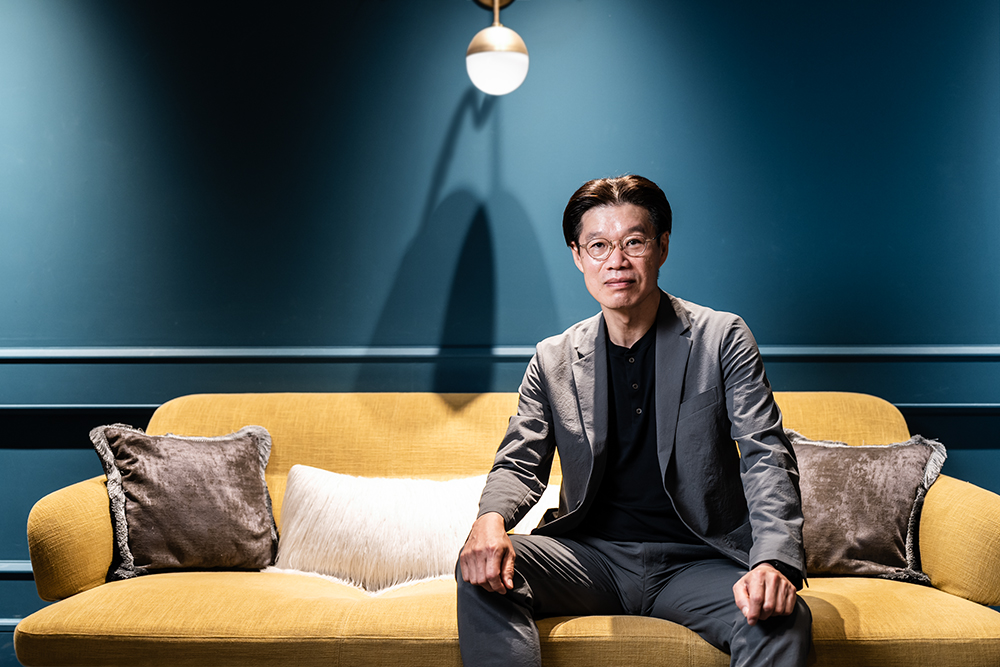
In the mountains on the border between Kyoto and Shiga prefectures, there is a sculptor who silently works with stone. His name is Masaomi Raku. Black granite, marble, welded tuff... For over twenty years, Raku has sculpted a variety of stones, but the feelings he pours into the shapes he creates from them remain unchanged. Born and raised in a family of Raku ware potters in Kyoto with a history of over 450 years, Raku felt the atmosphere of his home firsthand from a young age, and while accumulating that experience, he embarked on a new creative path in stone carving. Raku's creative activities and innovative works, which are attracting attention not only in Japan but also overseas, are worthy of the "PREMIUM JAPAN AWARD 2026".
Like a magatama (comma-shaped bead), like an ammonite, like a mysterious life form... What are the thoughts and feelings embedded in the work "Reincarnation"?
A curve that falls just short of closing, leaving a small hole in its center as it comes to an end. The roughly fractured and chipped surface contrasts sharply with the polished areas. Its shape resembles a magatama (comma-shaped bead), an ammonite, and a mysterious life form all at once. The series of works that sculptor Masaomi Raku created intensively in his twenties are all titled "Reincarnation." The curve, aiming for a circle and still trying to extend, evokes the eternally continuing circular motion, truly reminiscent of "reincarnation."
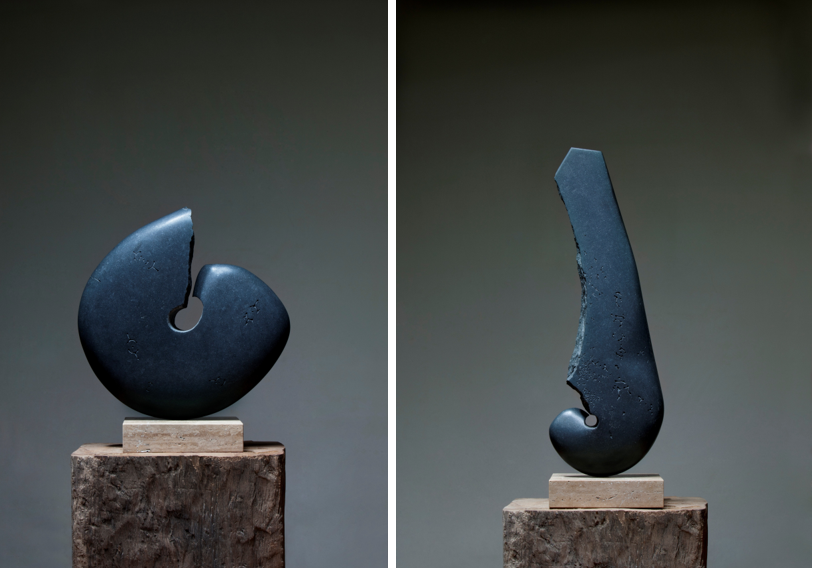
Right: Reincarnation "Eboshi" (traditional Japanese hat) 2009 H975 W300 D150mm Left: Reincarnation "Ogi" (fan) 2010 H500 W500 D100mm ©ImuraArt Gallery
Zimbabwe Black. A stone with an overwhelming presence, embodying a history stretching back to ancient times.
The material used in his works is stone. As the name "Zimbabwe Black" suggests, it originates from Zimbabwe in Africa. Masaomi encountered this stone at a stone carving workshop while attending art college.
"I went to art school with the desire to express something, but I didn't know what or how I wanted to express it, and I hadn't decided to pursue sculpture. However, the first material I encountered resonated with my desire to express something, as if a gear had clicked into place. I was drawn to the overwhelming presence of stone, which seems to condense the passage of time from ancient times. Breaking, carving, polishing—as I worked with stone as a material through various processes, I felt its presence more and more."
Zimbabwe Black is a type of black granite that is said to be the most produced in the world, but it is also actually the most difficult stone to carve.
"It's a tough stone. If it were hard, it would be easier to carve, but because it's tough, it's not easy to break or shatter. It's a very troublesome stone to carve. To begin with, stone carving starts with making your own carving tools, and the work itself requires an enormous amount of time. It's a field that's rather tedious, and even in art schools, few people actively pursue it."
It's precisely because there's no end that I can start on the next project.
Why is Masaomi-san facing such a troublesome stone?
"A sculptor is supposed to finish carving, but with Zimbabwean black, it seems like there's no end to the carving. It's precisely because there's no end that I can move on to the next piece. I've been making many pieces in the 'Reincarnation' series since my mid-twenties, but I don't feel like any of them are perfectly finished; I feel like there's still something that needs to be added."
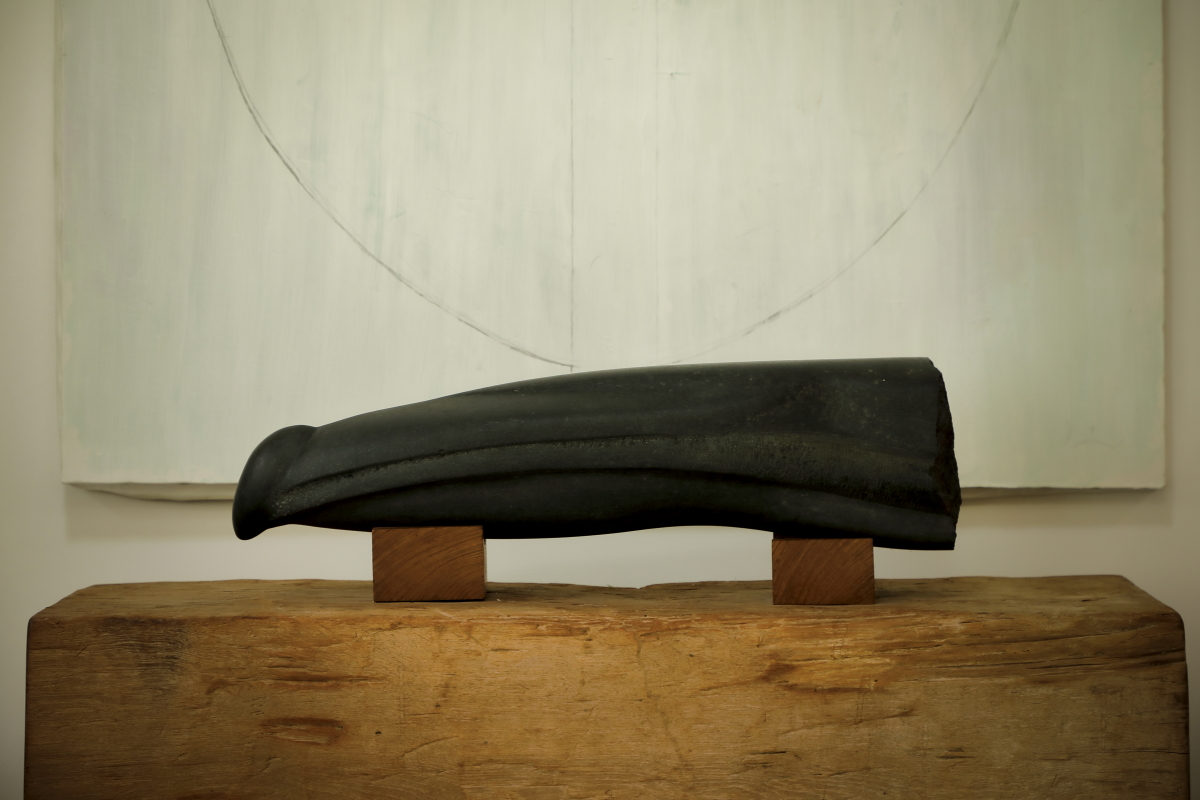
"The Beginning of Creation" is the first work I created during my student days. I was inspired to create it by seeing a pelican pecking at the water in a pond with its beak, which reminded me of the "creation myth" of Japan, in which the gods Izanagi and Inazami stirred the ocean with a spear and created the islands of Japan from the dripping water. I deliberately left the head unfinished, abstracting it by only depicting the beak.
An endlessly deep black. This "black" color inherent in Zimbabwe Black was one of the main reasons why Masaomi was drawn to it as a material.
"Black granite is also produced in India and China, but when these stones are polished, a sharp, inorganic texture becomes prominent. However, when Zimbabwe Black is polished, a mica-like gradation of light and dark appears, creating an organic look similar to layered Japanese paper. I personally want to cherish that unique appearance."
Born into a family with a tradition of Raku ware that has continued for over 450 years.
And another reason, which Masaomi himself says was "one of the big reasons," is the existence of the Raku family, where he was born and raised.
The Raku family, whose founder was Chojiro, who followed Sen no Rikyu, the great master of the tea ceremony, and created red and black Raku tea bowls, has been continuously preserving the tradition of Raku ware in Kyoto since the late 16th century. Currently, Masaomi's older brother has succeeded to the Raku family as the 16th generation Raku Kichizaemon, and Masaomi's father, after passing the name Kichizaemon to the 16th generation, has adopted the name Raku Naonyu and is freely engaged in pottery making.
"From a young age, my father would give me clay for pottery, and my siblings and I would make all sorts of things, so I loved making things. My father also crushed stones he collected from the Kamo River and used them as glaze to fire black Raku tea bowls. There were always stones in our house, and perhaps because I grew up watching my father do that, stones feel very familiar to me, and even when I look at the finished tea bowls, I think, 'Ah, these are stones that have been transformed.' After all, the clay used as material for pottery is originally made from crushed rocks."
The black of the Raku tea bowls that the Raku family has been firing for generations, and the jet-black of "Rinne" created by Masaomi—the blacks of these two pieces are connected on a deep level.
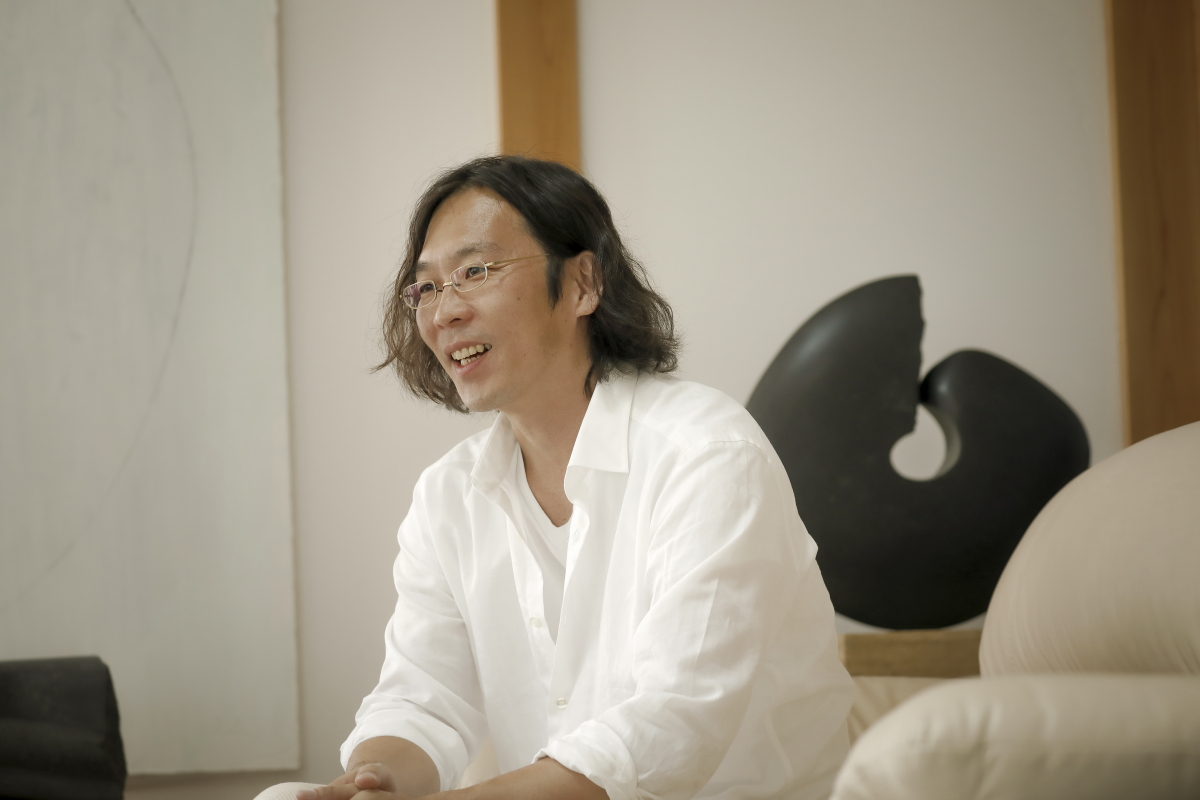
"Since we're deep in the mountains, we get a lot of snow in the winter. When we're busy with snow removal, we spend more time digging snow than carving stone," Masaomi says with a laugh, jokingly. His demeanor is always lighthearted.
The moment the gears clicked into place.
During his middle and high school years, Masaomi was unable to attend school very often, but he wasn't a recluse. Instead, he spent much of his time in the mountains of Kyoto, where his father's studio was located. Surrounded by trees that sprout, grow lush, bear fruit, and eventually wither, the time he spent in nature instilled in Masaomi, albeit vaguely, the natural order of life's cycle.
For Masaomi, who had always been surrounded by stones since childhood, the cycle of life was something he held deep within his heart. When he first encountered a stone at art school that seemed to condense ancient time, he tried to carve out the cycle of life that he had always held dear. In Masaomi's words, it was as if "the gears clicked into place," and this was not a coincidence but an inevitable progression.
"In middle and high school, my attendance record was always full of red marks, but in college, I became a dedicated student who was at school from morning till night. There were many times when I stayed until late at night."
Masaomi, who primarily worked on the "Reincarnation" series in his 20s, released the "Stone Box" series in his 30s, which uses bird beaks as a motif and translucent marble. Then, about three years ago, as he turned 40, he started working on the "Stone Tools" series. The "Stone Tools" series is, quite literally, a "tool." The material is welded tuff. This stone, also known as "Jinmu rock," is carved, polished, and fired. By firing it at high temperatures, the stone becomes distorted, which gives it a unique and appealing appearance.

Stone box "Shed Skin" 2023 H90W275D80mm The Stone box series uses the beak of a bird, which is seen as a bringer of happiness, as its motif, and, like "Reincarnation," expresses the cycle of life. What is inside the box is left to the viewer's imagination. ©ZENBI
"Both 'Reincarnation' and 'Stone Box' are themed around the laws of nature. In this new series, I wanted to express nature, especially the connection between nature and humanity, and that led me to the idea of creating vessels by firing stone at high temperatures. Firing stone might sound a little strange, but within the Earth, stones are constantly being fired, turning into magma and circulating. Therefore, fired stone is also a part of the cyclical nature of the environment. Furthermore, since the Jomon period, humans have eaten the bounty of nature they obtained by placing it on leaves or stones. There must have been a sense of gratitude at play, and that eventually evolved into vessels. Perhaps vessels will continue to exist forever, albeit in different forms, and they truly tell the story of the connection between nature and humanity."
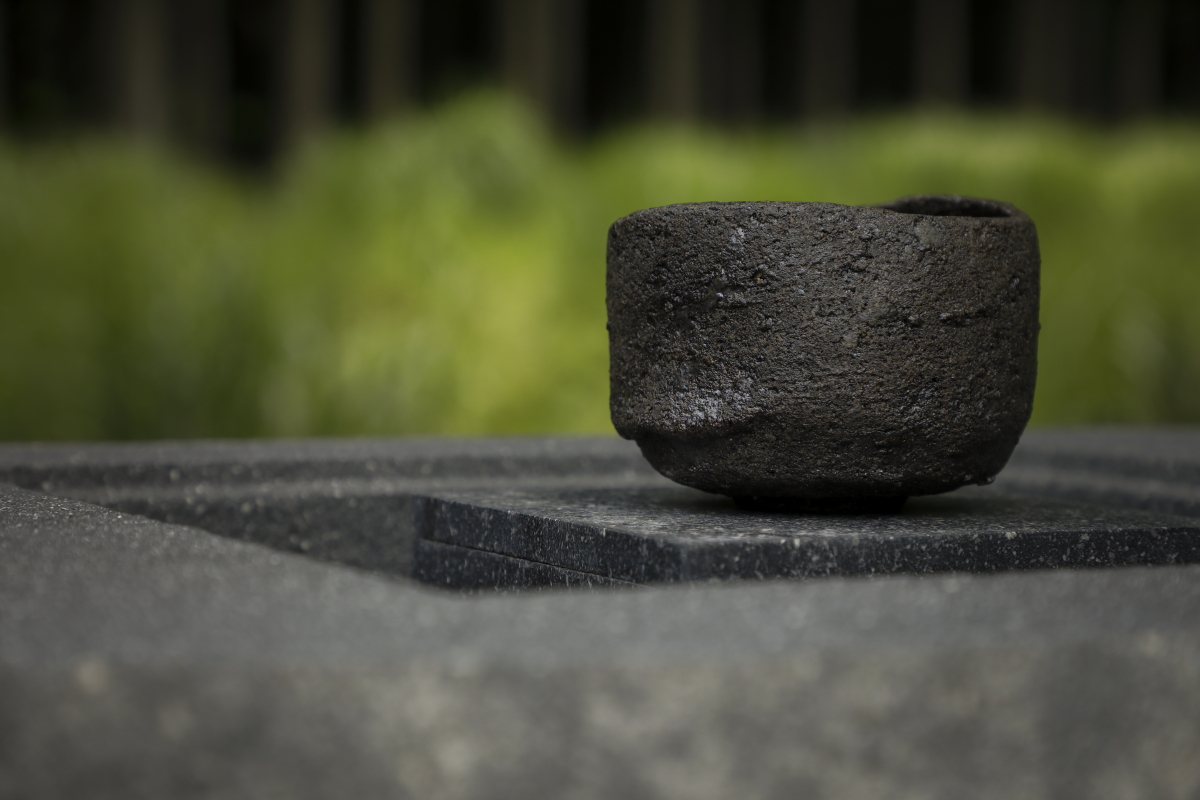
"Stone Tool" 2024 H95 W120 D120mm. The material is "welded tuff". Distortion occurs when fired at high temperatures, which gives the vessel a rich and expressive appearance.
The resulting "stone tools" are reminiscent of the form of the Raku tea bowls that the Raku family has been making for generations.
"Having grown up in the Raku family, when it comes to tableware, the shape naturally gravitates towards the Raku tea bowls I've been familiar with since childhood, and at the same time, it also serves as an homage to the 450-year history of Raku tea bowls."
Masaomi also said, "This time it took the form of a vessel, but that was just the result; my attitude of facing the stone hasn't changed." Over the past 20 years, the form and shape of the works Masaomi creates and the stones he uses have changed, but his firm resolve to express the laws of nature and the cycles that surround them has remained unchanged.
Stone carving is a series of tasks from which there is no turning back.
What kind of work is involved in carving stone?
"It's a process from which there's no going back. Splitting the raw stone, chiseling it, polishing it—once you've done any of these steps, you can't go back to how you were before. Based on the initial sketch, I try to split the stone I've acquired, thinking that if I hit this spot, it will split into the shape I envisioned, but it doesn't always split as planned. Conversely, sometimes it splits into a more interesting shape than I imagined, and at those times, I'm truly reminded that I'm working with nature. Also, the cross-section created by splitting is called the 'split surface,' and its appearance is wonderful; it's truly nature itself. In the 'Reincarnation' series, I made use of the 'split surface' while finishing the other parts by hand polishing with waterproof sandpaper."
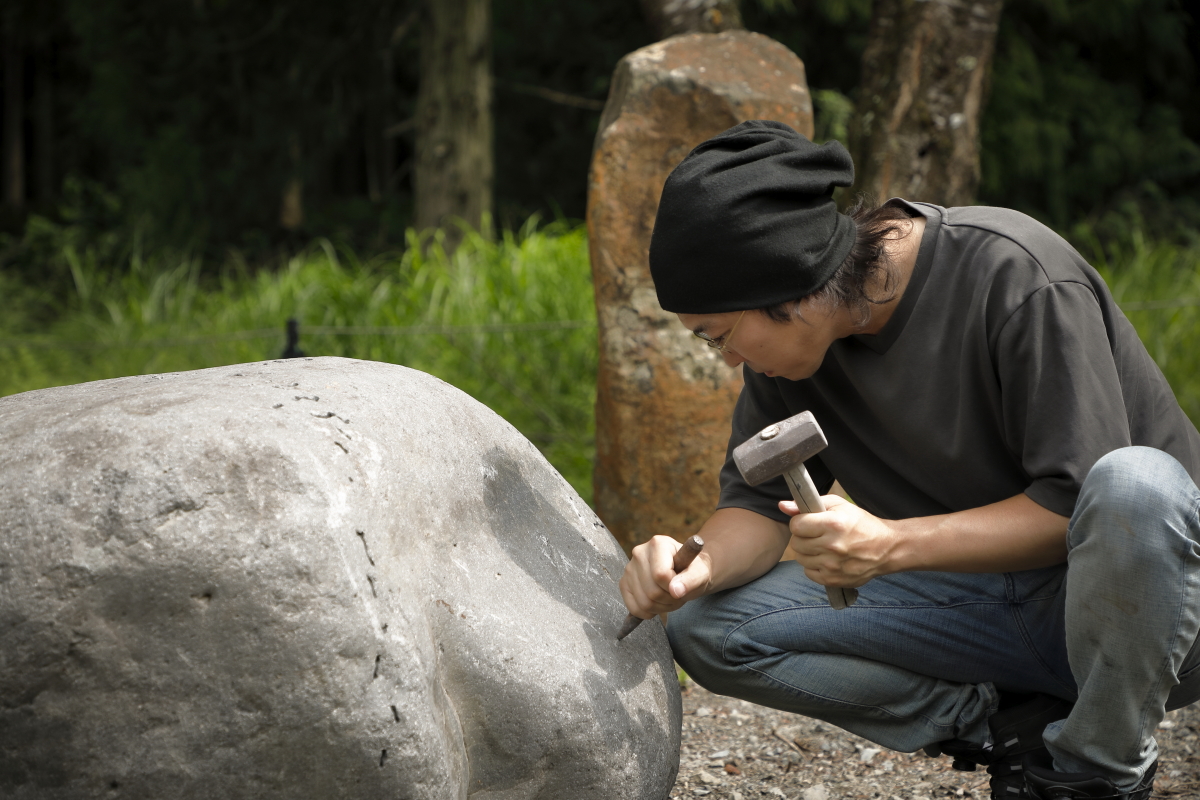
Stone carving is a time-consuming process, involving the gradual and meticulous use of chisels.
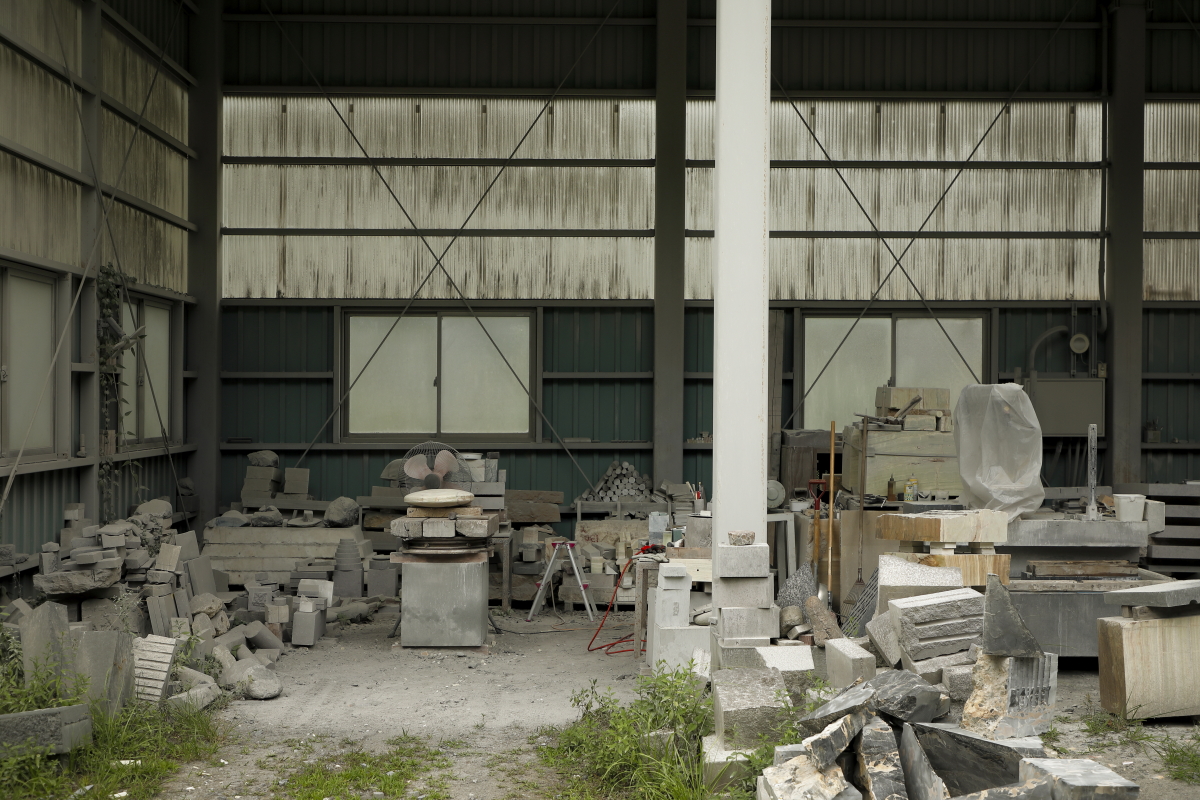
Various types of stone are piled up in the workshop's workspace.
As a member of the Raku family, he still participates in firing the Raku ware kilns.
At the Raku family home, the Raku ware kiln is fired several times a year. This firing process, which adheres to techniques that have been used for over 450 years, is arduous work involving long hours of work in a small, high-temperature kiln. The firing is carried out under the direction of the current head of the Raku family, with the participation of many staff members. Masaomi still always participates in this firing process. Furthermore, it was a family tradition at the Raku family that any male who did not inherit the name "Kichizaemon" would be adopted and leave the "Raku" surname upon marriage. However, in Masaomi's case, his father decided to break with tradition, and he retained the "Raku" surname even after marriage.
"The Raku family's tea bowl making is done using a technique called 'tezukune,' where the bowl is shaped using only both hands, without a potter's wheel. Finally, a spatula is used to trim it. Once you trim it, there's no going back. In that sense, Raku tea bowls have a lot of sculptural elements, and it was perhaps a natural progression for me to pursue a career in sculpture, having grown up watching the work being done at home since I was a child."
While Masaomi does not create Raku tea bowls himself, his works embody the philosophy of craftsmanship that has been passed down through the Raku family.
An hour's drive from downtown Kyoto, a collection of works are displayed on the grounds of a workshop nestled in the mountains.
Masaomi has set up his workshop about an hour's drive north of downtown Kyoto. Because he needs space to place the huge stones he uses as materials, and because his work sometimes produces loud noises, he inevitably has to do it in a remote mountainous area. On his vast property, surrounded by lush trees, are numerous works of various sizes, seemingly telling the story of Masaomi's journey so far.
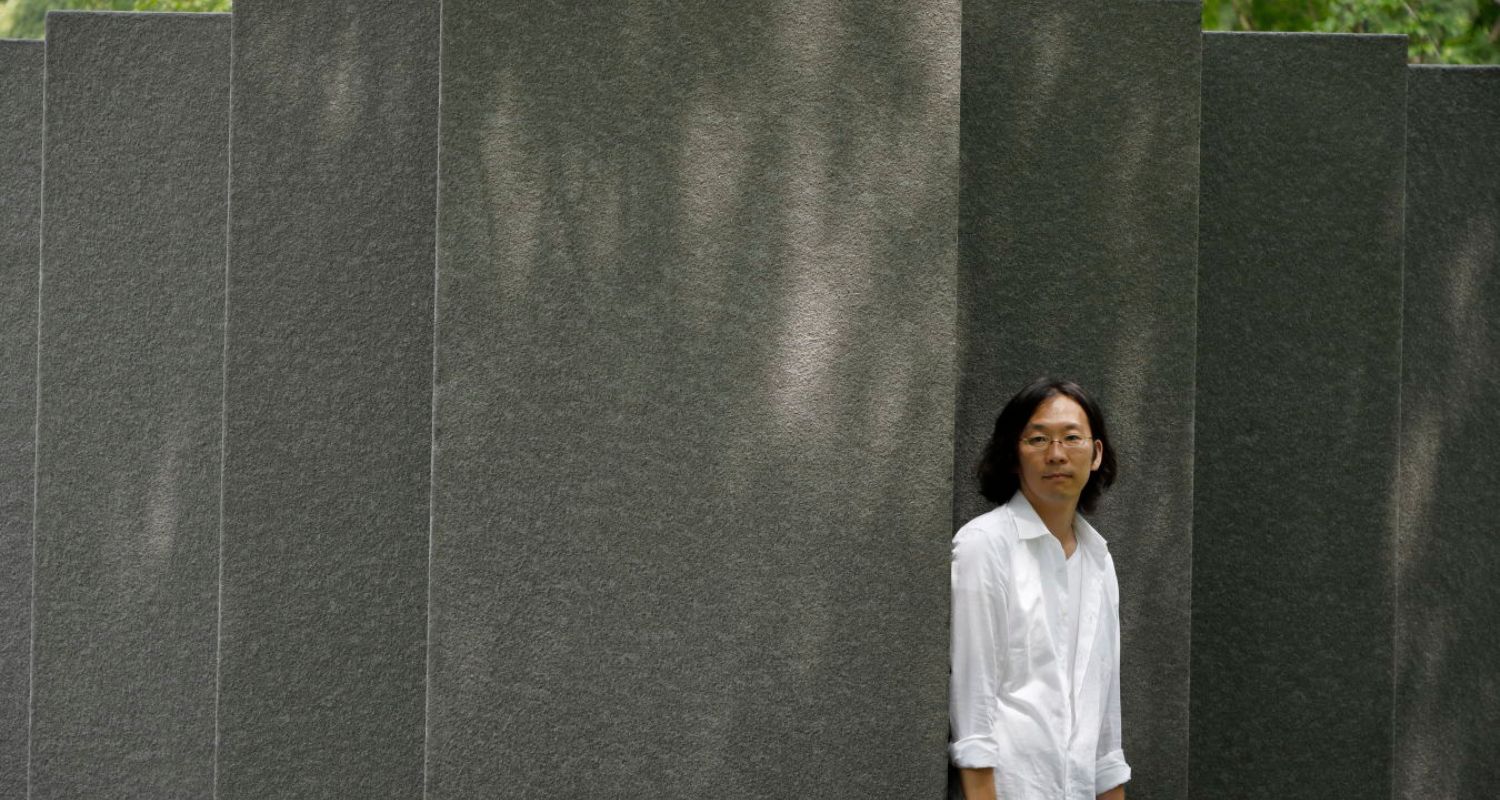
There is also a chamber-like space created using several large rectangular blocks of Zimbabwean black stone. This, too, is part of the artwork. Except for a narrow opening, the space, only about two tatami mats in size, is surrounded on all sides by stone and is filled with a serene and sacred atmosphere, as if time has stopped there. On the other hand, since the ceiling is not covered with stone, when you look up, the sky framed by the stones stretches out surprisingly far, giving off a sense of liberation.
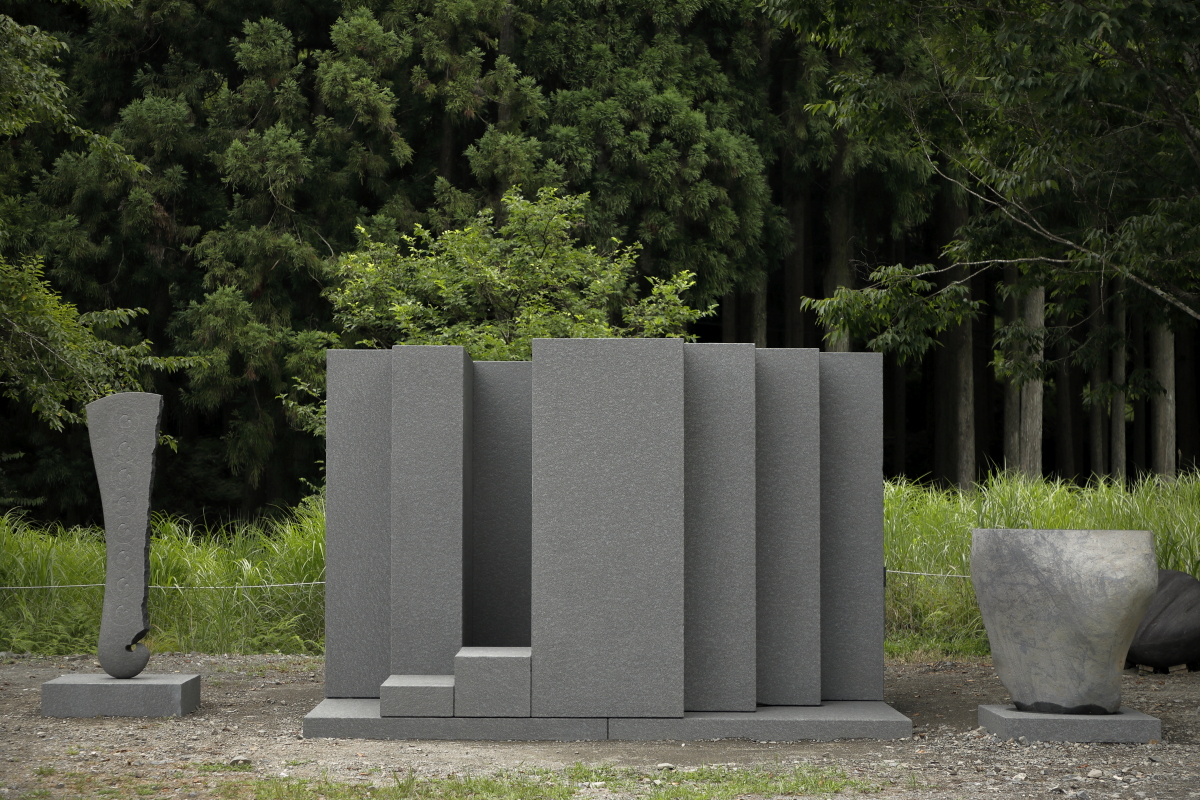
The artwork in the center of the photo is composed of rectangular pieces of Zimbabwean black stone placed vertically. In the center of the space surrounded by stones, there is a space of about two tatami mats, which Masaomi says he wants people to use as "a space to freely confront themselves." The pieces placed on either side are also works of art.
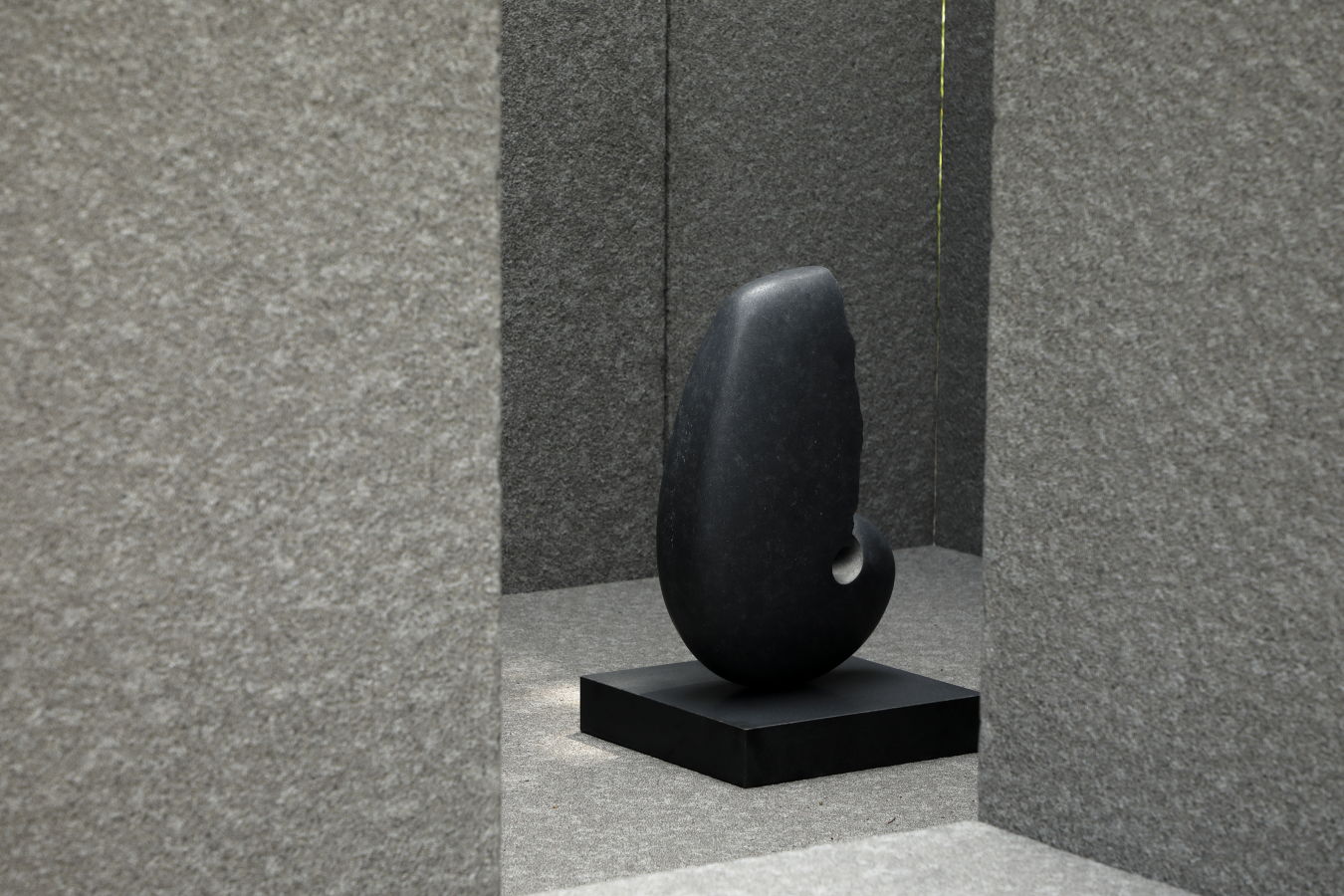
The "cycle of reincarnation" is placed in the center of the space surrounded by stones. Soft light spills down from the sky into this monochrome world of black and gray. The faint glimpses of green from the trees visible through the tiny gaps between the stones are also striking.
Masaomi commutes to this workshop every morning, a one-hour journey from his home in Kyoto, and returns home in the evening. Behind the workshop flows a beautiful stream that eventually empties into Lake Biwa. "You can catch cherry salmon from spring to summer, and sweetfish in the summer. I sometimes go into the river during my lunch break intending to spend just 30 minutes there, but before I know it, an hour or two has passed."
Masaomi smiled nonchalantly and without a care in the world.
If only we could create a stone park where the artworks are lined up like monuments...
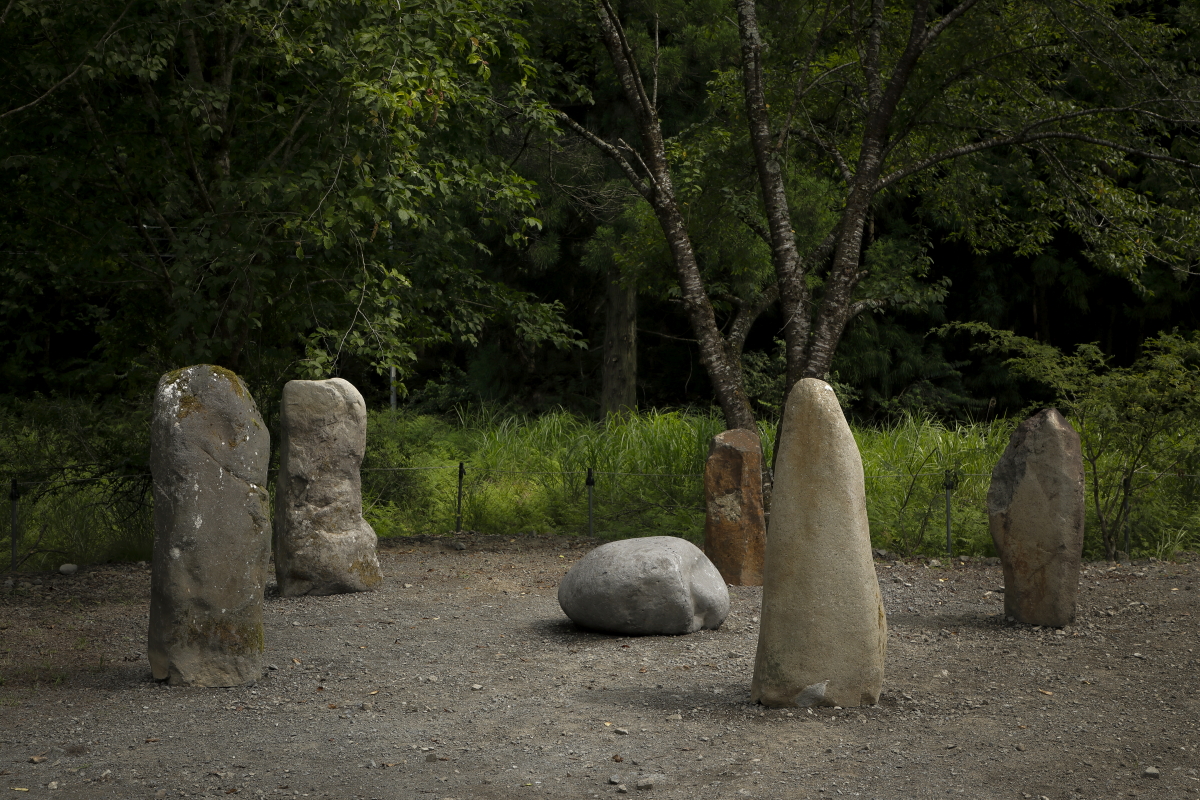
He arranged the stones he acquired in a stone circle-like fashion to create a single artwork. "I'd like to create something like a park where stones are placed like monuments," said Masaomi.
"In the future, I'd like to create something like a stone park. My works would be placed here and there like monuments, and people could freely walk around and feel the relationship between nature and humans, and between stones and humans—a kind of plaza-like space."
Masaomi Raku, 43 years old. He faces the stone with unwavering determination, yet there is not a trace of pretension about him; rather, he is generous and flexible. Perhaps it is this flexibility that allows him to carve the laws of nature from the strong material that is stone. I suddenly thought of this while sitting in the garden of his workshop, surrounded by lush trees.
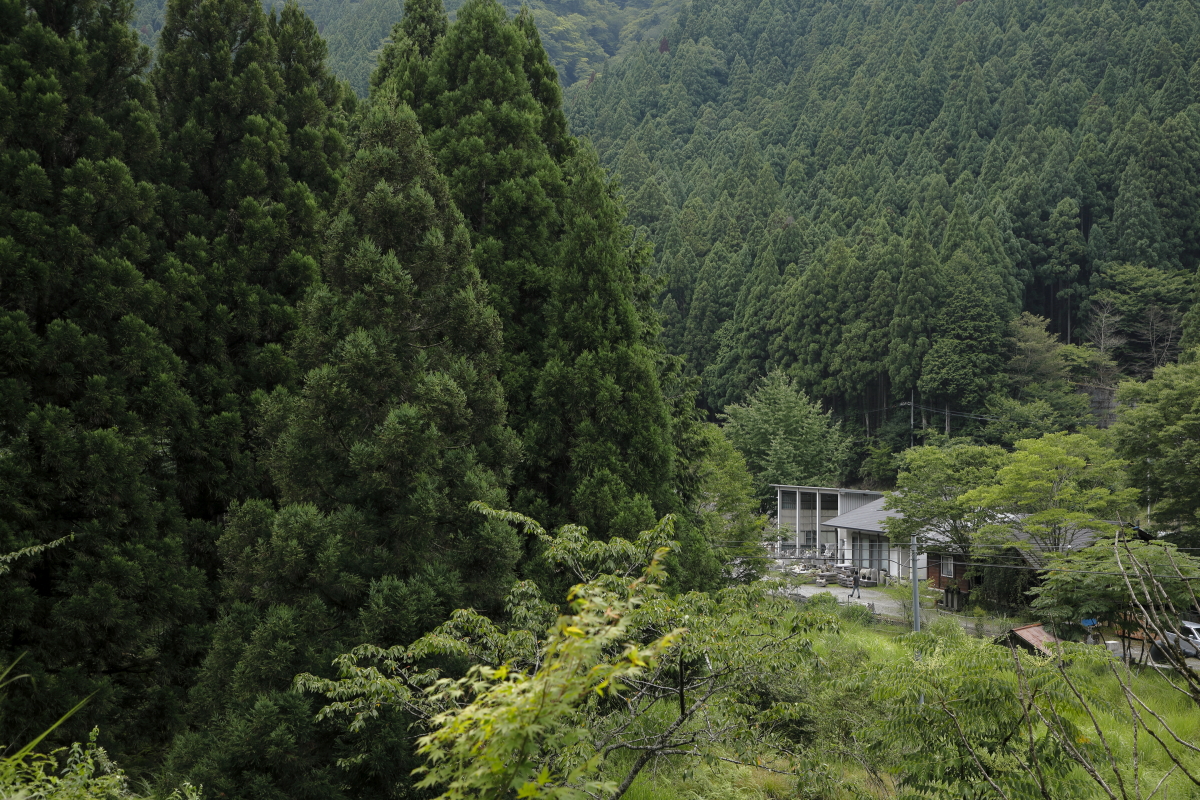
The workshop is situated along a valley that winds its way through deep mountains. Every day, I commute to this workshop from Kyoto city, a journey of about an hour by car.
Masaomi Raku
Born in Kyoto in 1983. Graduated from the Department of Fine Arts, Graduate School of Fine Arts, Tokyo Zokei University. Received the Kyoto City New Artist Award in 2018. Since her first solo exhibition, "White Bird ~The Flow of Tangible and Intangible Things~," held at Miyuki Gallery in 2008, she has held numerous solo exhibitions both in Japan and internationally, including at the Ishikawa Prefectural Museum of Art, Museum "Eki" KYOTO, Pierre Marie Giraud (Belgium), and Kamo Wakeikazuchi Shrine. She has also been active internationally, exhibiting at Artfair Basel and TEFAF Maastricht, and being nominated for the special exhibitions "PROPORTIO" (2015) and "INTUITION" (2017) held at Palazzo Fortuny in conjunction with the Venice Biennale.
Photos by Makoto Ito
JCCO
PREMIUM JAPAN AWARD
PREMIUM JAPAN AWARD 2026



PREMIUM JAPAN AWARD