

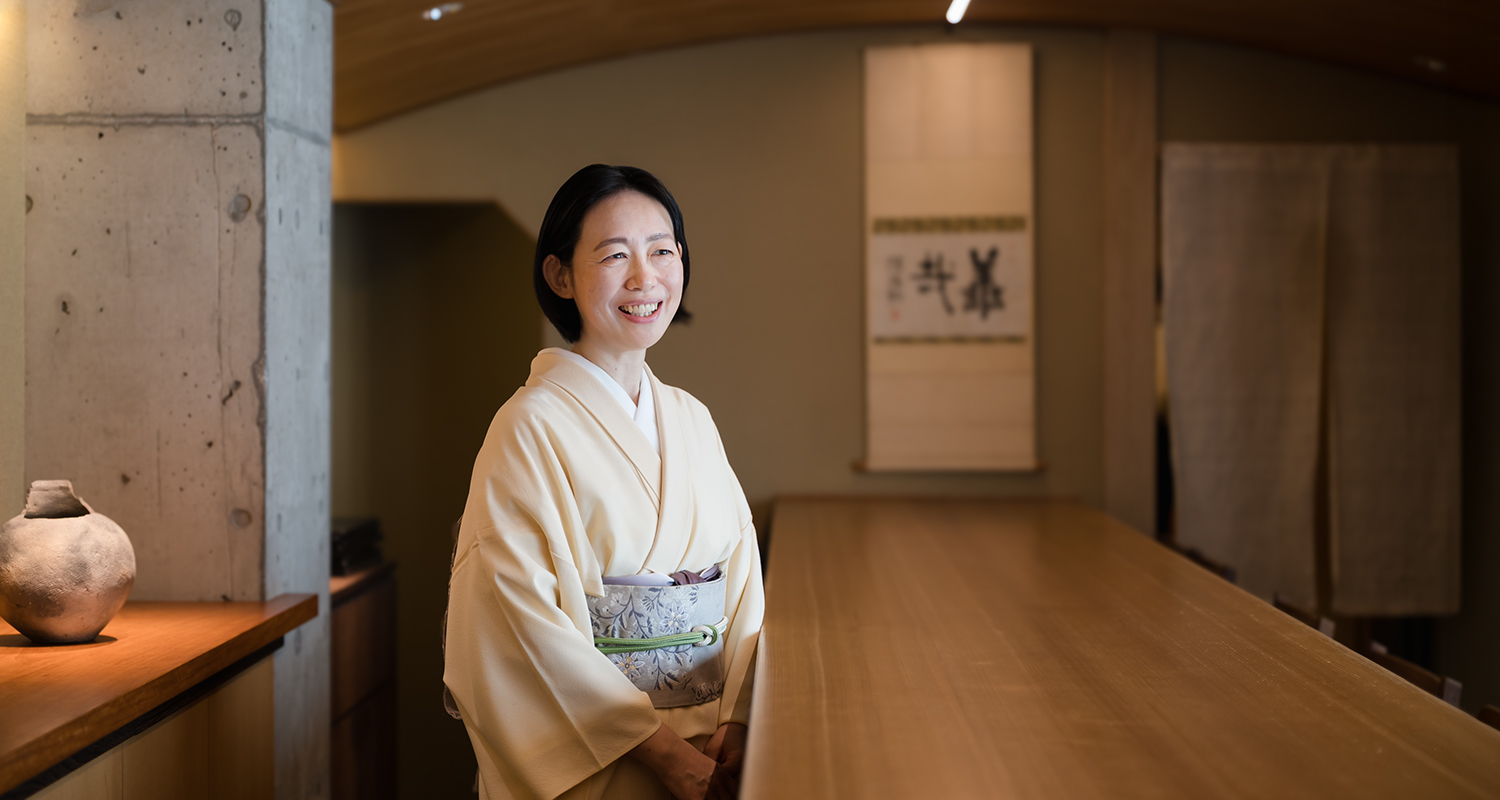
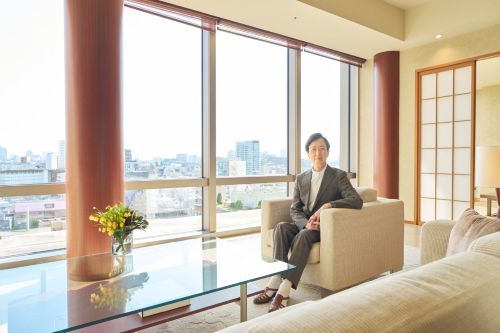
"Fushiki"—founded in 2011, this restaurant was the first in Japan to advocate and practice "sake pairing," which involves pairing one type of sake with each dish throughout an entire kaiseki course, even considering the differences in taste depending on the shape of the sake vessel. Japanese cuisine, which captures the essence of the season, is paired with the sake that best suits it, at different temperatures and in sake vessels chosen for their shape and seasonality. Here, you can experience the rare joy of this trinity. The restaurant first received a Michelin star the year after it opened in 2011, and has maintained that status ever since. Word of mouth has spread that this is a place where you can truly appreciate the value of sake, and it is bustling with regulars and overseas customers every day. This approach to Japanese cuisine has been highly praised, and the restaurant received the "PREMIUM JAPAN AWARD 2026." We visited the proprietress, Sachiko Miyashita, in Kagurazaka in the height of summer.
The story behind the company's founding and "sake pairing"
In September 2011, Yusuke Miyashita, then 32 years old, founded "Fushikino" while working as a company employee.
The following is what the proprietress, Sachiko Miyashita, said.
"At the time, 'marriage,' which involved pairing Western cuisine with wine, was common, but there were no restaurants specializing in pairing sake with each individual dish in a kaiseki course. The term 'marriage' with sake sounded strange, so my husband Miyashita came up with the idea of 'sake pairing,' offering food pairings with sake throughout the entire course."
My husband worked as a company employee, but he was also a tea ceremony practitioner and deeply valued traditional Japanese culture, including sake. He collected tableware, so he had a strong belief that by combining the three elements of "food, sake, and tableware," he could create a dream restaurant where customers could enjoy the best of each even more. With that in mind, he created his own business plan and launched this restaurant."
That was precisely the kind of idea that could only be conceived by someone who doesn't specialize in the food and beverage industry. Nowadays, there are more and more restaurants that advertise "sake pairing," but it's always the "eccentrics" with their own unique perspectives and ideas, who aren't bound by conventional thinking, who pave the way for new paths.
The very origin of the name "Fushiki no" itself tells us this.
"The shop's name comes from the story of Sen no Rikyu, who, upon seeing an unusual bamboo flower vase, exclaimed, 'What a wondrous thing!' It also relates to the Zen term 'fushiki' (unknown/unseen). It symbolizes the philosophy we had when we founded the shop: to offer our customers something unexpected, something unprecedented, like sake pairings."
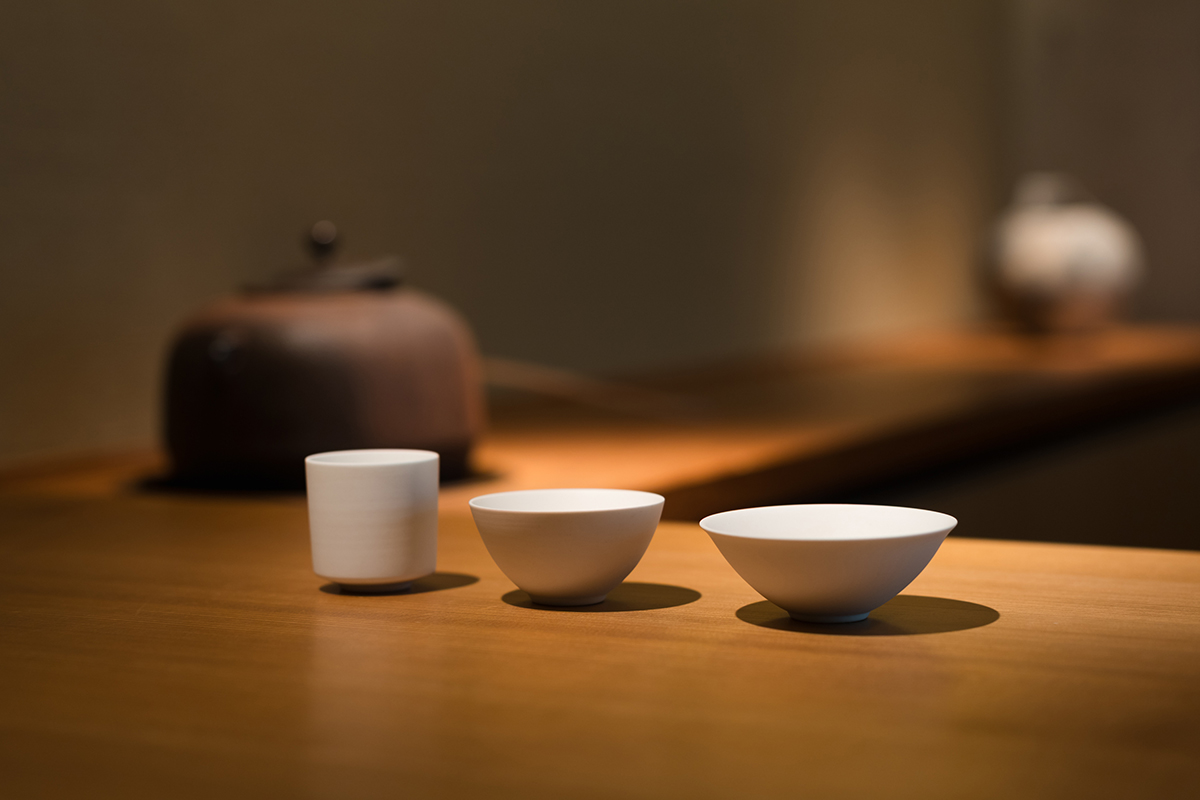
These Arita ware sake cups were designed and commissioned by the company's founder. The cup on the left gives a richer, more full-bodied taste. The flat cup on the right makes the acidity more noticeable, and even heavier sakes become lighter. The one in the middle offers a taste somewhere in between.
Unleashing the full potential of Japanese sake
Let's delve into the three elements in more detail.
"The core of our restaurant lies in the concept devised by our founder: enjoying Japanese cuisine, sake, and tableware as a trinity. What's important to us isn't whether it's a famous brand or not. 'All sake is equally delicious.'"
The important thing is how to bring out the potential of sake and how to serve it. Every type of sake has its own unique charm. So, we are always thinking about how to bring out the characteristics of each individual sake and how to pair it with food."
What exactly does that mean?
"There are ways to pair sake with food that complement its flavors and create a rich aftertaste. To maximize this characteristic, we pay close attention not only to the compatibility with the food, but also to adjusting the serving temperature and the way the shape of the vessel affects the taste."
For example, even with the same sake, the shape of the vessel can greatly change the taste; it might be perceived as richer or sweeter, or conversely, more acidic and lighter."
In terms of temperature, sake can be enjoyed at a wide range of temperatures, from chilled to room temperature and even warmed. It's a type of alcohol that offers a lot of flexibility in how it's served.
Furthermore, when it comes to pairing Japanese cuisine with sake, there is no other restaurant that has reached a higher level of perfection than this one. I can say that with absolute certainty, without a shred of doubt.
The founder, who had a deep love for Japanese sake culture, strived to educate people about sake through seminars and other means.
"While warming the sake is an important factor, the fact that you can appreciate the flavor more easily when your mouth is warm means that we always pair warm sake with a warm bowl. We consider the overall flow and pace of the experience to select the optimal temperature and sake vessel."
This approach is truly a pioneering endeavor, and as a result, it creates an optimized and profound dining experience in the combination of food and sake.
The dining experience at the restaurant was truly a series of astonishing moments. In fact, I realized just how little I knew about sake. I understood that my previous comments about whether something was "delicious" or "not delicious" were almost entirely meaningless.
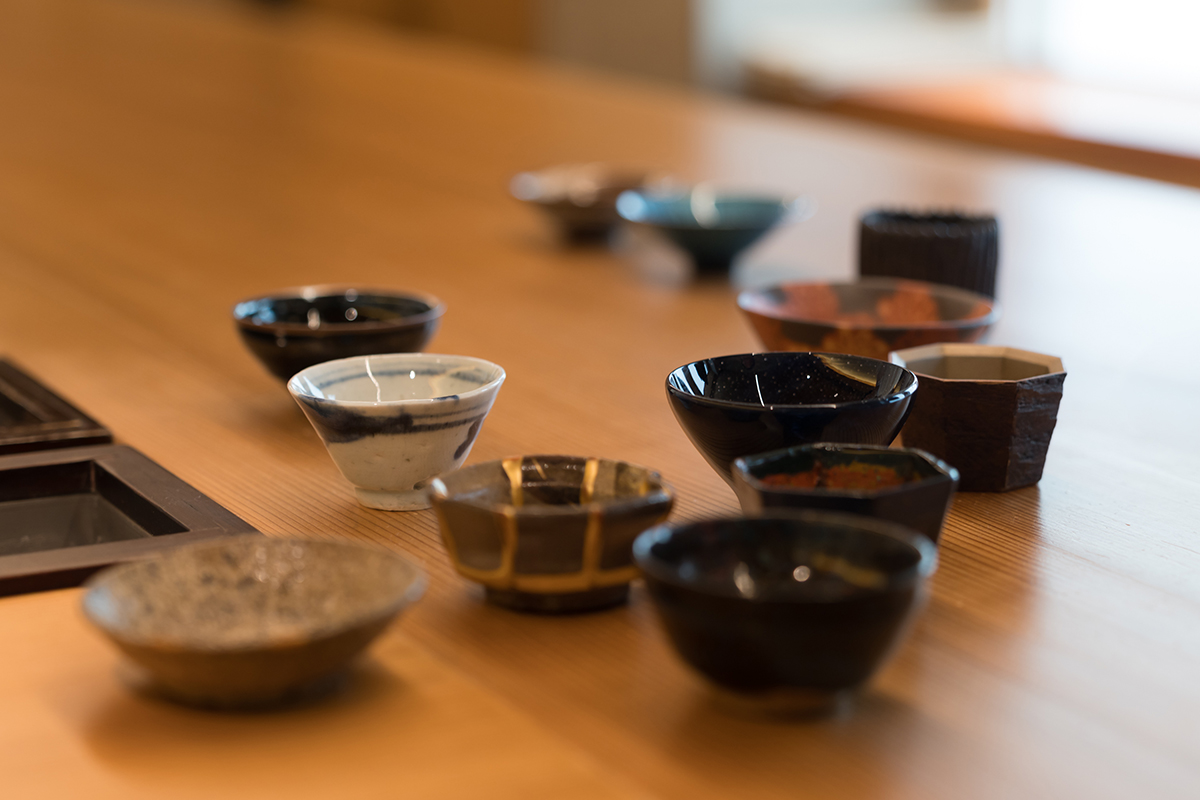
The sake cups range from those dating back to the late Heian period, from old Karatsu ware to modern pieces. They are used without hesitation in everyday life.
Passion for pottery and the role of a gallery
Furthermore, what's interesting about the flow of this restaurant's kaiseki cuisine is that they always serve matcha tea at the end.
"My husband was also a tea master. In a tea ceremony meal, while there is alcohol served with the meal, the emphasis is on how to make the final matcha tea taste as delicious as possible. We have also incorporated that tradition of kaiseki cuisine."
So why change the drinking vessel?
"Even a single vessel has its own story. On the other hand, some sake names are derived from Chinese poetry or Zen sayings. I find it interesting to interpret those origins, and to consider the season and your preferred flavor when choosing a vessel."
Since its founding, "Fushiki" has included a gallery within the restaurant that displays and sells tableware, demonstrating its commitment to promoting tableware culture. It may be the only Japanese restaurant in Japan that does this. And its collection is truly impressive.
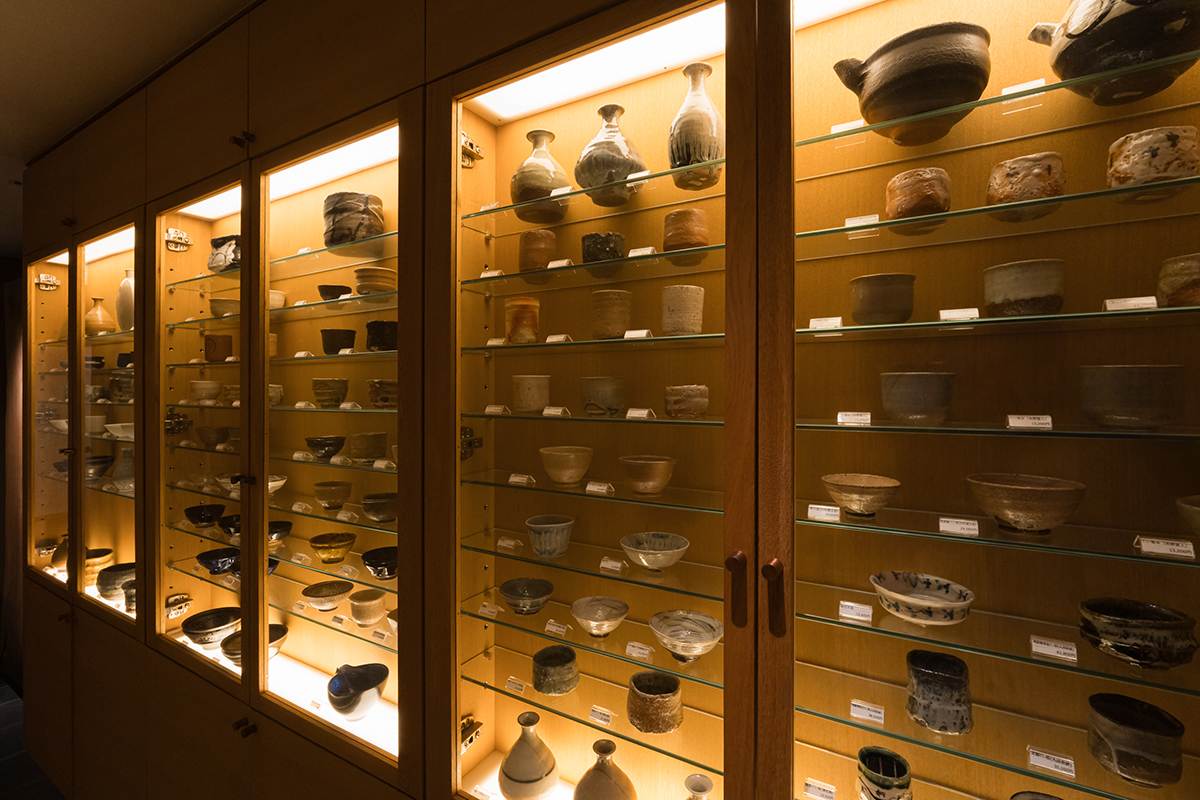
A gallery located in a corner of the shop. It displays works selected by the owner after direct visits to popular artists. The exhibited works are available for purchase.
"The tableware displayed in our restaurant ranges widely, from ancient ceramics from the late Heian period to old Karatsu ware from the Azuchi-Momoyama and early Edo periods, as well as works by Living National Treasures and up-and-coming contemporary artists. We generously use these precious pieces in our daily operations, allowing our customers to experience their charm through their meals. We introduce the tableware while you dine, and we also have a separate gallery where we display and sell works, so you can purchase any pieces that catch your eye on the spot."
It could be described as an extremely unique system.
To give you a glimpse, the exhibition features sake cups made from old wood from Kyoto's Kinkaku-ji Temple, and lacquerware called "shinshitsu," which is made using only lacquer tree sap and takes 10 to 15 years to produce without using any wood at all. The works on display are rich in stories.
This initiative provides artists with opportunities for continuous creative activity and contributes to the preservation of Japanese pottery culture.
"Some customers have become collectors of tableware, started practicing the tea ceremony, or even opened their own galleries after experiencing our shop."
Its influence is extremely immense.
The legacy of the founder and the current state of the store
Ten years after its founding in September 2011, the store, which had been on track, was struck by a major ordeal when the founder, the owner, suddenly died in an accident.
"At that time, I was truly at a loss. But it would be such a shame to lose this restaurant. So I decided, 'Losing it will only take a moment. Let's just struggle as hard as we can.' The chefs who stayed at the restaurant also supported me."
The restaurant began its journey to survival with that philosophy in mind. Its innovative concept was recognized less than a year after its founding, and it has maintained its one-star rating in the 2013 Michelin Guide without interruption for a full year since then.
"Currently, in addition to our regular customers, we have guests from all over the world, including America, Europe, Asia, and South America."
For our international guests, we don't just focus on providing meals; we also prioritize conveying in English the Japanese spirit, including the satoyama (rural landscape) culture, rice culture, respect for nature, and aesthetic sensibilities that lie behind sake.
University students who are interested in the way these shops operate are taking on the role of cultural communicators, enthusiastically sharing information about Japan with foreign customers while serving them."
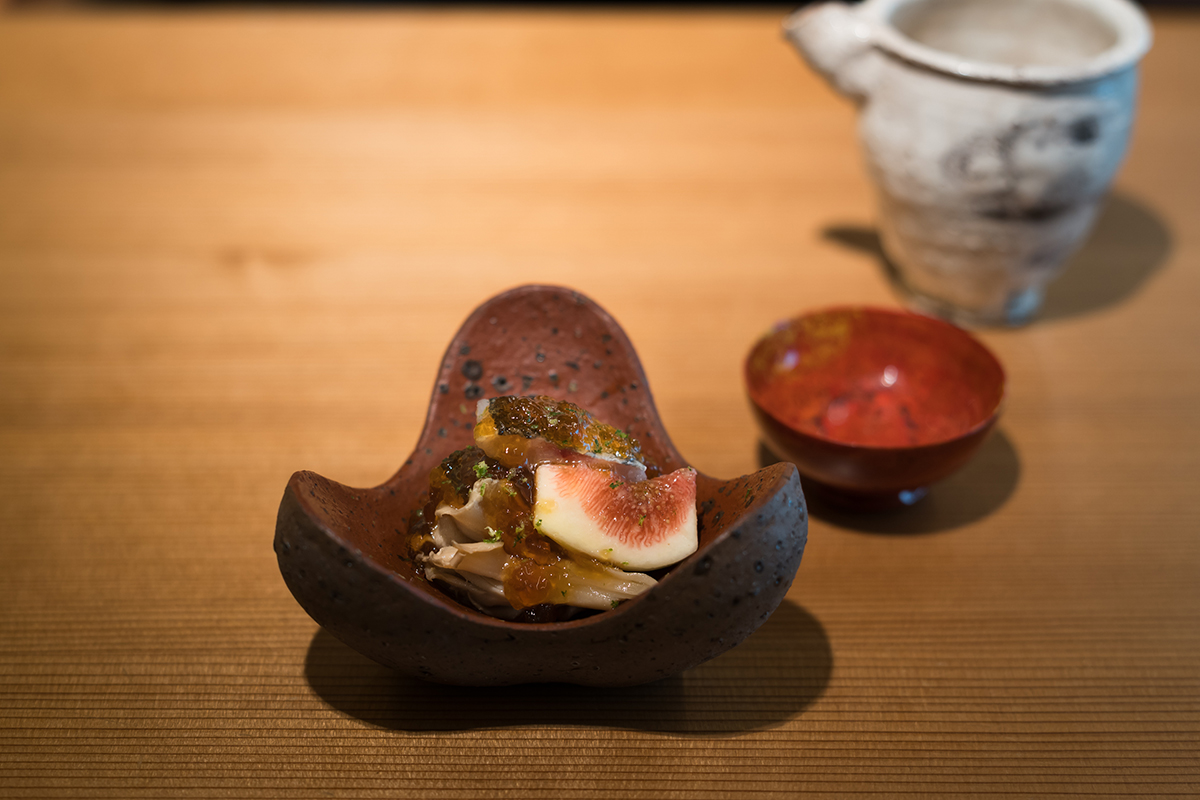
The sake cup paired with the "Grilled Barracuda and Fig Salad" was made by Yamagaki Shodo.
Specific pairings of food and sake
I had the opportunity to experience a pairing of dishes and sake that perfectly embodied the restaurant's concept.
The first dish is "Grilled barracuda with fig in vinegar." Chef Koda Takeda, who is also in charge of sake, explains.
"This dish features a lightly seared barracuda, topped with grilled lotus root, maitake mushrooms, and figs, all served in a vinegared jelly dressing. The sake cup is made by Yamagishi Shodo in Wajima City, Ishikawa Prefecture, using only lacquerware. For the sake, I chose Kon, one of the flagship brands of Terada Honke in Katori District, Chiba Prefecture."
This sake's acidity mellows and its umami flavor increases with aging. It has a sweetness, but this umami comes from amino acids. Incidentally, the bottle we're serving today has been opened in our shop and aged for about a year. It has a yogurt-like quality due to the lactic acid, so it pairs well with vinegared dishes."
First, the common belief that "sake should be stored at low temperatures" is overturned. The umami that develops through aging is extraordinary. You are initially hit with umami, but soon you begin to feel the deliciousness in all directions, including spiciness, sweetness, and acidity.
However, what's important is how the combination of the drink and the food works. Pairing isn't about adding the flavors of the food and the drink together, but rather multiplying them, and it truly transformed in my mouth.
"We use a lot of sake that becomes smoother after it's opened."
However, they don't leave everything at room temperature.
"The ideal storage temperature and aging method vary depending on the type of sake. Some sakes improve in flavor at temperatures above 20°C, while others need to be kept at -5°C to maintain their delicate character. Furthermore, the taste changes depending on the temperature at which it is warmed. Observing the changes in each sake and bringing out its unique charm is part of the fun. Sometimes, discovering an unexpected deliciousness is also part of the enjoyment."
There's a way of appreciating the variations in shape and the unique characteristics of each piece of pottery, too. I think the fun lies in paying attention to the differences between sake and pottery and making the most of their individuality."
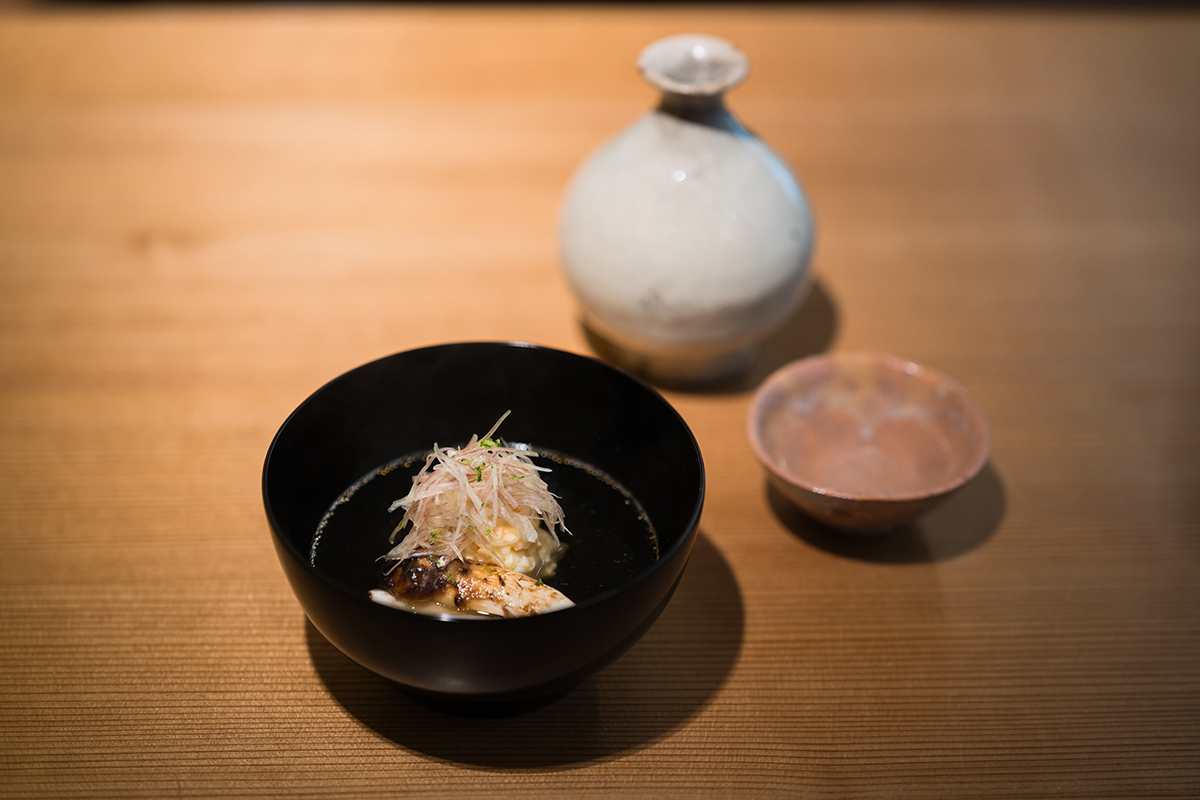
The sake cup paired with the "Shrimp and Matsutake Mushroom Soup" was made by Shiro Tsujimura.
The second dish is "Shrimp dumpling and matsutake mushroom soup."
"We've added shrimp paste and matsutake mushrooms, topped with myoga ginger and yuzu. The sake cup is made by Shiro Tsujimura. The sake paired with it is Komagura Shin, a junmai daiginjo from Kurume City, Fukuoka Prefecture."
This dry junmai daiginjo, slowly aged at low temperatures, seems to permeate your body from the moment you taste it. The crisp, well-defined liquid blends perfectly with the piping hot broth, shrimp, and matsutake mushrooms in the bowl, creating a synergistic effect that enhances the flavor.
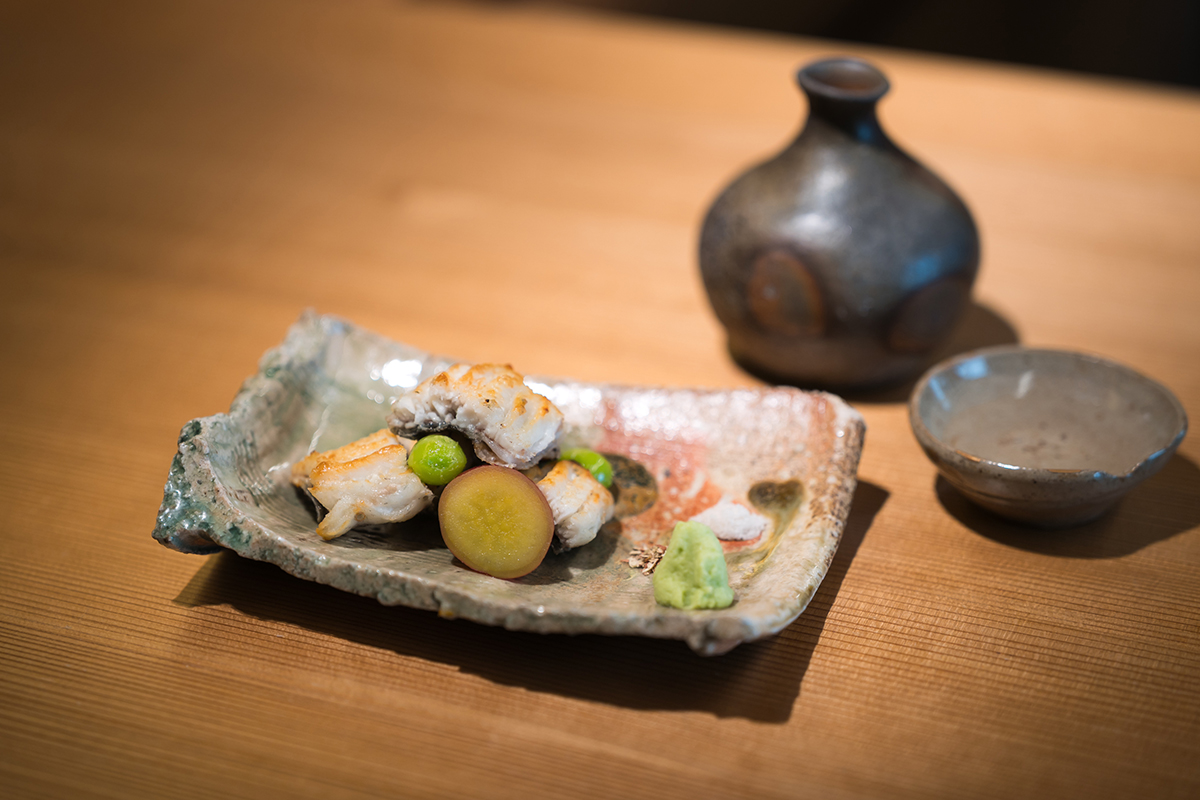
I paired the grilled eel with an antique Karatsu ware.
The third dish is "grilled eel without sauce."
"We served the grilled fish with ginkgo nuts and sweet potato. The sake cup is an old Karatsu ware from the Azuchi-Momoyama period, and the sake is "Chochin" from Tsushima City, Aichi Prefecture."
This sake is wrapped in newspaper to prevent deterioration from sunlight, and this careful handling reflects the brewery's attitude. It is characterized by a rather distinctive, strong acidity. Within that, there is a firm, complex, and rich umami flavor."
As you savor the eel and then wash it down with sake, the flavors of each ingredient combine. It's a wave of deliciousness.
At "Fushiki," there is a deep intention behind not only the selection of alcoholic beverages but also the way they are served.
For example, a well-crafted Daiginjo sake is intentionally stored at room temperature to allow its flavor to develop. Furthermore, the serving vessels are chosen with the seasons in mind, using cool glassware and warm earthenware depending on the occasion.
Through these meticulous calculations, a unique and unparalleled dining experience is created at "Fushiki," where the food, sake, and tableware are all seamlessly integrated.
Finally, we asked proprietress Miyashita for her thoughts on receiving this award.
"I really love Yusuke Miyashita's worldview. It's a world where the food, sake, tableware, and the people, regions, and traditions that create them all come together in a wonderful way, enhancing each other and creating various synergistic effects. I think we're doing something quite niche, but I'm very happy that this award recognizes what Yusuke Miyashita and Fushiki have been doing. Taking this as an opportunity, I would like to work even harder so that people can enjoy the trinity of Japanese cuisine, sake, and tableware even more."
Fushiki
2nd Floor, Kagurazaka Tsunasho Terrace, 4-3-11 Kagurazaka, Shinjuku-ku, Tokyo
Tel: 03-3269-4556
Photos: Toshiyuki Furuya
JCCO
PREMIUM JAPAN AWARD
PREMIUM JAPAN AWARD 2026
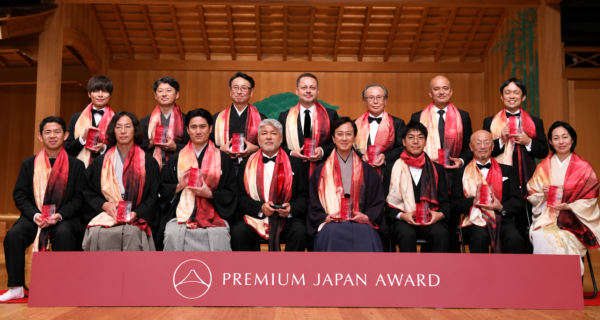



PREMIUM JAPAN AWARD


