

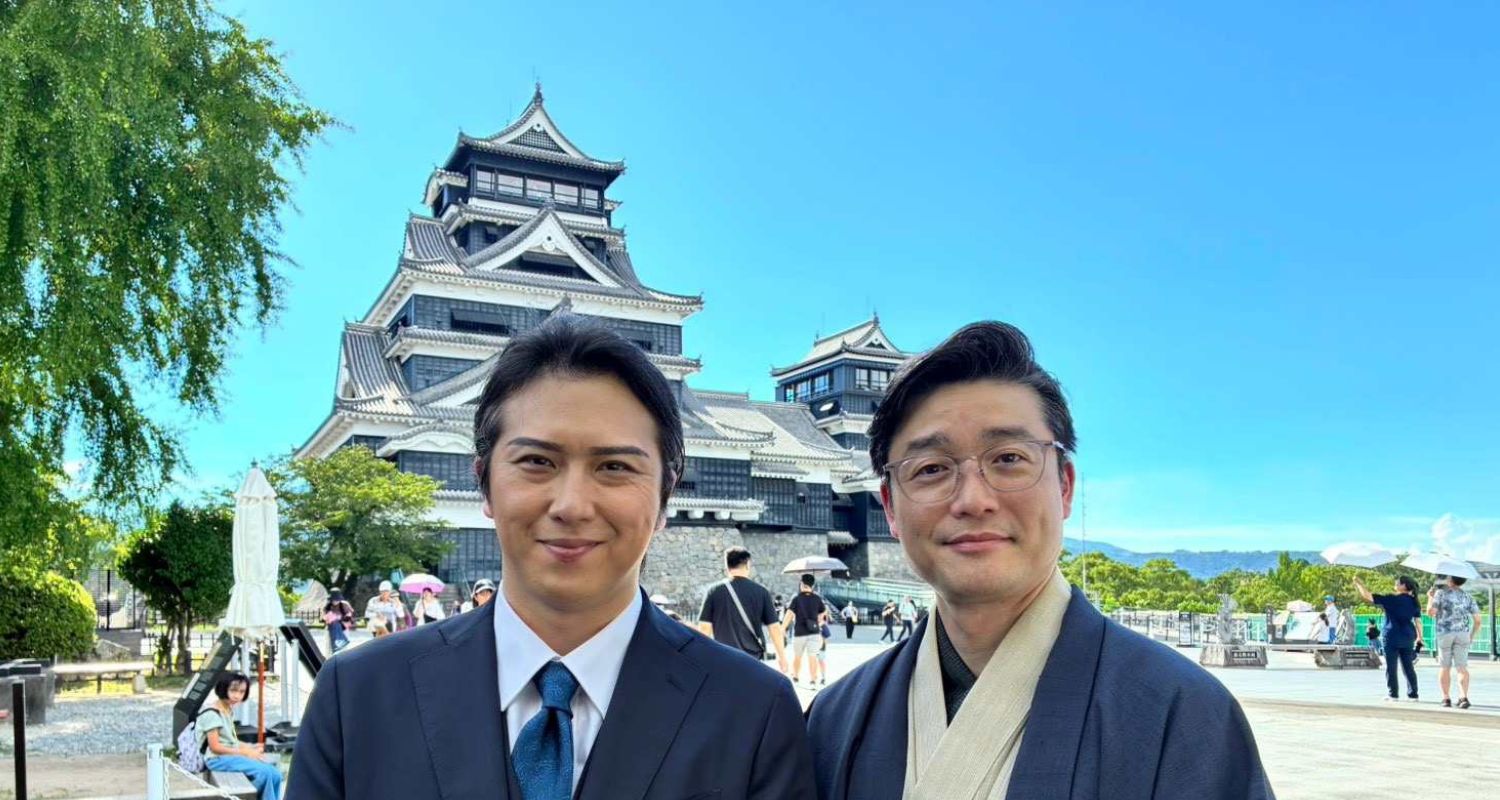
Hello, this is Kikunojo Onoe.
First and foremost, I would like to express my deepest sympathies to all those affected by the Kumamoto earthquake on July 28th. I sincerely hope that you will be able to return to your normal lives as soon as possible.
The day before, I had visited Kumamoto. I had gone to Kumamoto Castle and the city hall with Matsuya Onoe, who plays Yamato Takeru, for the poetic drama "Take to Ken ~The Land of Fire~" which will be performed at Kumamoto Castle Hall on October 3rd and 4th. This performance was launched as a reconstruction support event to mark the 10th anniversary of the 2016 Kumamoto earthquake, and was planned with the hope of being able to help in some small way.
Amidst all of this, another major earthquake has struck, and my heart truly aches when I think of the anxiety and hardships the people of Kumamoto are experiencing. I had just met with the Vice Governor, the Vice Mayor, the staff of KKT Kumamoto Prefectural Television, and the people of Kumamoto, and witnessed firsthand their bright and positive efforts toward reconstruction, so it was truly heartbreaking. I feel helpless because there is nothing I can do, but thanks to everyone's support, the October performance will be held, and I hope that through this performance, we can stand alongside the people on their journey toward reconstruction and deliver their prayers and hopes.
A prayer for reconstruction, embodied in the stone walls of Kumamoto Castle.
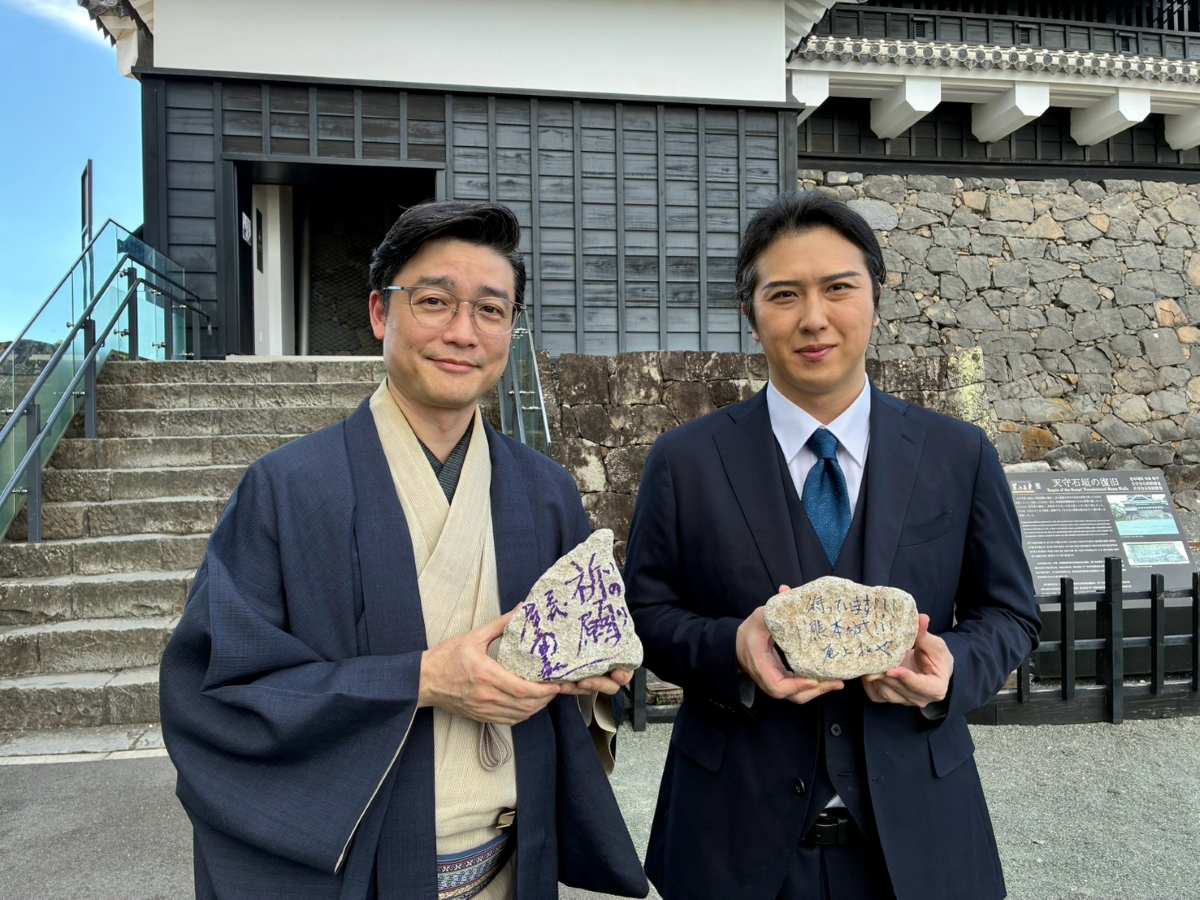
I visited Kumamoto Castle with Matsuya Onoe and wrote a message on one of the cobblestones.
When I visited Kumamoto on July 27th, I paid a courtesy call to the deputy governor and deputy mayor, and at that time I was told that "it will take another 26 years for Kumamoto Castle to be fully restored."
The castle tower, being a symbolic structure, was the first to be restored after the earthquake 10 years ago, and it is already possible to climb to the top. On the other hand, the restoration of buildings such as the main palace and the stone walls will take a long time. The stone walls in particular were so meticulously calculated that it's hard to imagine how they were built at the time, and the process begins with investigating where each stone should be placed and returning each one to its original location. Apparently, with current technology, they can only return about four or five stones per day. There are approximately 20,000 of these stones. Large numbered stones were lined up all over the vast grounds.
Large stones are used to create the surface of the stone walls. Smaller stones embedded within are called "guriishi" (chestnut stones). Matsuya and I wrote a message on one of these guriishi. The restoration of Kumamoto Castle is a source of energy for everyone living in Kumamoto. These stones support not only the castle but also the hopes of these people, so we wrote "prayer" with all our hearts. The performing arts we are involved in ultimately boil down to "prayer." We hope that this will connect with the wish for reconstruction.
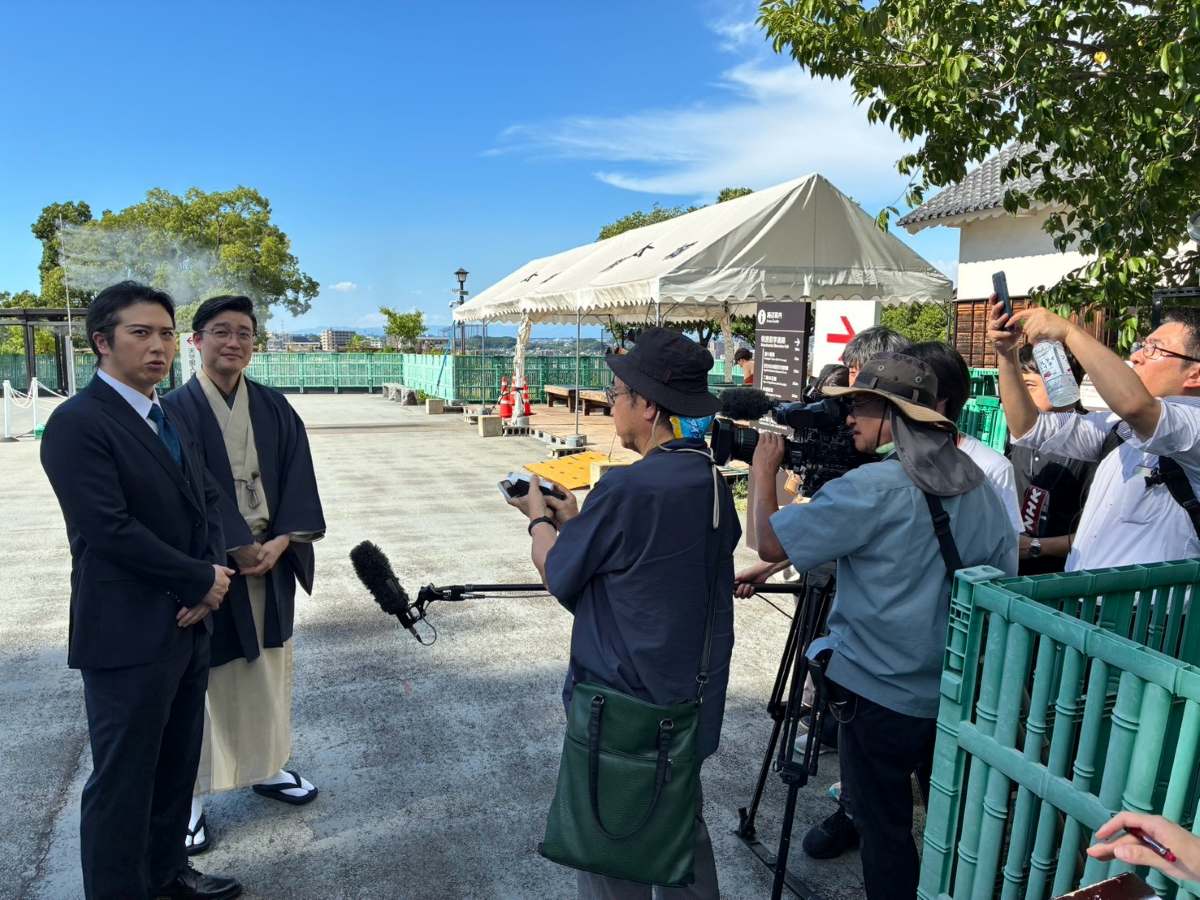
I'm currently being interviewed by local media.
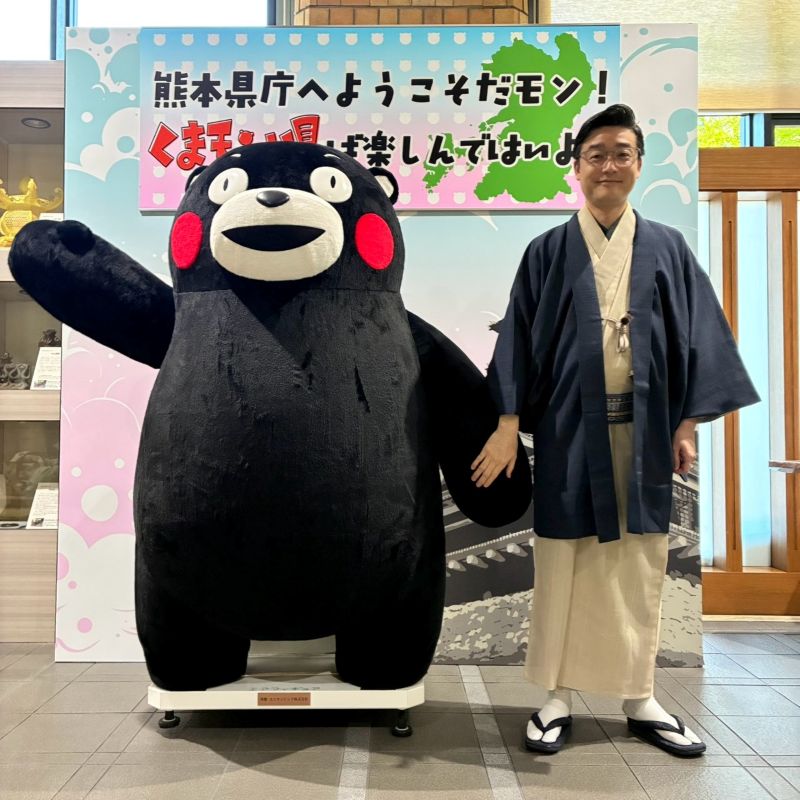
I actually got a photo with Kumamon!
It was the first time for both Matsuya and me to visit Kumamoto Castle, and the black walls of the keep exude an air of dignity and strength. There's a route around the castle where you can see the ongoing construction, allowing you to experience the restoration process firsthand. As we toured the castle, receiving various explanations, we could sense the pride everyone we met had in Kumamoto Castle. Experiencing the atmosphere of Kumamoto together with Matsuya was a huge benefit for our performance of "Take to Ken." It definitely boosted our morale, and it certainly changed the way we immerse ourselves in the world of the play. It was a valuable trip for creating the stage production.
The next day, I parted ways with Matsuya and headed to Hakata for my next destination, Shimane. That night, the earthquake struck, and I was stunned. The faces of the people who had helped me in Kumamoto came to mind, and although there was nothing I could do, I felt restless and couldn't just sit still... I wanted to do something, anything, to help.
I was deeply impressed by how proud the people of Kumamoto were of the groundwater developed by Kato Kiyomasa, and how they said, "Kumamoto's tap water is the best-tasting." When I learned that the water supply had been cut off, and since it would take a long time to get there from Tokyo, I sent bottled water through an acquaintance in Kagoshima, and did everything I could to help. I know that many people are still in a very difficult situation, but I want to stand by the people of Kumamoto in any way I can, along with the feelings I poured into the stone wall.
The traces of my ancestors, as felt at Iwami Kagura and Izumo Taisha Shrine
In Shimane Prefecture, I first visited Masuda City. I've collaborated with the Iwami Kagura of Masuda City on several projects, including the poetic drama "Yakumo Tatsu" at the end of last year. They've come to Tokyo each time, and I hope that one day we can perform in Masuda City as well.
Kagura is a form of dance offered to the gods, and its history is said to have originated from a dance performed by Amenouzume to lure Amaterasu Omikami out of the cave where she was hiding. Among these, Iwami Kagura, while being a religious ritual, also has strong elements of performing arts, and there are many things that resonate with us.
Like the "Sanbaso" dance, which was performed to pray for a bountiful harvest and peace throughout the land, dance was probably something essential for us, an agricultural people, to survive. Working with Iwami Kagura has made me feel these fundamental roots more deeply. Just as I was inspired, I hope that the people of Iwami Kagura will also feel something from us, and that we can mutually uplift and deepen each other's understanding.
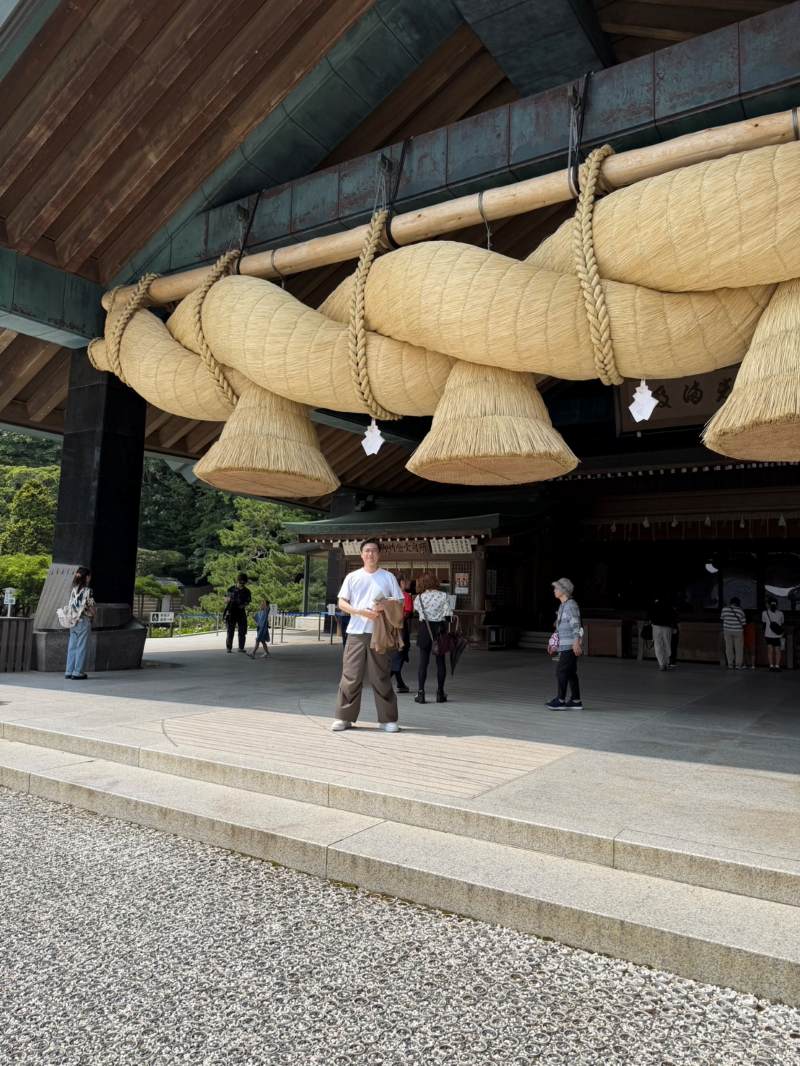
At the Kagura Hall of Izumo Taisha Shrine. The large sacred rope in front is said to be about 13 meters long and weigh 5.2 tons!
After that, I headed to Izumo Taisha Shrine for the first time in about 10 years. I had wanted to go back and offer my thanks ever since I visited when I directed "The Founding of the Nation ~ The Destiny of the Gods" (a new production by the Japan Dance Association in 2013), which featured Okuninushi as the main character, but I hadn't been able to go until now.
This latest work, "Take and Ken," also deals with Japanese mythology, and I wanted to breathe in the atmosphere of Izumo Taisha, where it is said that eight million gods gather. In a sense, it is part of my creative process. When I put my hands together in front of the main shrine, I feel the presence of something great and unseen in the silence, or rather, I am enveloped in that kind of atmosphere.
The large shimenawa (sacred rope) had just been replaced about a week ago, and it was absolutely beautiful. While there's a certain charm to shimenawa that have grown to an amber color over time, there's a certain satisfaction in seeing something brand new. The skill involved in twisting the rope is incredible, isn't it? It reminded me of the craftsmanship found in the stone walls of Kumamoto Castle.
When we touch things that have been preserved through time, we can feel the footsteps of our ancestors, and we realize that they are definitely connected to our performing arts.
Dancing and praying
In modern times, there are many amazing dancers with overwhelming skill in physical movement, such as street dance and acrobatics. If we were to try to compete with them, Japanese traditional dance might not stand a chance. However, I believe that the fact that our performing arts have roots that extend back to the age of mythology is what gives them value.
Since I began to create with that in mind, I've come to strongly feel that "prayer" is at the heart of Japanese dance. Dancing and praying—these two are connected. Invisible thoughts and prayers are embodied in the body and expressed, and that is conveyed to the audience.
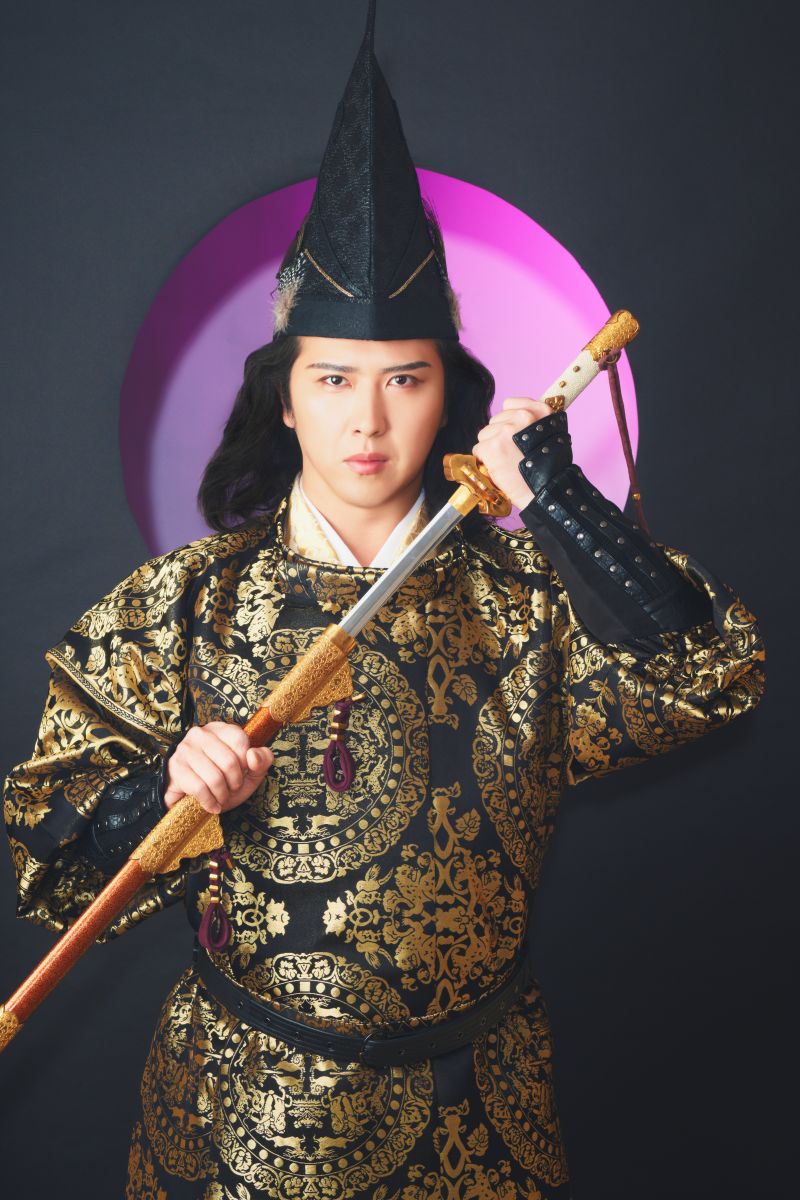
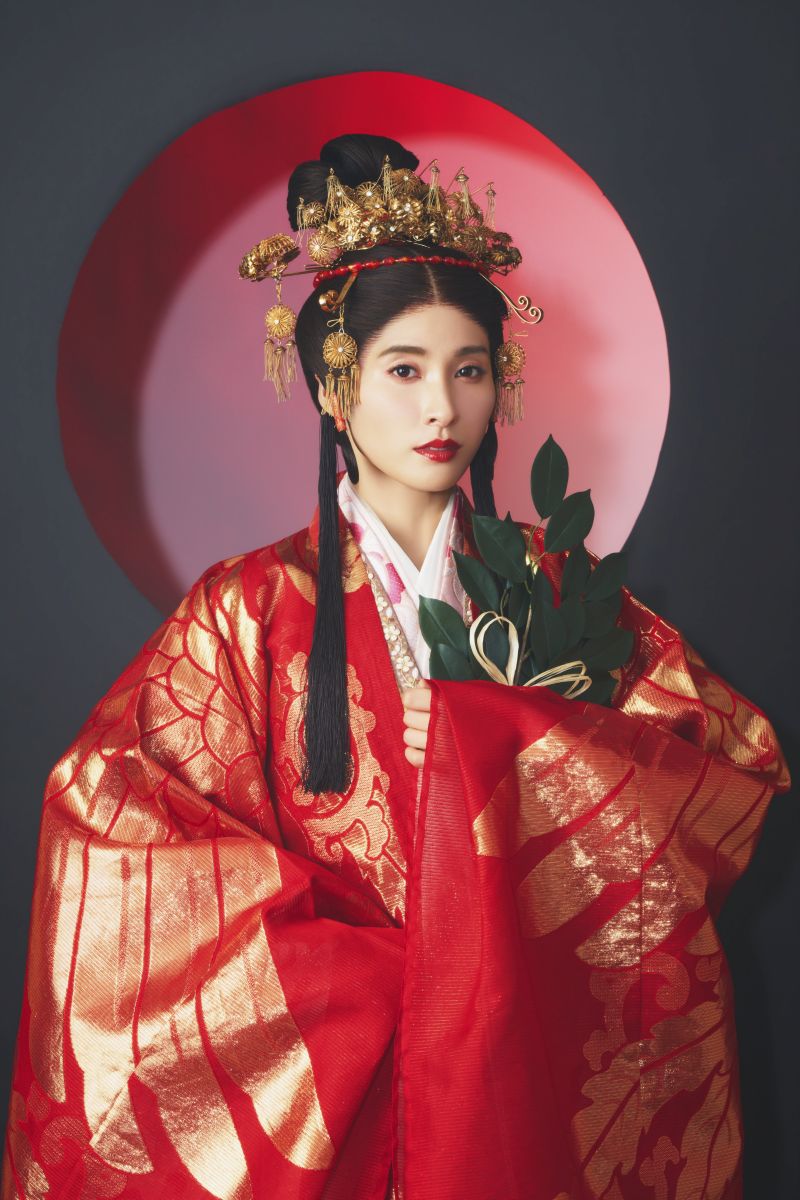
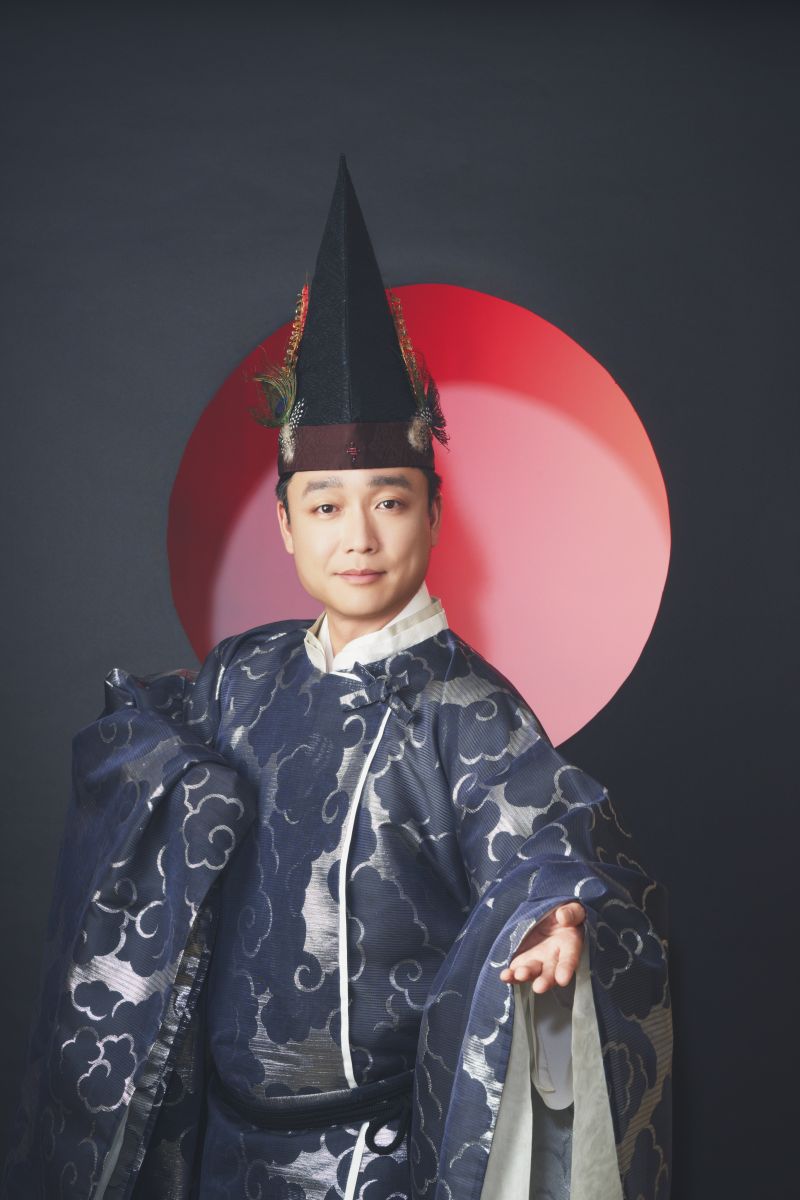
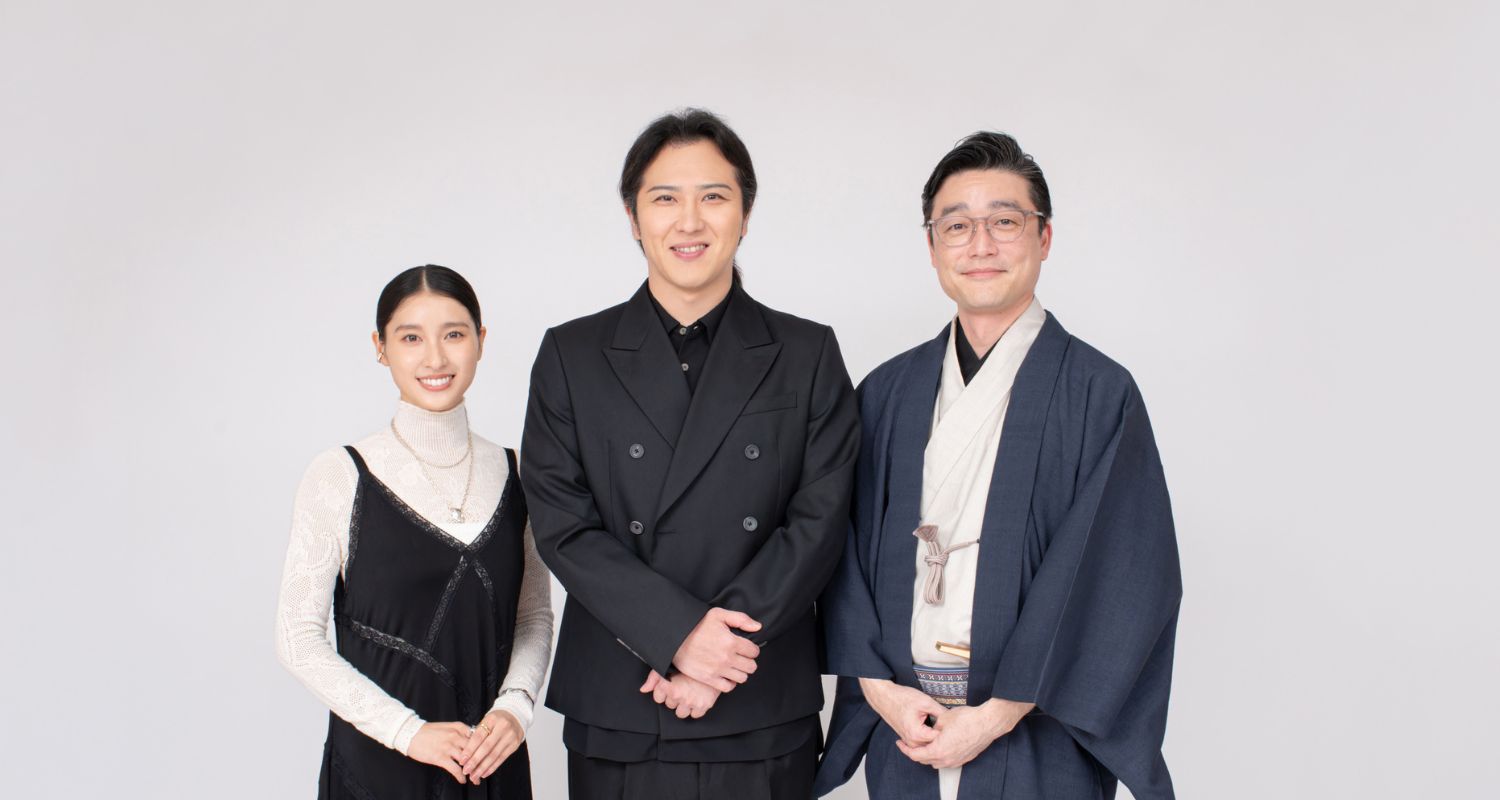
"Take to Ken," which will be performed in October, is a new work that depicts Kumamoto as a "magoroba" (a beautiful and idyllic place), using Yamato Takeru's conquest of the Kumaso as its theme, and exploring how Kumamoto came to be known as the "Land of Fire." We also want to express the strength of living, with themes of "coexistence and love," such as the love between Yamato Takeru and Princess Takeru, and the love between him and Emperor Keiko. And we hope that everyone who sees it will be able to feel the essence of "Kumamoto."
We hope to deliver a performance that will energize everyone, and together with the cast and staff, including Matsuya-san and Tsuchiya Tao-san, we intend to create it carefully, imbued with our prayers for recovery.
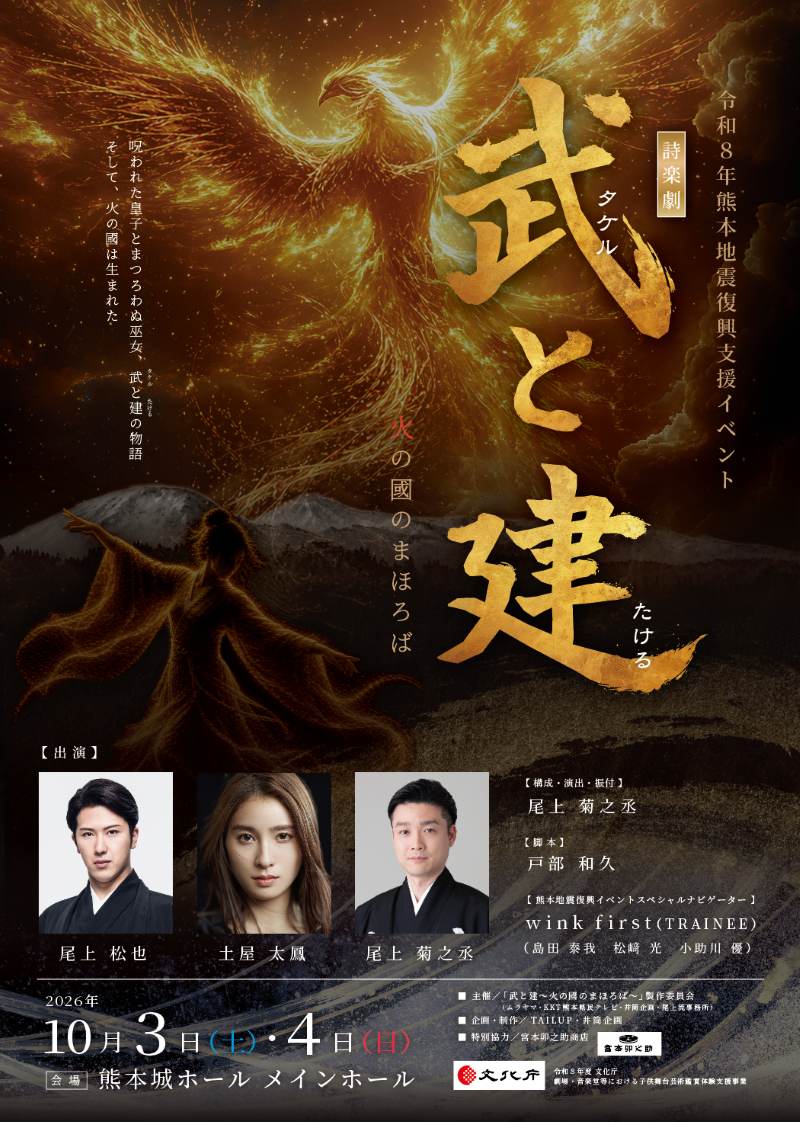
Reiwa 8 (2026) Kumamoto Earthquake Reconstruction Support Event
Poetic drama "Takeru and Takeru ~The Land of Fire~"
Date and time: October 3rd (Sat) and 4th (Sun), 2026
Start time: 12:00 p.m., 3:30 p.m. (4 performances in total)
Venue: Kumamoto Castle Hall Main Hall (3-40 Sakuramachi, Chuo-ku, Kumamoto City, Kumamoto Prefecture)
Composition, Direction, and Choreography by Kikunojo Onoe
Script by Kazuhisa Tobe
Cast: Matsuya Onoe (Yamato Takeru), Tao Tsuchiya (Princess Takeru), Yuki Hayashi (Izanagi), Miumi Maiha (Izanami), Kikunojo Onoe (Emperor Keiko), and others.
Ticket prices: SS seats 10,000 yen, S seats 8,000 yen, A seats 6,000 yen
(Tickets on the day of the performance will be priced as follows: SS seats 11,000 yen, S seats 9,000 yen, A seats 7,000 yen)
Official website: https://takerutotakeru.com/
*This is a performance covered by the "Agency for Cultural Affairs' Support Program for Children's Appreciation Experiences of Performing Arts at Theaters, Concert Halls, etc."
Children aged 4 to 18 are invited to A seats free of charge. (Accompanying adults receive a 50% discount.)
This is a valuable opportunity for children, who will shape the future, to experience performing arts.
Official website for the poetic drama "Take and Ken ~The Land of Fire~"

Kikunojo Onoe
■ Onoe Kikunojo III, fourth-generation head of the Onoe school
Born in 1976, he studied under his father from the age of two and made his debut on stage at the age of five. In 2, he succeeded the fourth head of the Onoe school and took the stage name Onoe Kikunojō III. He hosts his own recital, "Onoue Kikunojō no Kai," and "Itsusei-kai" with Kyogen performer Shigeyama Ippei. He also devotes himself to creating new works and has presented a wide range of pieces. He has directed and choreographed in a variety of genres, including new kabuki, Hanamachi dance, the Takarazuka Revue, OSK Nippon Revue, and ice skating shows "Hyouen" and "Luxe." He is a part-time lecturer at Kyoto University of Arts and a director of the Japan Dance Association.
For inquiries to “Kikunojo FAN CLUB”, please contact:Onoue official website .
Lounge
Premium Salon
Onoe Kikunojo Diary ~Listen to good things~


Premium Salon


