

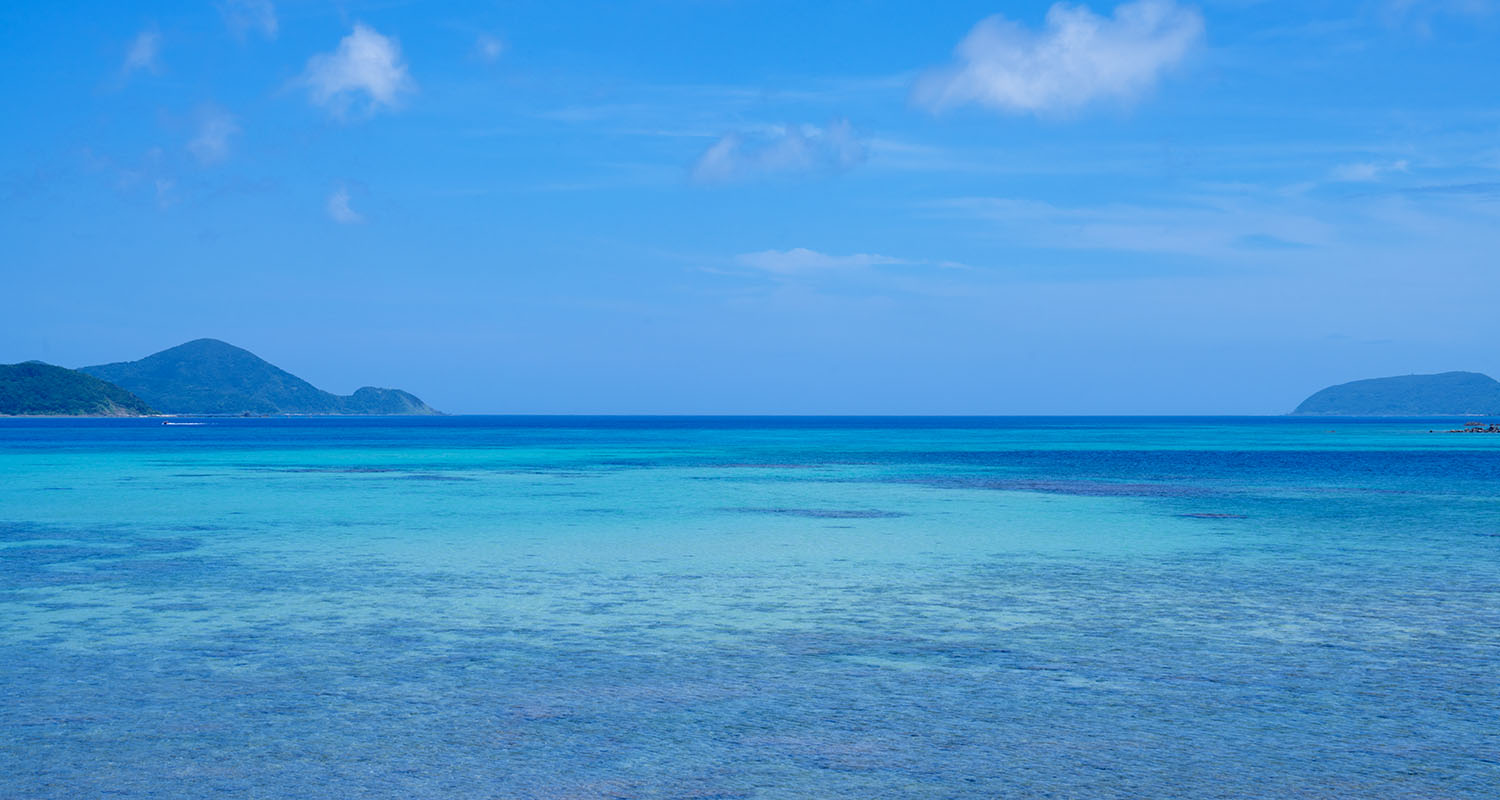
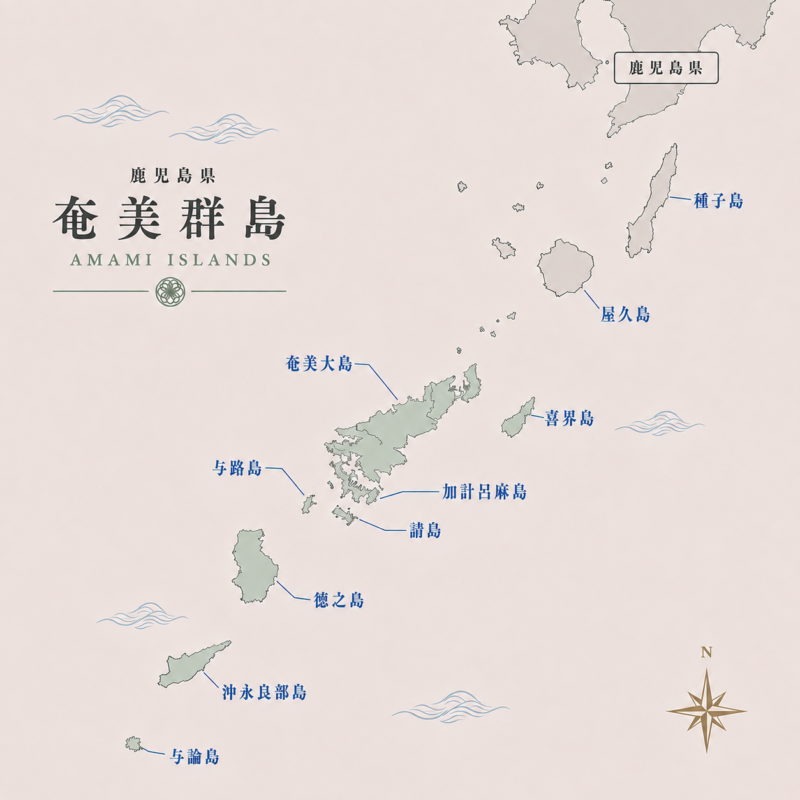
Located almost midway between mainland Kagoshima Prefecture and Okinawa Prefecture, the Amami Islands consist of eight inhabited islands: Amami Oshima, Kakeroma Island, Uke Island, Yoron Island, Kikai Island, Tokunoshima Island, Okinoerabu Island, and Yoron Island. Amami Oshima, which I visited this time, is the largest of the eight, with an area of over 700 square kilometers. It is larger than the 23 wards of Tokyo or Lake Biwa, and it takes about two hours to drive from north to south across it.
Amami Oshima, along with Tokunoshima, the northern part of Okinawa Island, and Iriomote Island, is registered as a UNESCO World Natural Heritage site, and celebrated its 5th anniversary in July 2026. The island is home to a unique ecosystem that can only be found here, and is a precious natural environment where endangered species such as the Amami Jay and the Amami Rabbit live.
Blessed with two seas—the East China Sea and the Pacific Ocean—and subtropical forests, this island still thrives in daily life, thanks to a unique culture nurtured over a long history. I traveled to Amami Oshima with the themes of "touching, eating, and staying."
Strong sunlight and deep green. My first impression of Amami Oshima.
As you drive your rental car from Amami Airport, the first thing that catches your eye is the intense sunlight and the deep green of the sugarcane fields stretching out below. The contrast between light and shadow is astonishingly vivid. Villages appear and disappear, and in between, small coves come into view. The sea shines with an emerald green hue, calm and without a single wave. I get out of the car and take a walk in the cove. My skin is burned by the relentless sunlight, but when I step into the shade of a tree, I am enveloped in a refreshing coolness that is a welcome relief.
"Miki," the soul food of Amami Oshima, has its roots in a drink offered to the gods.

One of the joys of traveling around the island by rental car is stopping by local supermarkets along the way. Just by looking at the shelves, you can get a glimpse of the unique food culture of this region. What caught my eye in particular was a drink called "miki." It's a fermented lactic acid beverage made from rice, sweet potatoes, and sugar, and is one of Amami Oshima's representative soul foods. Several companies on the island manufacture and sell it, and it seems that the islanders each have their favorite. I bought one and tried the "miki." It had a thick, porridge-like texture, with a subtle sweetness and a hint of sourness.
In the past, female priests called "Noro" presided over religious ceremonies in Amami. "Miki" is said to have originated from kuchikamizake (sake made by chewing rice) that was offered to the gods during harvest festivals, and its name is also said to be derived from "omiki" (sacred sake). It was apparently once made in every household. Even in the drinks that are lined up so commonly on supermarket shelves, there is a culture that has been passed down on the island. Such discoveries are also part of the fun of traveling to Amami Oshima.
"Touching" Amami Oshima's Traditional Industries: Visiting Oshima Tsumugi Village
With sugarcane fields, the sky, and the sea in the background, it's about a 20-minute drive from Amami Airport to Oshima Tsumugi Village, a place to visit Oshima Tsumugi, Amami's representative traditional craft. The approximately 1-tsubo (about 5,000 square meters) site is lush with subtropical plants such as palm trees, pandanus trees, cycads, and tree ferns, resembling a botanical garden. In summer, shikwasa citrus fruits ripen, and in autumn, the Rhaphiolepis indica trees bear red berries.
"I can hear the call of a Ryukyu Jay. It might show itself," said Tokuharu Koshima, president of Oshima Tsumugi Village and a traditional craftsman himself. Mr. Koshima was born into a family that has been involved in the production of Oshima Tsumugi for generations. This village was created by his father with the wish that people would learn about Oshima Tsumugi while experiencing the nature of Amami. Currently, in addition to tours of the production process, they also offer tie-dyeing experiences in mud fields.
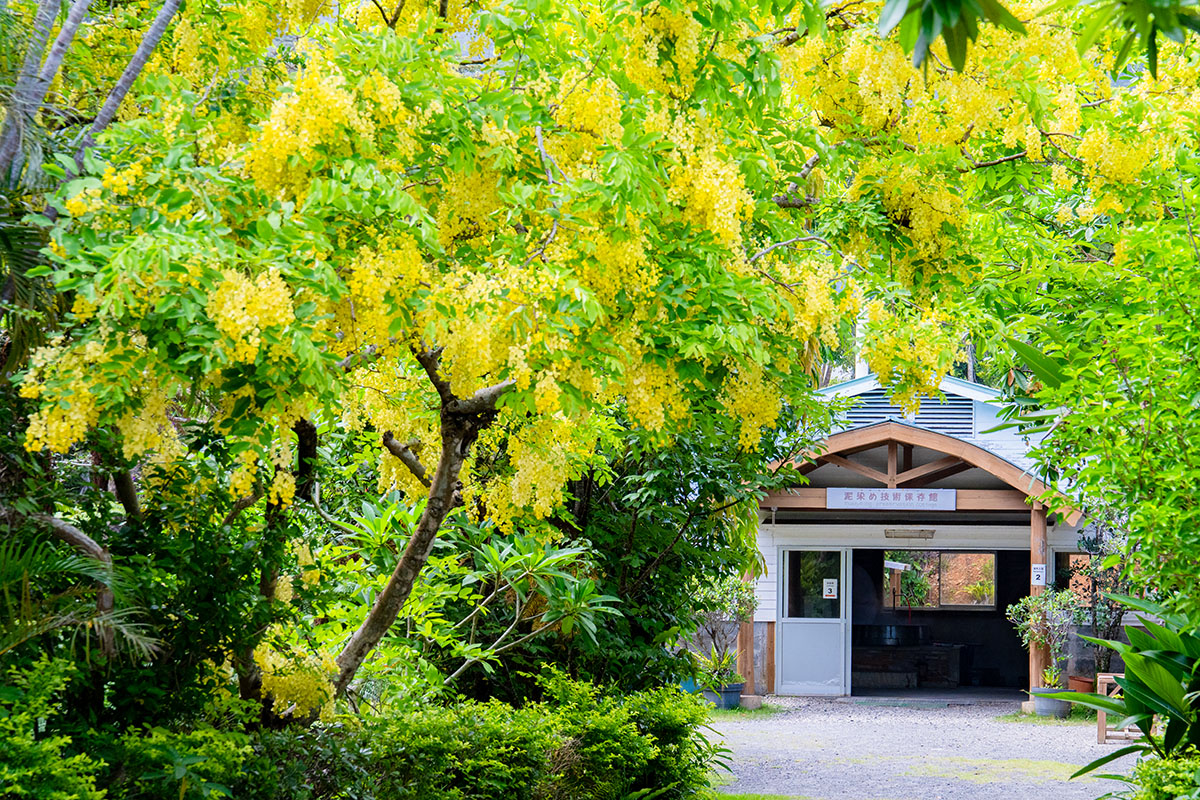
The deep black of Oshima Tsumugi silk, created from mud and plants.
As we walked through the garden with Ms. Koshima, we arrived at the mud-dyeing workshop. Mud dyeing, a symbol of Oshima Tsumugi silk, is a traditional technique that uses a chemical reaction between the tannins contained in the Rhaphiolepis indica plant and the iron in the mud to produce a unique dark brown color. The fabric is dyed, dipped in mud, and washed. This process is repeated many times, taking two to three weeks, sometimes more than a month, to fix the deep black color.
"This technique originated in the Edo period. One theory suggests it began when a samurai from the Satsuma domain hid some silk fabric by dipping it in mud, which resulted in a unique black dye. The technique was established during the Meiji and Taisho periods."
At the workshop, you can see the entire process of making Oshima Tsumugi silk, from dyeing with Rhaphiolepis indica, stencil printing, weaving on a loom, to hand weaving. You will be overwhelmed by the complexity and meticulousness of the process. Each step requires skilled technique and time, and it is through the accumulation of these steps that a single bolt of Oshima Tsumugi is created. Seeing the handiwork firsthand, you will truly feel its preciousness.
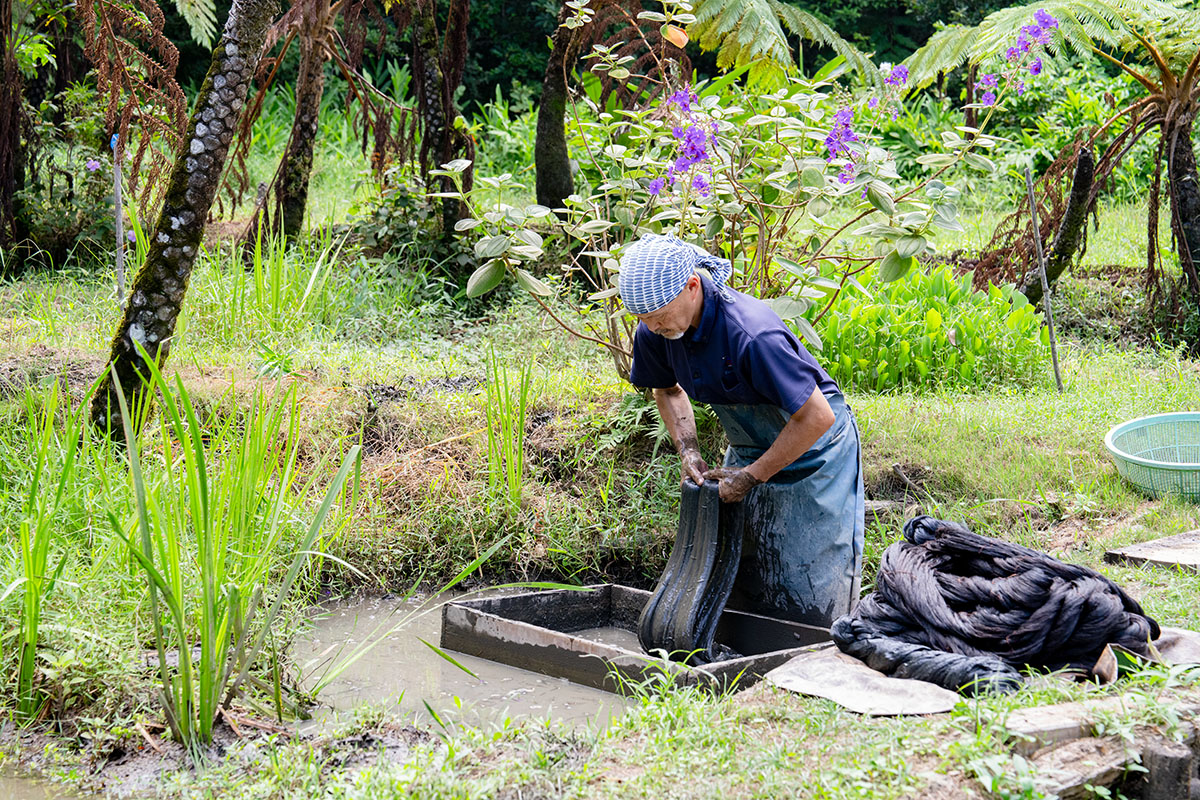
I saw the mud dyeing process for the first time. So this is how the unique black of Oshima Tsumugi silk is dyed.
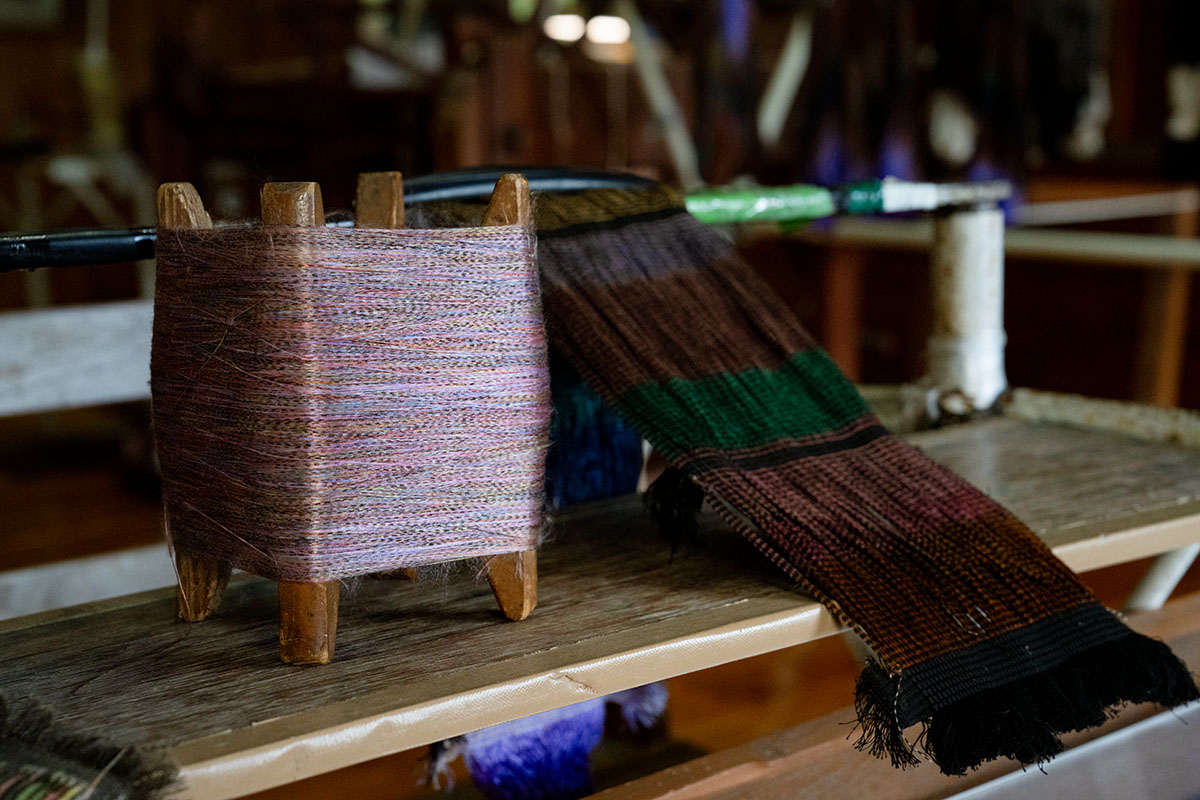
The intricate patterns of Oshima Tsumugi silk are not drawn as the fabric is woven. In fact, the design is already embedded in the threads before weaving even begins. Following a blueprint, each individual thread is dyed to form a portion of the pattern, and these ikat threads are used as the warp and weft threads, carefully aligning the dyed sections as they are woven. In other words, the pattern cannot be seen by looking at a single thread. The parts of the pattern embedded in each thread overlap as the weaving progresses, eventually revealing the intricate design. The pattern of a single bolt of Oshima Tsumugi already exists, broken down into countless threads, even before it is placed on the loom.

The "Tatsugo pattern," said to originate in Tatsugo Town on Amami Oshima Island, is one of the representative traditional patterns of Oshima Tsumugi silk, with its striking geometric design. This traditional pattern has developed using motifs from the island's nature, such as the back pattern of the habu snake and the leaves of the cycad tree. The geometric pattern appears neat from a distance, but is surprisingly intricate when viewed up close. It is one of the patterns that best showcases the ikat weaving technique unique to Oshima Tsumugi.
Bringing Oshima Tsumugi into modern life.
The park also features a modern shop with a white-based interior. It offers a wide selection of kimono fabrics, from traditional Tatsugo patterns to striking polka-dot white Oshima silk, as well as items easily incorporated into modern wardrobes, such as Aloha shirts, bow ties, bags, and wallets. Even the scraps left over from tailoring the fabric are transformed into covered buttons, obi clips, and scrunchies. Every last piece of the fabric, created over a long period of time, is utilized. The shop offers a collection of items that make traditional crafts feel much more accessible, and time flies by as you browse through them.
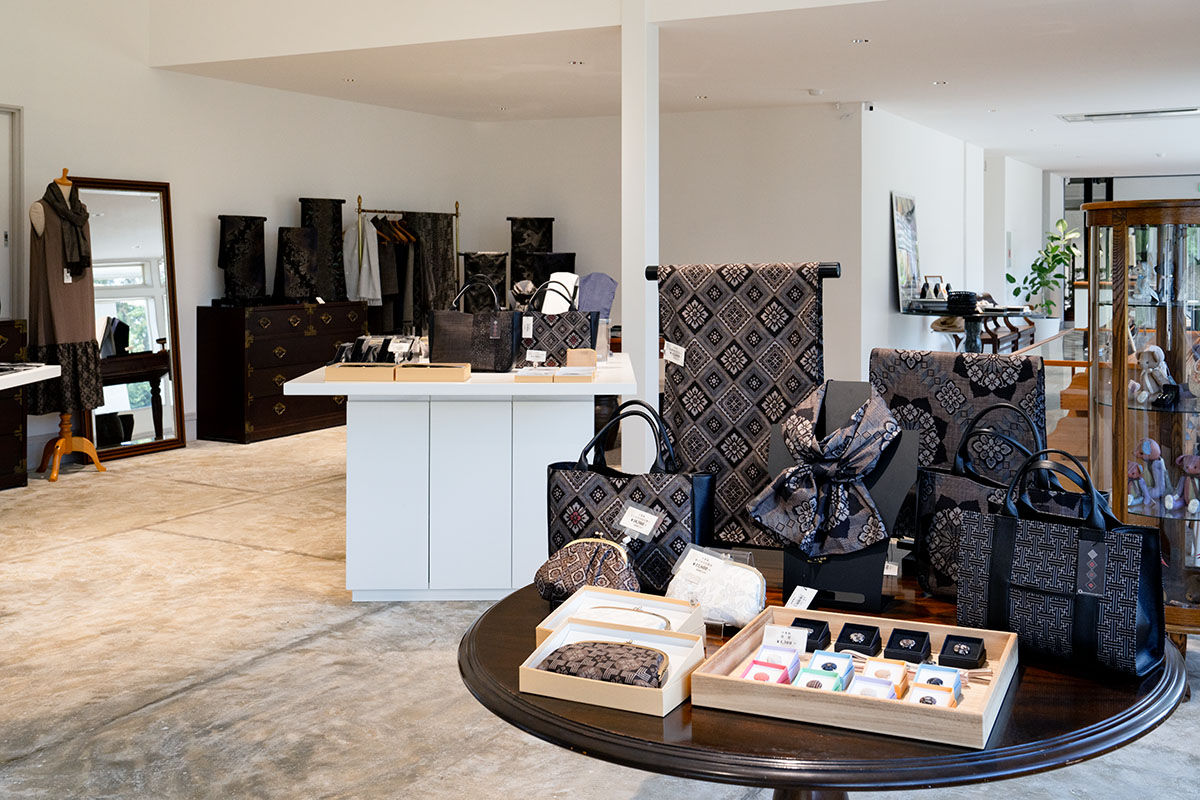
"We actively incorporate not only classic patterns but also modern designs and original designs. We also value a 'zero waste' approach, ensuring that not a single piece of fabric, which is filled with the craftsmanship of artisans, goes to waste," says Koshima.
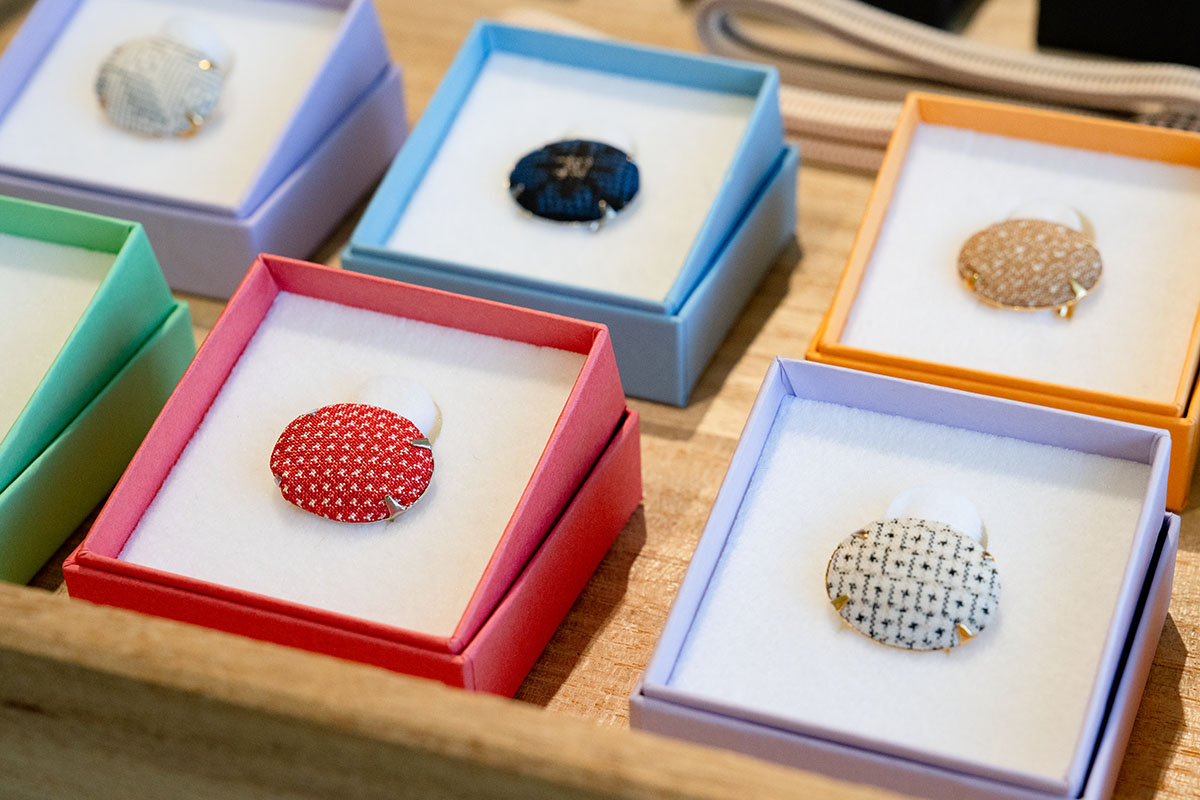
These obi clips made from Oshima Tsumugi silk have a cute, rounded oval shape. There are so many different patterns and colors to choose from, it's hard to decide!

A chic bow tie made of Oshima Tsumugi silk. The crisp, lustrous texture of Oshima Tsumugi is sure to elevate any outfit.
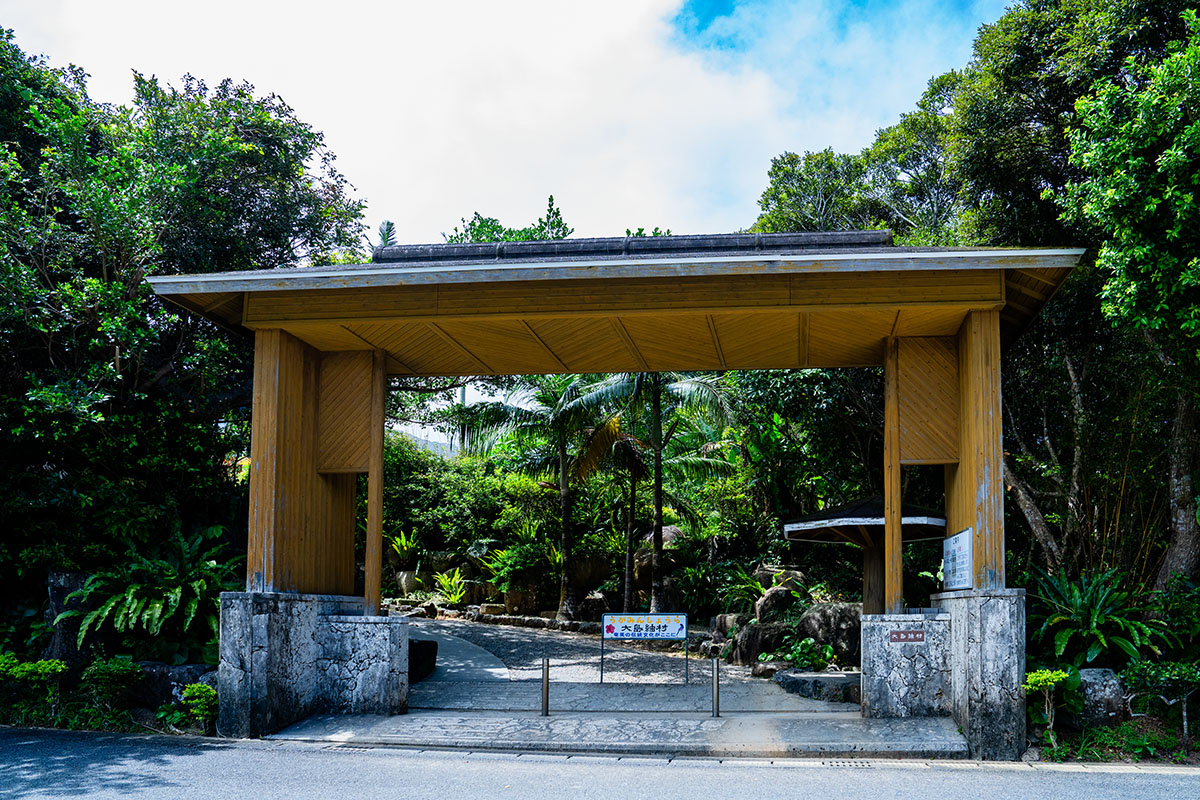
Oshima Tsumugi Village and Oshima Tsumugi Manufacturing Factory Tourist Garden
1945 Akaogi, Tatsugo-cho, Oshima-gun, Kagoshima Prefecture
0997-62-3100
"Eating" - We want to pass on Amami's food culture to the next generation - The nostalgic dining table of the Natsukashiya family
Naze, a hub for business and tourism, is the heart of Amami Oshima. Yanigawa Street, lined with numerous restaurants, is affectionately known locally as "Yango Street." Just off that street lies "Natsukasha-ya." It's less of a restaurant and more of a local cuisine restaurant housed in a detached house, giving you the feeling of visiting a relative's home in the countryside. Even though it was my first visit, I felt a sense of nostalgia. It truly lives up to its name, "Natsukasha-ya" (meaning "nostalgic house"). On this day, the restaurant was fully booked, and the proprietress, Isako Egami, was busy managing it all.
As we sat down, the table was laden with local dishes. There was vibrant pink handama rice, peanut tofu, pork bone broth, and sticky rice tempura, an essential dish for celebrations. Each dish was filled with the wisdom of the island.
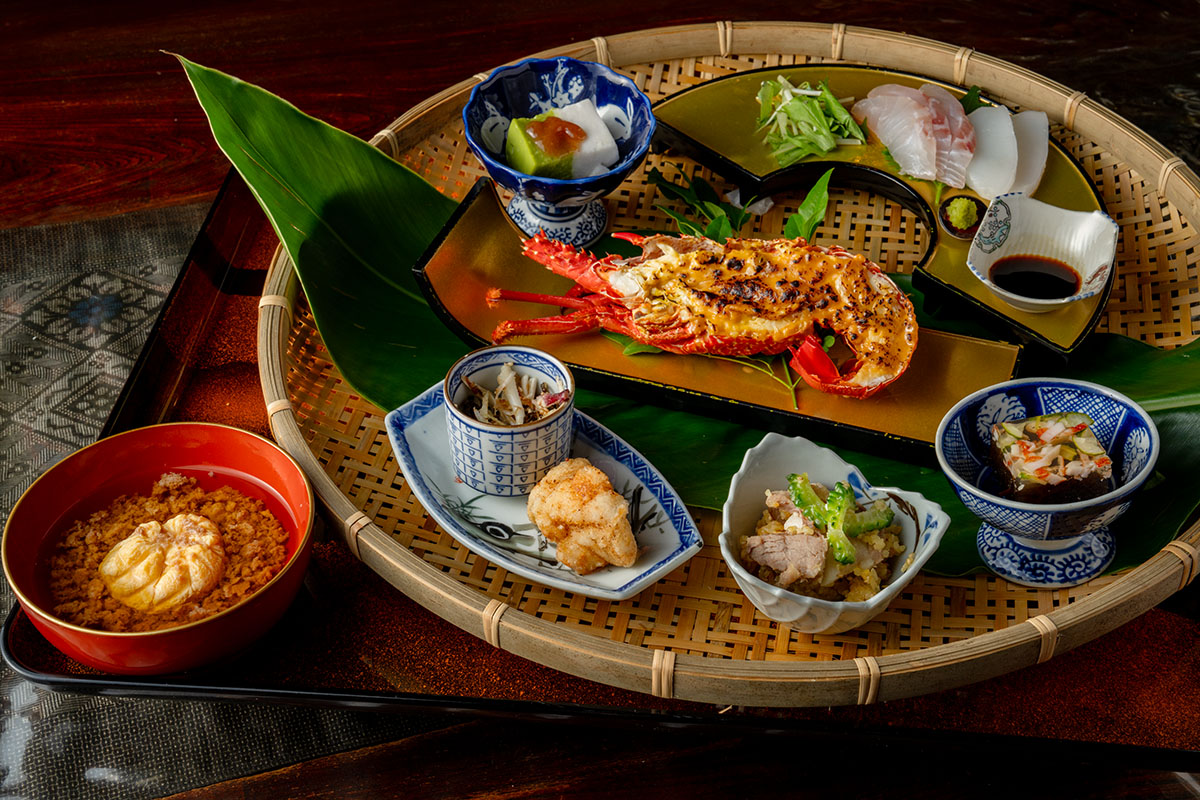
I asked, "What are the characteristics of Amami Oshima cuisine?" Ms. Egami explained, "The key to the flavor is the skillful use of coarse sugar and brown sugar, both made from sugarcane. Coarse sugar is used in most dishes, while brown sugar is used for sweets. When you use coarse sugar and brown sugar in cooking, the flavors are completely different. The richness is totally different."
Amami also has a deeply rooted culture of "salted pork." In the days before refrigerators, pork was heavily salted to preserve it, and the prepared pork, ready before the New Year, was eaten around May of the following year, during the rice planting season.
"In the old days, each household grew rice, so they would salt a lot of pork, wrap it in straw, and hang it under the eaves. Around the time of rice planting, they would take it down, boil it, and eat it."
Salted pork, a method of preserving meat for extended periods, was also intertwined with the lifestyle of rice farming. Amami's local cuisine reflects the lives of the people who have lived on the island.
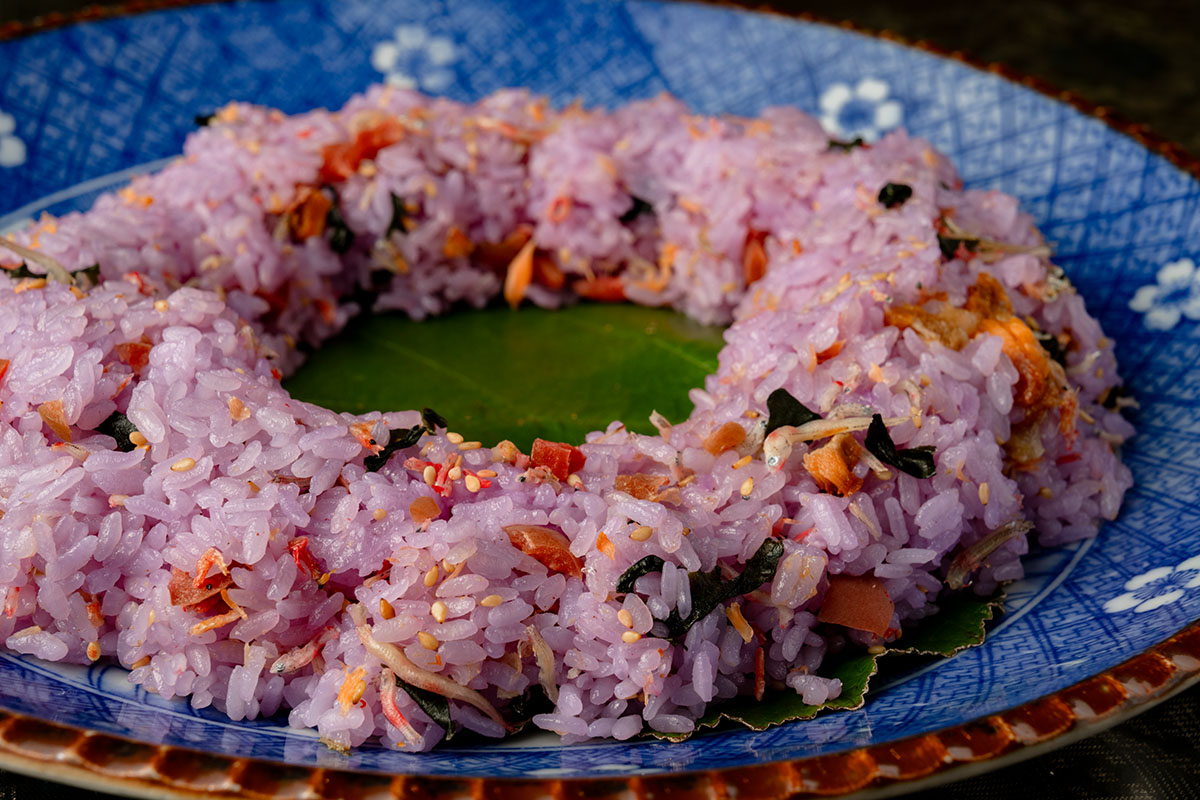
The vibrant pink color of the Handama rice is eye-catching. Ms. Egami devised this dish because island cuisine tends to be brown, and she wanted to offer something visually appealing to the eyes as well. It is made by cooking Handama, an island vegetable, together with rice.
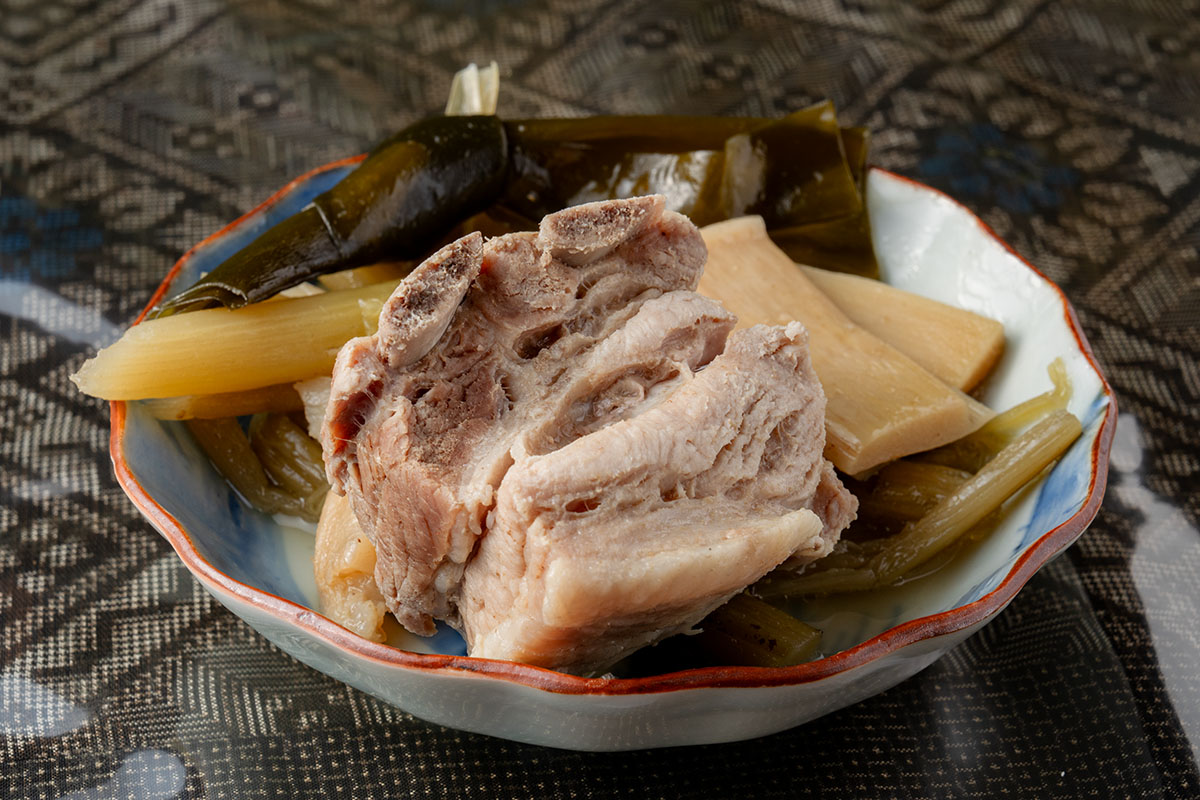
Salted pork was strongly linked to the island's rice-farming culture.
Ms. Egami is a former middle school teacher. She worked until retirement, and her dream was to open a restaurant serving local cuisine after leaving school. She lost her father when she was three years old, and naturally learned to cook by helping her mother. By the time she was in fifth grade of elementary school, she was making her own hand-rolled sushi for the school sports day.
"Although my family was poor, my mother's favorite saying, 'Even if we are poor, I will not let our hearts be poor,' is at the core of my way of life."
And an incident that occurred during my time as a teacher also became the driving force behind opening "Natsukashiya." It was on a hot day just before summer vacation.
"This happened several decades ago, back when there were still differences in living standards even within Amami Oshima. Three brothers, the eldest being a first-year junior high school student, caused trouble and were sent to a reformatory in Kagoshima. When I went to see them off at Naze Port, I asked them, 'Why are you leaving your parents?' They replied, 'Teacher, as long as the three of us brothers can eat breakfast, lunch, and dinner, anywhere is fine.'"
Even though it happened decades ago, Ms. Egami's eyes welled up with tears. The words she spoke that day had transformed into a sense of mission: "I must never let children experience such hunger again." After retirement, she wanted to create a place where her former students could return and call her "teacher." That incident was the starting point for that desire.
My next dream is to create a "Hall of Experiences," connecting Amami's culture to the future.
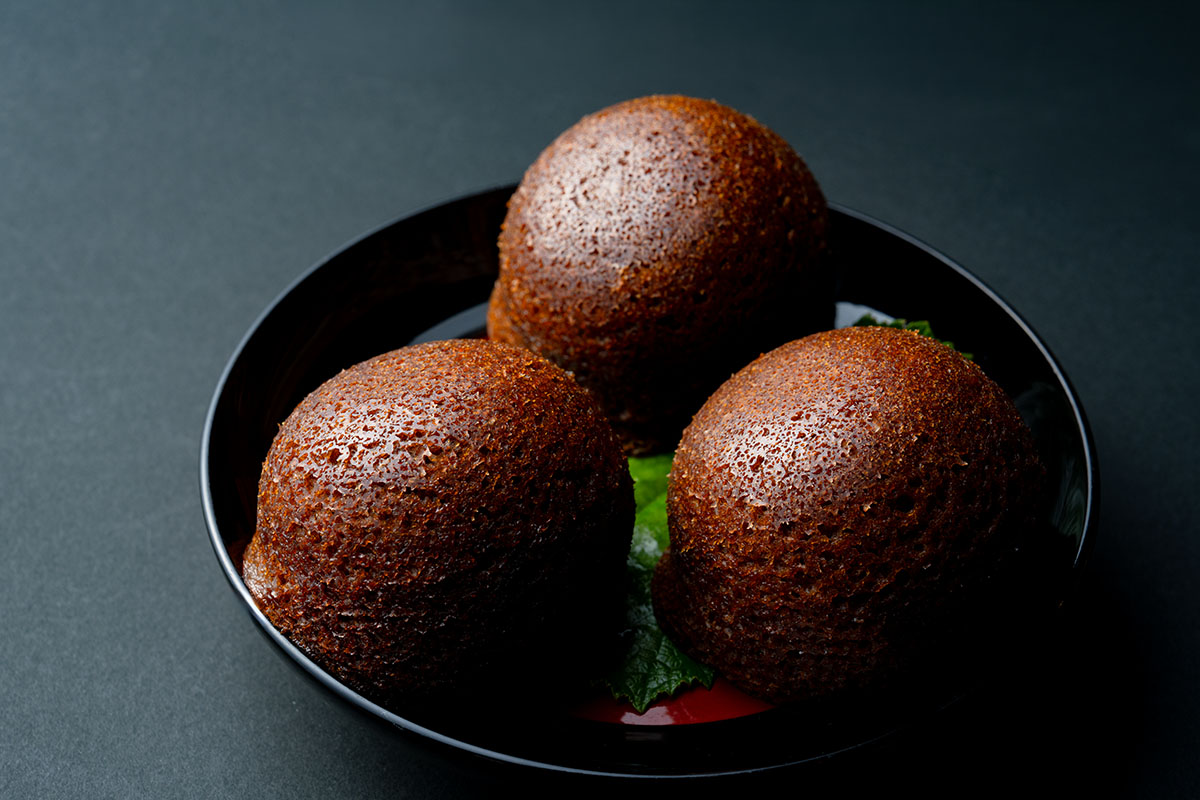
"It's delicious, try it. It'll help relieve your fatigue," said Ms. Keijo, recommending "Fukurakan." It's a traditional sweet made with brown sugar that has been popular in Amami Oshima for a long time. It has long been loved as a snack during breaks from farm work or as a treat with tea at festivals. Its soft texture and gentle sweetness of brown sugar make it perfect as a snack. Ms. Keijo's Fukurakan is very popular, and it is often taken home as a souvenir. It is not just a sweet, but also plays an important role in connecting Ms. Keijo with people.
Having realized the vision of "Natsukashiya," Ms. Egami has her next dream. She wants to create a "house" where people can not only eat local cuisine and say "it was delicious," but also make it themselves and experience the culture behind it. She envisions cooking classes that anyone can participate in, such as making fukurakan, a steamed confection made with brown sugar, and tempura.
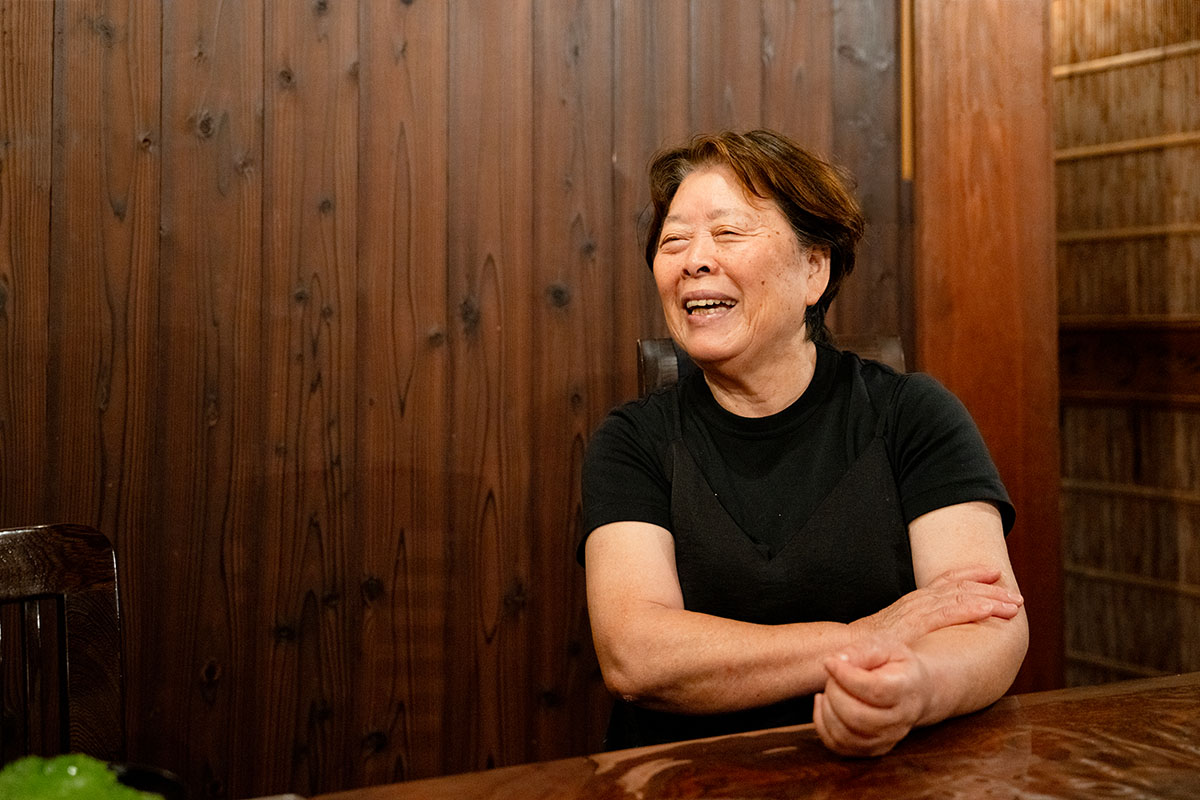
The proprietress, Isako Egami, is incredibly active, from working in the kitchen to welcoming guests.
Among the many things I'd like to share is "Sangon," a traditional Amami Oshima dish eaten during the New Year to pray for health and prosperity throughout the year. It's a ceremonial meal served in three courses: the first, second, and third courses. Even though it's all called Sangon, there are regional differences in the broth used for the soup, such as pork bone or fish.
However, among the younger generation, more and more families are simplifying the preparations and customs. To prevent the tradition from dying out, Ms. Egami teaches the Sankon Ryori (three-cup dine) method for four hours once a year in the home economics department of Amami High School.
"I hope that high school students will learn about this tradition, tell their families about it, and that even one more family will decide to try it next New Year's."
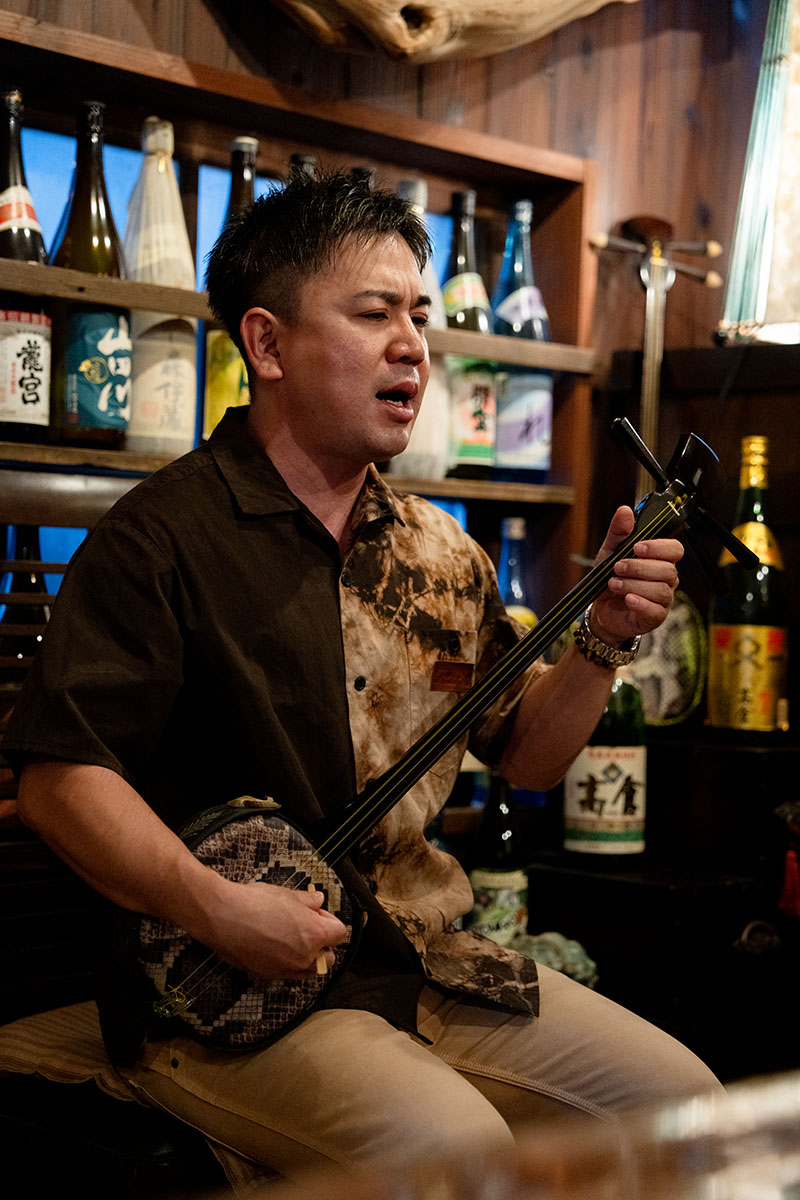
Tonight will be a lively evening with Amami singer Shingo Maeyama performing island songs. The evening begins with "Asahana-bushi." Playing the sanshin (shamisen), his falsetto, melodic phrasing, and scales evoke a sense of nostalgia, even though it's the first time hearing it. The atmosphere in the restaurant warms up with the uplifting "Wide-bushi." Ms. Egami dances while serving food, bringing smiles to everyone's faces. This restaurant is filled with a sense of comfort that makes you feel like this is your home.
"Even at 76 years old, I'm still chasing my dreams, like wanting to build an experiential facility, so people might think I'm crazy."
Ms. Egami speaks of it somewhat self-deprecatingly, but she never gives up on her dream. Now, her students are supporting her teacher. Ms. Egami's challenge to pass on Amami's food culture to the next generation continues.
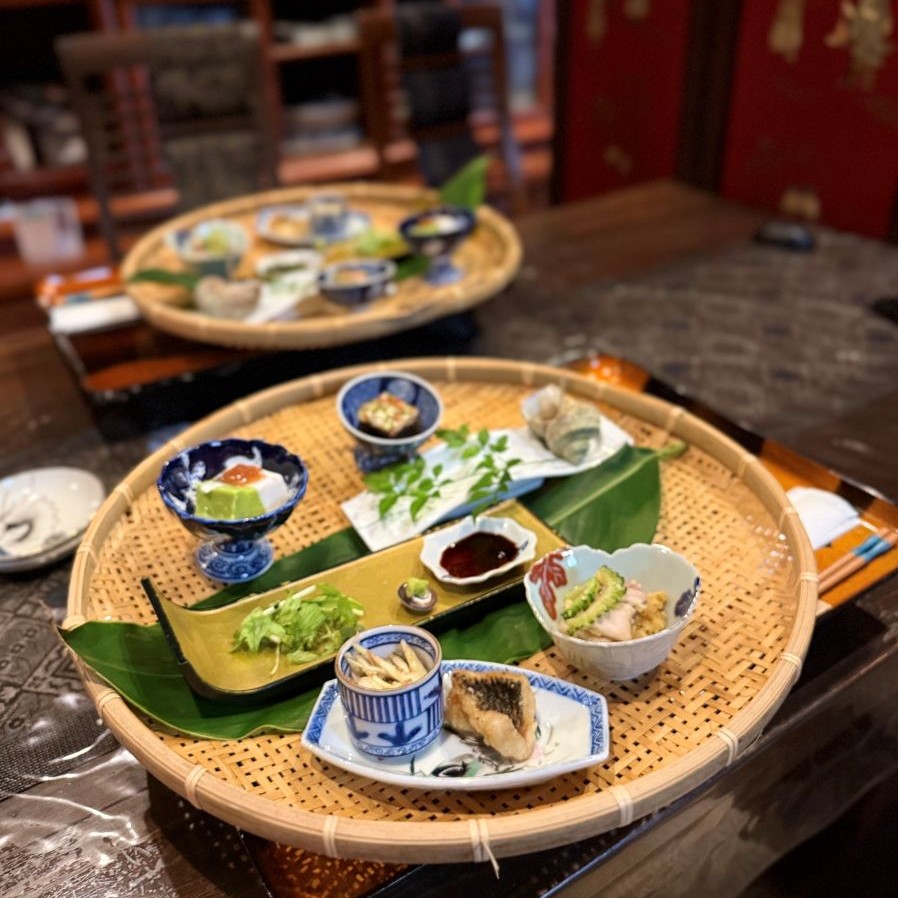
Nostalgic House
11-26 Yanagi-cho, Naze, Amami City, Kagoshima Prefecture
0997-57-1980
By appointment only
Music and sake brewing meet at Nishihira Brewery in Amami Oshima.
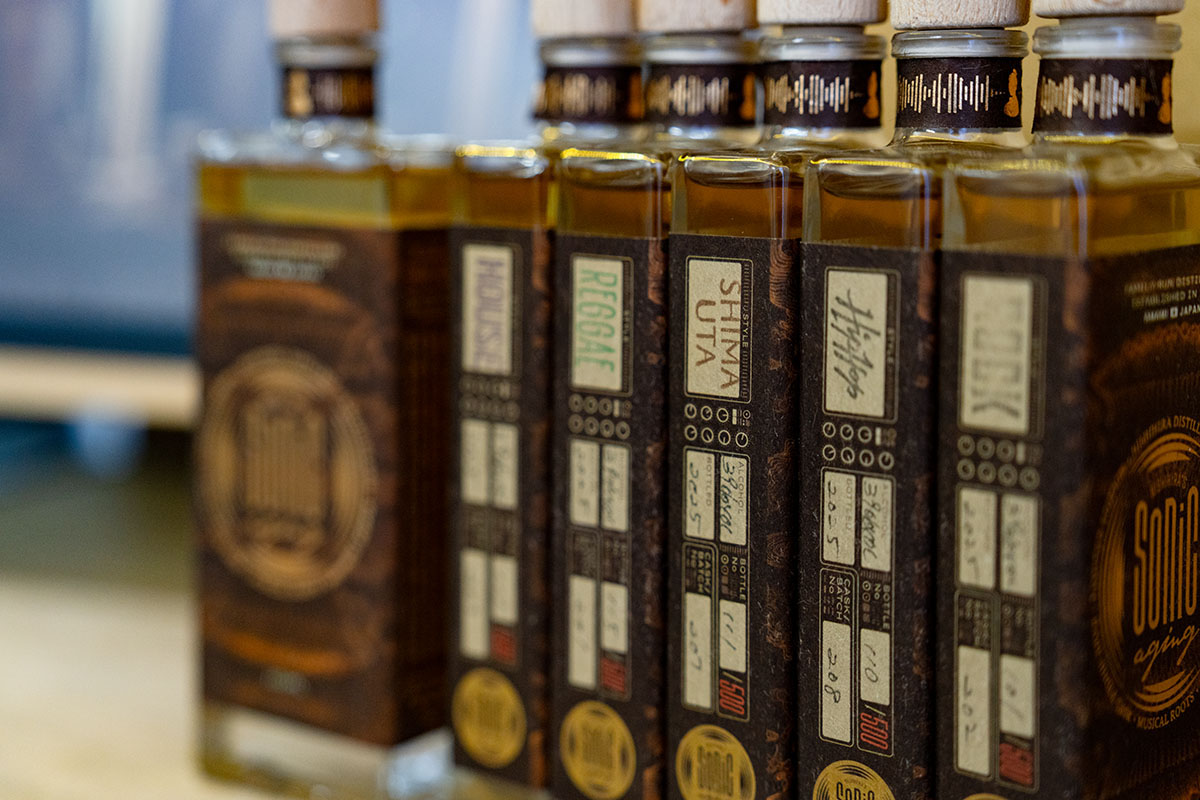
If you're traveling to Amami Oshima, brown sugar shochu is a must-try. Originally, distilled spirits made from brown sugar are classified as "spirits" under Japanese liquor tax law, which carries a high tax rate. After the war, however, the production of shochu using brown sugar as an ingredient was permitted only in the Amami Islands (Amami Oshima, Kikaijima, Tokunoshima, Okinoerabujima, and Yoronjima), on the condition that rice koji was used, and this practice continues to this day. Brown sugar shochu is a unique local liquor that can only be produced in the Amami Islands.
There is a distillery that is approaching brown sugar shochu with a fresh perspective. It is Nishihira Shuzo, which will soon celebrate its 100th anniversary. The fourth-generation owner, Serena Nishihira, has a background as a musician after attending a music university in Tokyo. She is currently both a distiller and a musician. What's even more interesting is that half of the employees are also musicians.
Music and sake brewing. These two seemingly disparate worlds are naturally connected in this brewery. Each plays its role, and together, their sensibilities resonate with one another as they create brown sugar shochu. This process is similar to being in a band.
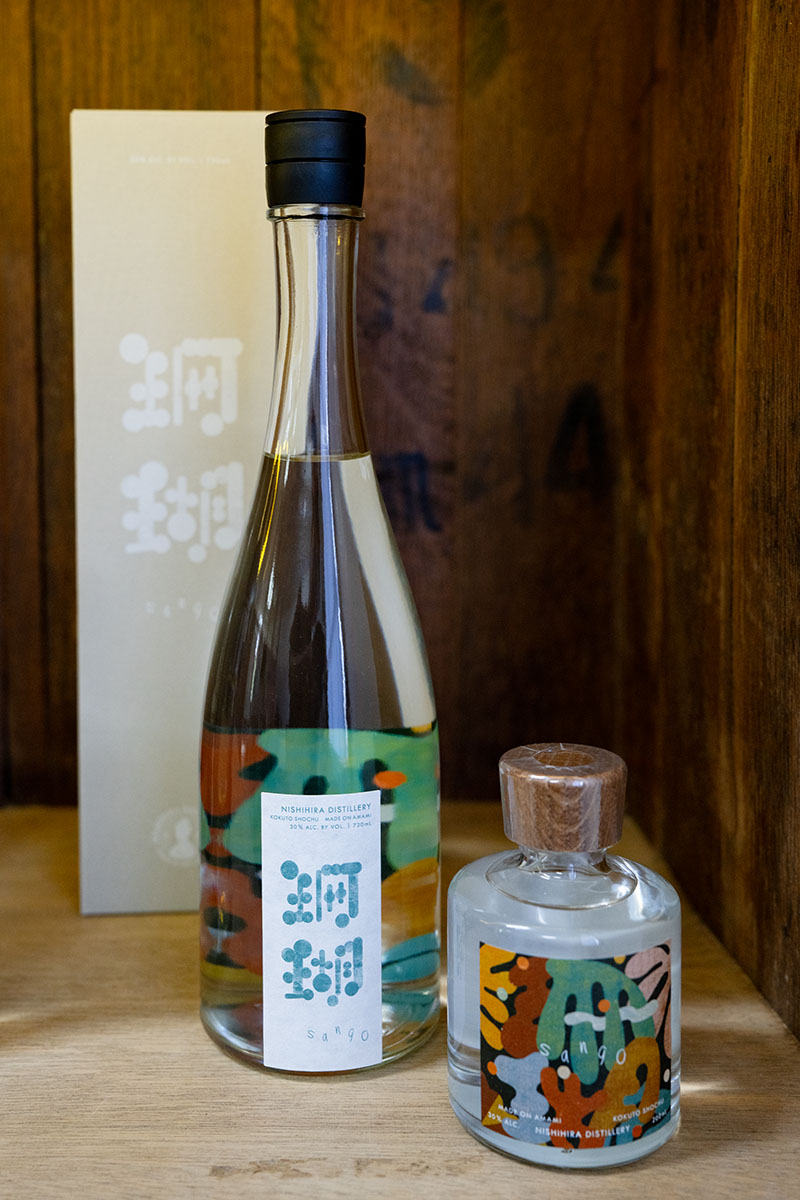
The main brand since the brewery's founding is "Sango" (Coral). "Sango" is the oldest brand, and it used to have a much stronger flavor. After Mr. Nishihira returned to his hometown, there was a movement to revamp the brewery with the aim of creating something that would be easier for women and young people to drink, so he persuaded the master brewer to improve the flavor to what it is today. The label design was also revamped three years ago. The pop design is appealing.
"Sonic Aging," a brown sugar shochu that matures with music.
One of the most distinctive features of Nishihira Brewery, a company known for its musicians, is its unique initiative called "Sonic Aging." Aging barrels are placed in a dedicated music room, and each barrel is played different genres of music. Six genres were selected: rock, reggae, hip-hop, house, Latin, and Amami island songs. The project explores how the different frequencies and rhythmic vibrations of each genre affect the aged spirit inside the barrel, influencing its maturation and flavor.
Instead of simply marketing it as "sake aged while listening to music," they've commercialized six different varieties. There's sake aged while listening to Okinawan folk songs, sake aged while listening to rock music, and more. You can compare them side-by-side and experience the differences in aroma, color, texture, and flavor with your own palate.
Nishihira Brewery's motto is "Brew like you create music, and communicate like you play it." "Sonic Aging" is the result of linking their two unique characteristics—music and sake brewing—not just as an image, but as an actual part of their sake production process.
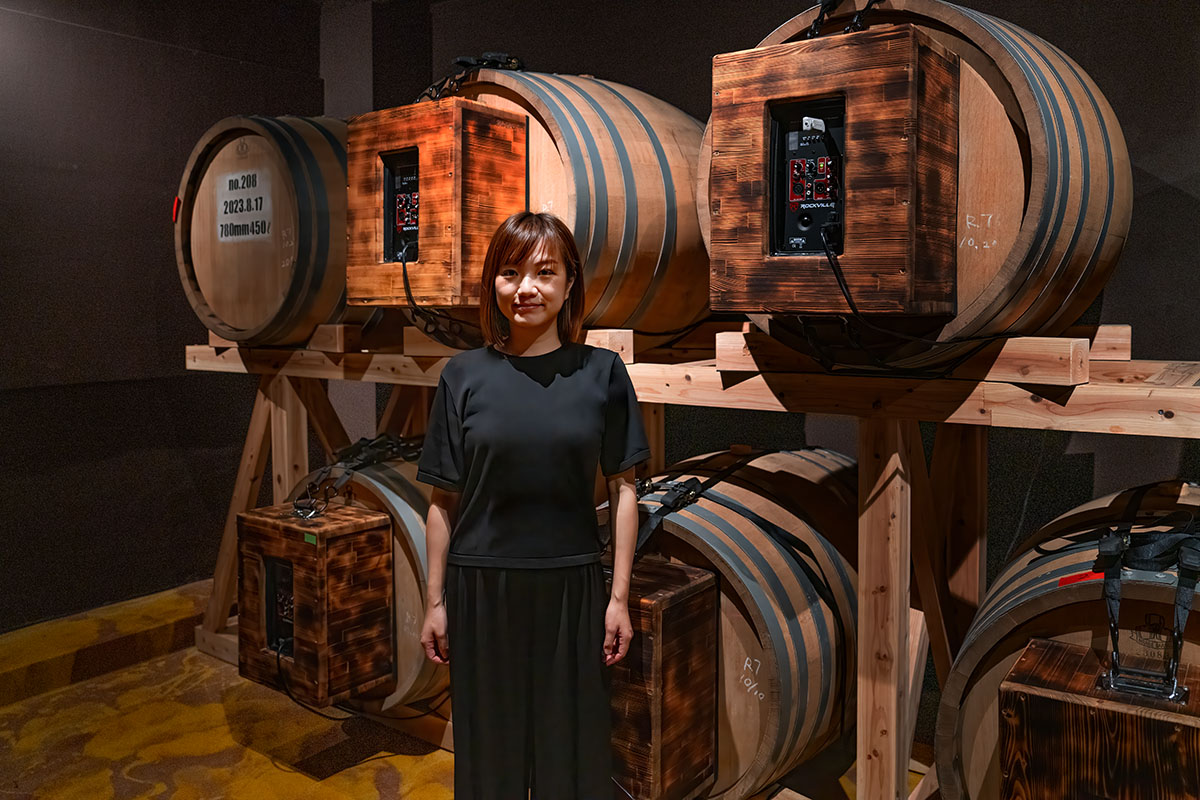
Serena Nishihira gives us a tour of the storehouse, which is currently undergoing sonic aging. The key person behind the idea of incorporating music was John, an Australian who was on the staff at the time. As for the speakers (hardware) that are actually used, she consulted with an engineer friend who lives on the island and had him make them for them.
I want the people of the island to know about brown sugar shochu first.
One of the things Nishihira Brewery is currently focusing on is brewery tours. Initially, they started these tours to introduce brown sugar shochu to visitors from outside the island, but surprisingly, many locals have participated. In particular, many younger generations are not very familiar with what brown sugar shochu is.
Therefore, they increased the number of tours to allow local people to learn about the sake brewed in their own land. By letting people see the brewing process firsthand and suggesting various ways to enjoy the sake, they hope to make brown sugar shochu feel more familiar to them.
Mr. Nishihira's gaze extends beyond the sake brewery.
"Eventually, I'd like to create a local information magazine. I envision it as a medium to archive stories and information about shops in Yanigawa, and to pass on the history and culture of the region."
Rather than simply continuing to produce, they are starting by raising awareness. At the heart of Nishihira Brewery's new endeavor is the desire to pass on the culture of brown sugar shochu, a product of Amami, to the next generation of islanders.
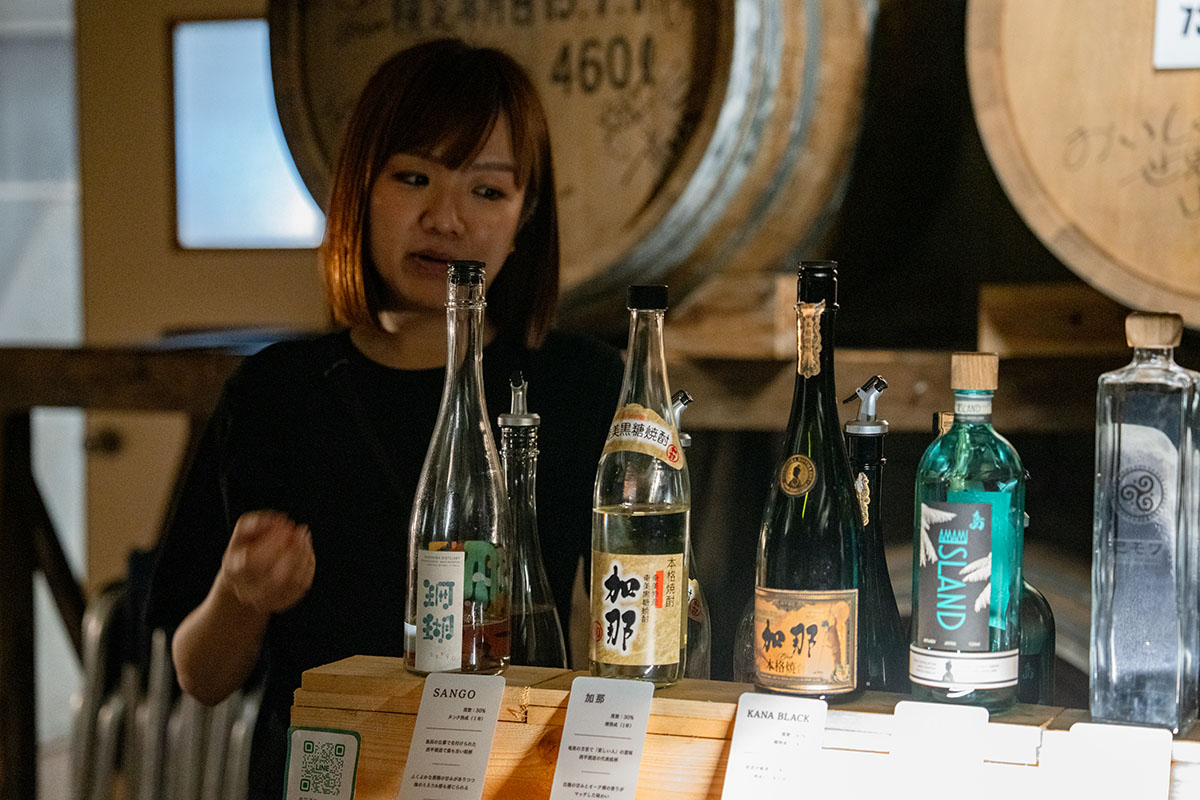
Along with long-established brands such as "Sango" and "Kana," Nishihira Brewery continues to challenge itself with new brown sugar shochu production.
Nishihira Sake Brewery Co., Ltd.
11-21 Omata-cho, Naze, Amami City, Kagoshima Prefecture
Brewery tours require reservations and cost 2,500 yen, including a souvenir.
0997-52-0171
"stay"Tidamoon, surrounded by the nature and culture of Amami.
The place I chose to stay was "Tidamoon," located about 10 minutes by car from Amami Airport, facing the Pacific Ocean. The blue sea stretches out before you, and in the distance, a rock called "Tachigami" floats. In Amami, it has long been believed that "Neriyakanaya," the dwelling place of the gods of fertility, lies beyond the sea. Tachigami has been considered a guidepost for the gods coming from there, and is deeply intertwined with the island's faith.
The hotel's name is a combination of "Tida," the Amami dialect word for sun, and the English word "MOON." The sun, the moon, the sea, and Tatekami. Just being at the hotel allows you to feel close to Amami's nature and the island's culture that lies beneath it. As the owner is a weaver of Oshima Tsumugi silk, the hotel also houses the "Oshima Tsumugi Museum." You can also enjoy dishes made with local island ingredients. Staying there itself becomes a time to experience Amami's culture. That's the kind of hotel it is.
Two suites overlooking the Pacific Ocean

Tidamoon has a total of 23 guest rooms, six of which are suites. Among them, "Gin" and "En," which face the Pacific Ocean, are particularly impressive suites, each offering a spacious 66 square meters and stunning ocean views.
The theme of "Clothing," as the name suggests, is Oshima Tsumugi silk. Oshima Tsumugi is incorporated throughout the room, creating an environment where it can be felt close at hand. Beyond the calming color scheme of the room, a large window opens up, offering a view of the Pacific Ocean. Guests can spend their time watching the sea and sky change color moment by moment from the comfort of their room.
The most striking feature of this room is the bathroom. The bathtub is situated in a space that opens onto the ocean, allowing you to enjoy a panoramic view of the Pacific Ocean while soaking in the water. In the morning, you can watch the sun rise over the horizon, and at night, you can gaze upon the ocean illuminated by moonlight while you bathe—a truly unique experience.
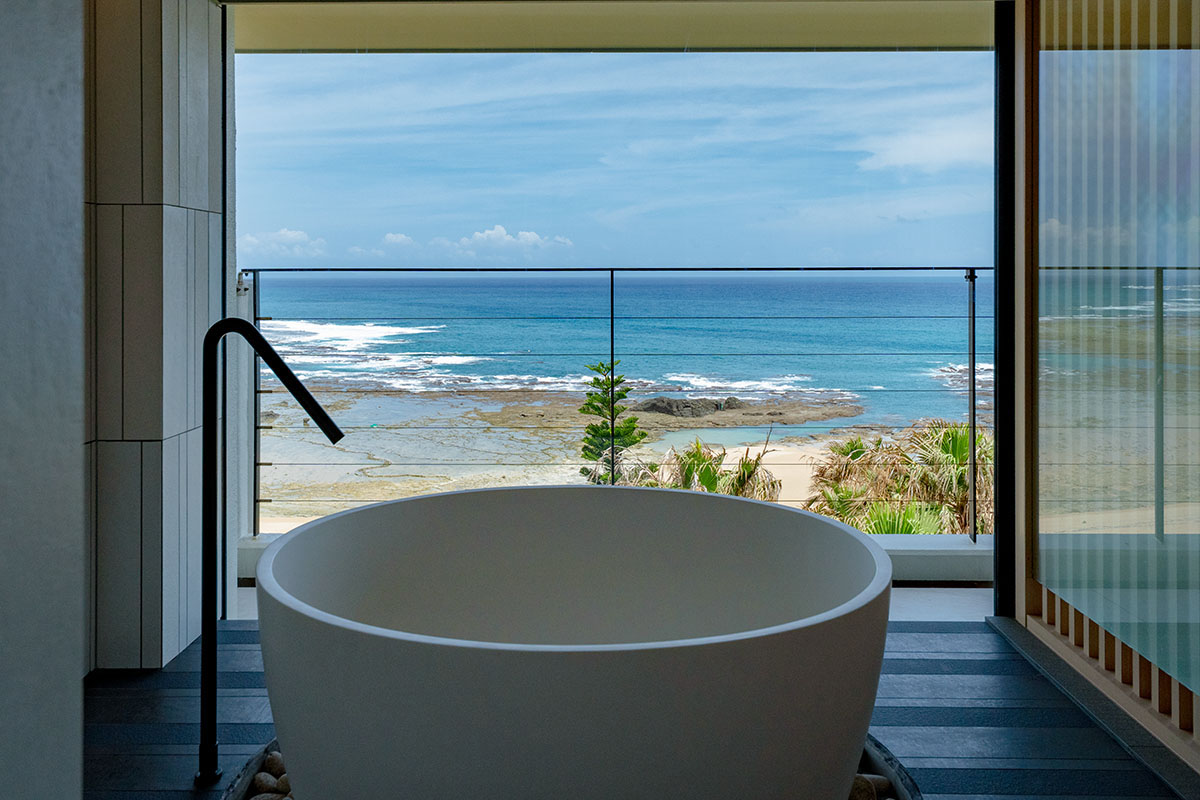
The bathroom at "Gin" offers a view of Kikaijima Island across the vast Pacific Ocean.
Another "connection" is the corner room facing the Pacific Ocean. Kikaijima Island can be seen beyond the window, and Tatekami Island in the distance. The interior is extremely simple, and a large glass window leads to a spacious terrace. You can do yoga while basking in the morning sun, or sit in a chair and gaze at the sea. It makes you want to enjoy doing nothing and not pack your schedule just because you're on vacation.
The defining feature of this room is its minimalist interior. There's no television, deliberately omitted. All you need to see in this room is the ever-changing sea and sky throughout the day. The dazzling brilliance of the slowly rising sun, the magic hour that appears for a short time in the evening, and at night, the "moonlit path" that stretches across the sea like a ribbon of moonlight—Amami Oshima's nature provides everything you need to see.
"Koromo" and "En," though different in style, share one thing in common: the vast expanse of Amami's ocean stretching across the windows. Step out onto the terrace, feel the sea breeze, and enjoy a bath while gazing at the ocean. Spend a day in this room without any plans. It's a suite you'll want to stay in just for that reason.
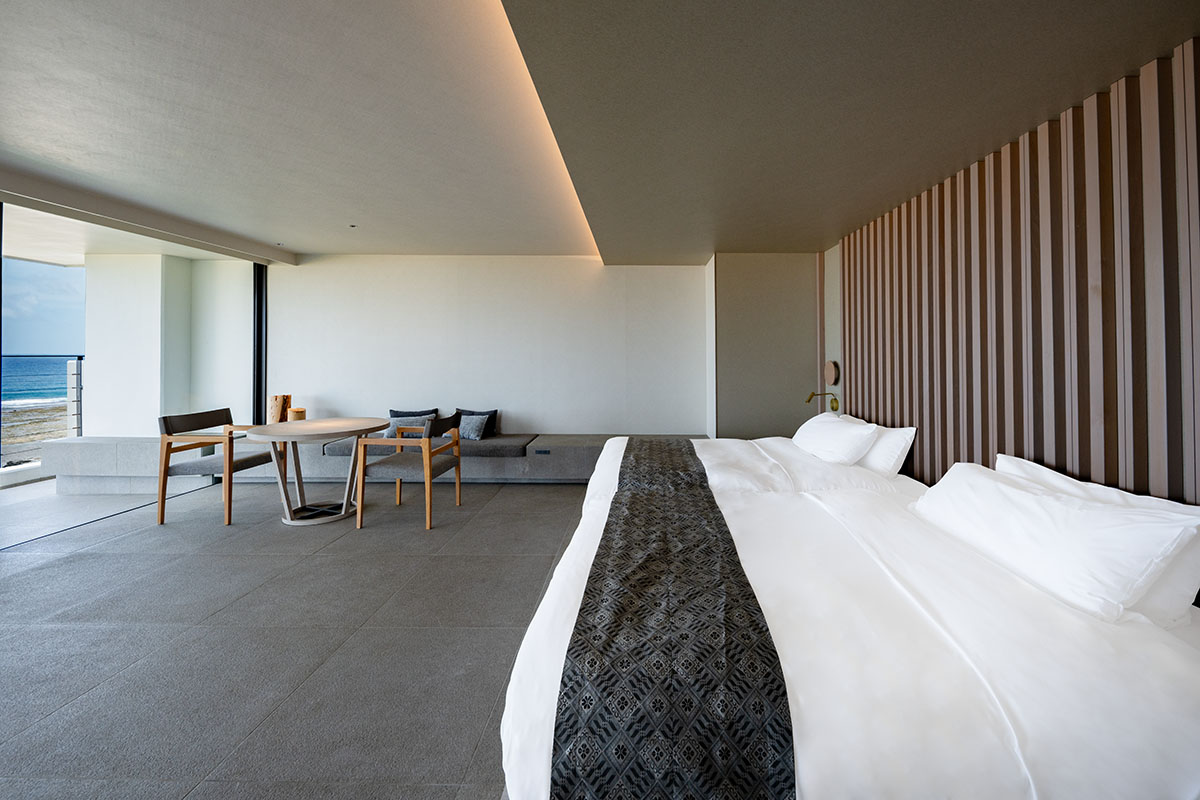
A minimalist interior that soothes the soul, and the sea and sky. Here, you'll find time to heal both mind and body.
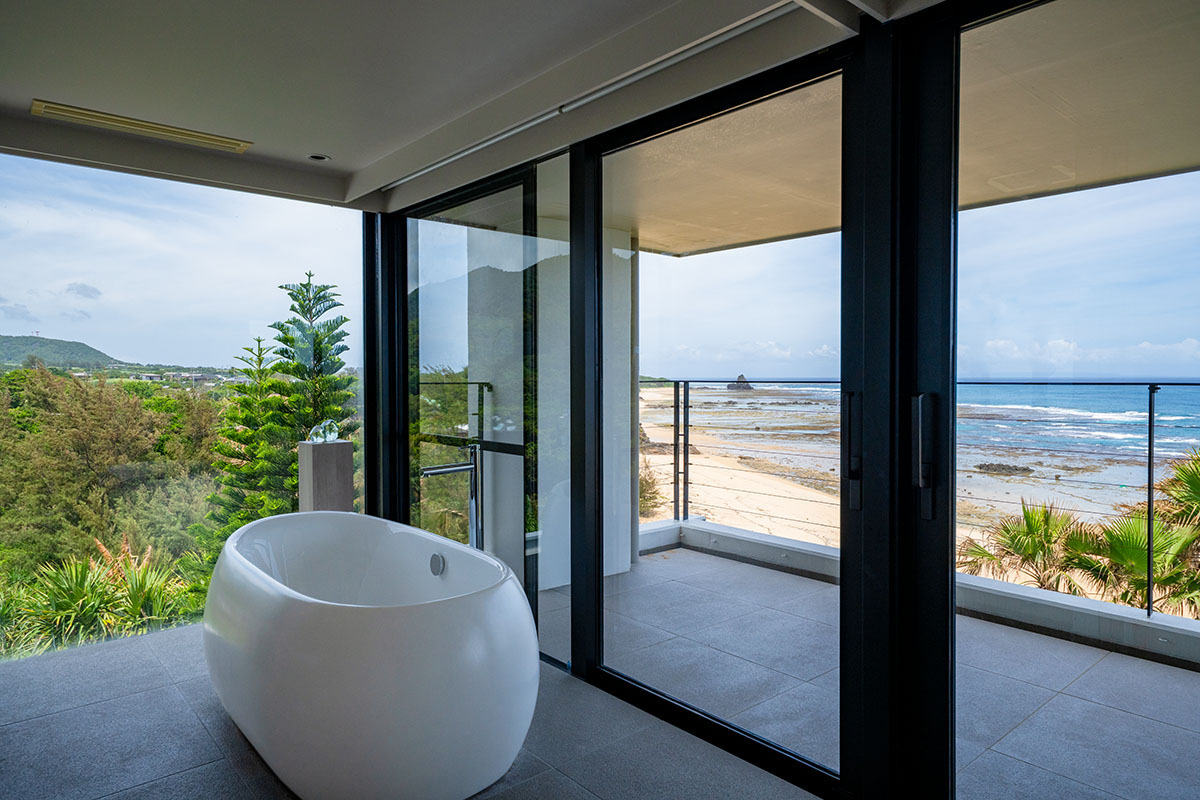
The interview took place during a new moon. The low tide made it look just like Mont Saint-Michel. From the bathroom, you can see a rock called "Tachigami," which gives off a spiritual vibe.
Experience the beauty of Oshima Tsumugi up close. Oshima Tsumugi Museum
When discussing Tidamoon, Oshima Tsumugi silk is an essential element. The owner is an Oshima Tsumugi weaver and continues to weave Oshima Tsumugi silk to this day. The "Oshima Tsumugi Museum" within the building houses a collection of Oshima Tsumugi ranging from historical pieces to modern designs, including precious works with the same patterns as those presented to the Imperial Family.
Furthermore, the exhibition features original drawings by Tanaka Isson, a Japanese painter who continuously depicted the nature of Amami, as well as works that express those drawings using Oshima Tsumugi silk, items that can only be seen here. The Oshima Tsumugi, which expresses the world of painting through dyeing and weaving, will amaze you with its meticulous detail and dramatic colors the closer you look at it.
Stay at Tidamoon and experience Oshima Tsumugi silk from various eras and styles at the Oshima Tsumugi Museum. Because the hotel is run by a weaving company, you can feel closer to Oshima Tsumugi during your stay.
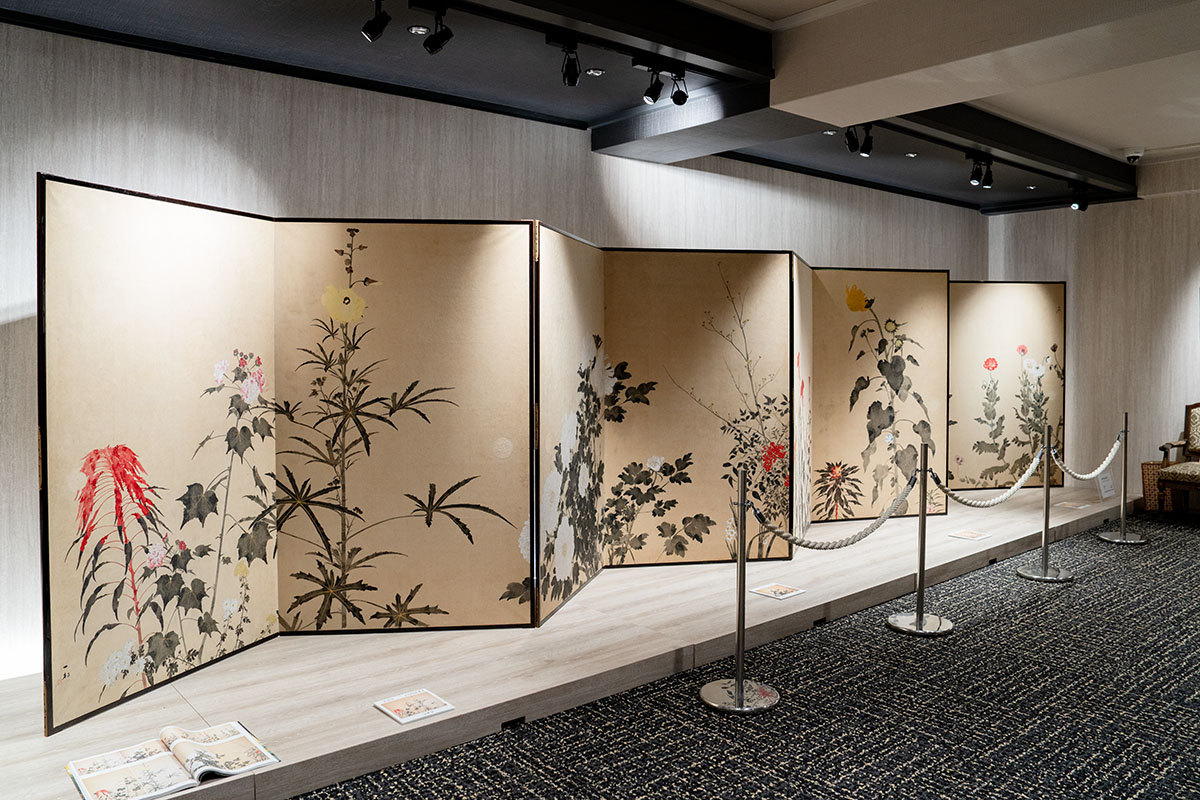
Immediately upon entering, you'll find a folding screen painting by Tanaka Isson, a writer who loved Amami Oshima. The eight-panel screen, a pair of screens, is truly impressive, capturing the vitality of Amami's plants.
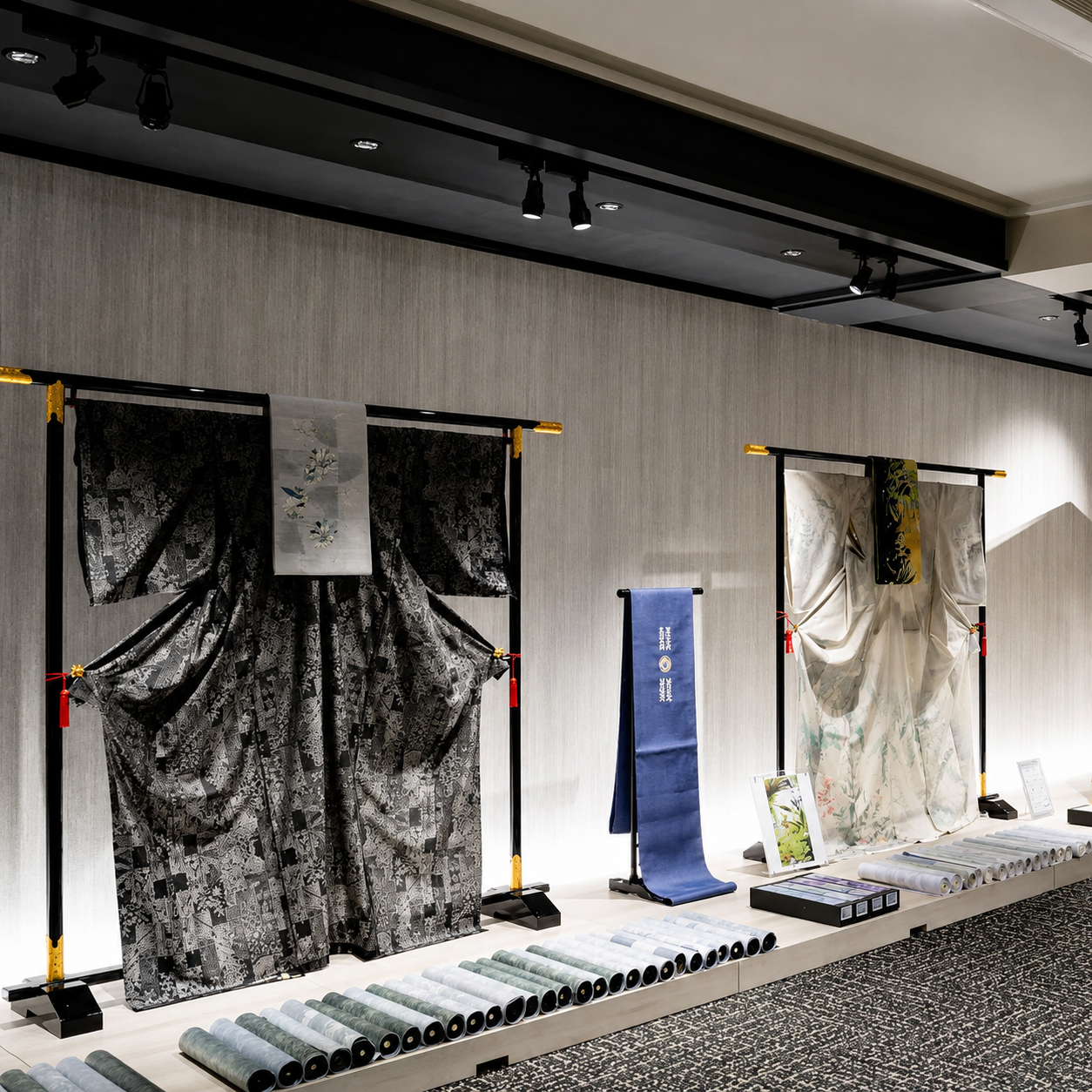
The exhibition features magnificent works by a weaver of Oshima Tsumugi silk, allowing visitors to fully appreciate the charm of Oshima Tsumugi. As the only weaver that can weave Tanaka Isson's paintings into kimono patterns, the exhibition also showcases many innovative works that completely redefine the traditional image of Oshima Tsumugi.
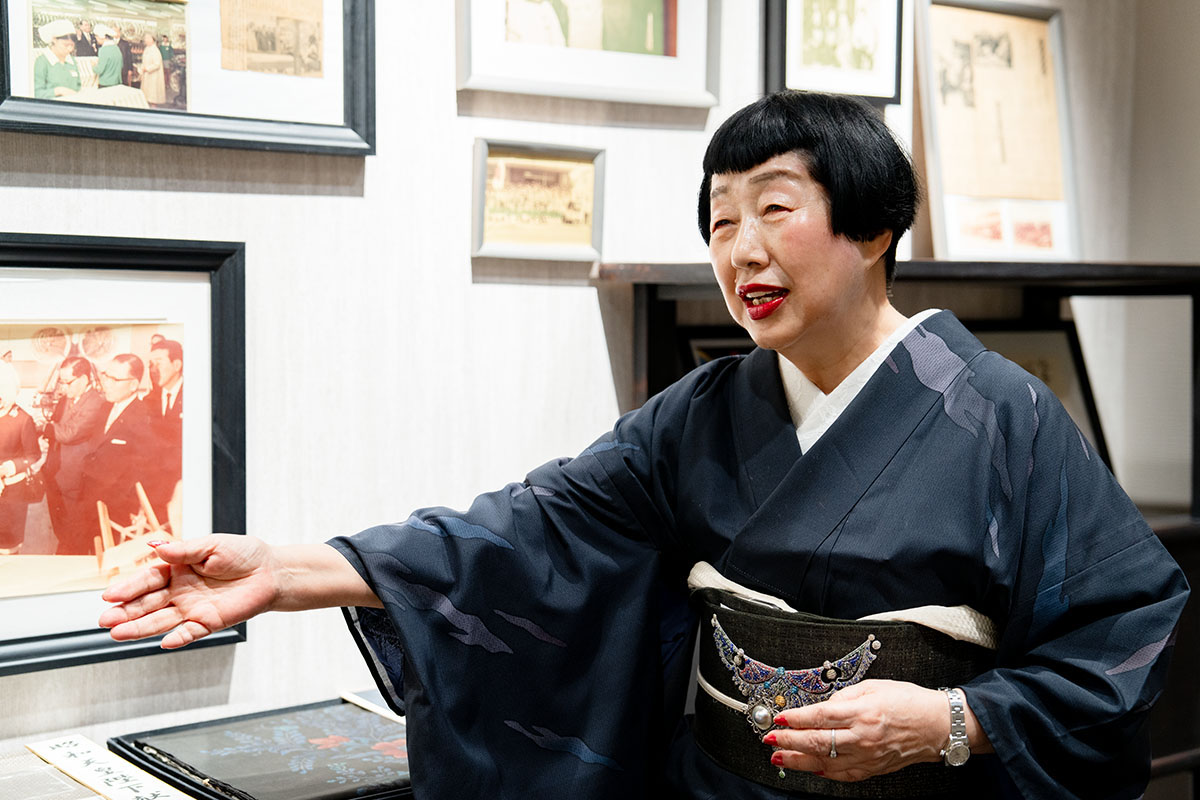
Reiko Hoshika of the Oshima Tsumugi Museum is a kimono expert. She'll teach you the joys of wearing kimonos in a friendly and easy-to-understand way.
Hotel Tidamoon
1260 Taira, Kasari-cho, Amami City, Kagoshima Prefecture
0997-63-0006
Located inside Tidamoon.
The beautiful sea and forests, the unique culture of the island, and the way of life of its people—Amami Oshima still retains a simple charm that hasn't been overly developed as a tourist destination. By the end of my trip, I had completely fallen in love with its unpretentious comfort. I want to come back again. That's the kind of feeling I got from my trip to Amami Oshima.
The journey to discover the treasures of Kagoshima continues. You can find previous installments of "Southern Treasure Chest: A Journey Through Kagoshima" below.
Click here for the first Kagoshima Tea Journey
Click here for the second Kagoshima Whisky Journey
Photography by Azusa Todoroki (Bowpluskyoto)
Stories
Premium X
A trip around Kagoshima's "treasures"



Premium X
