

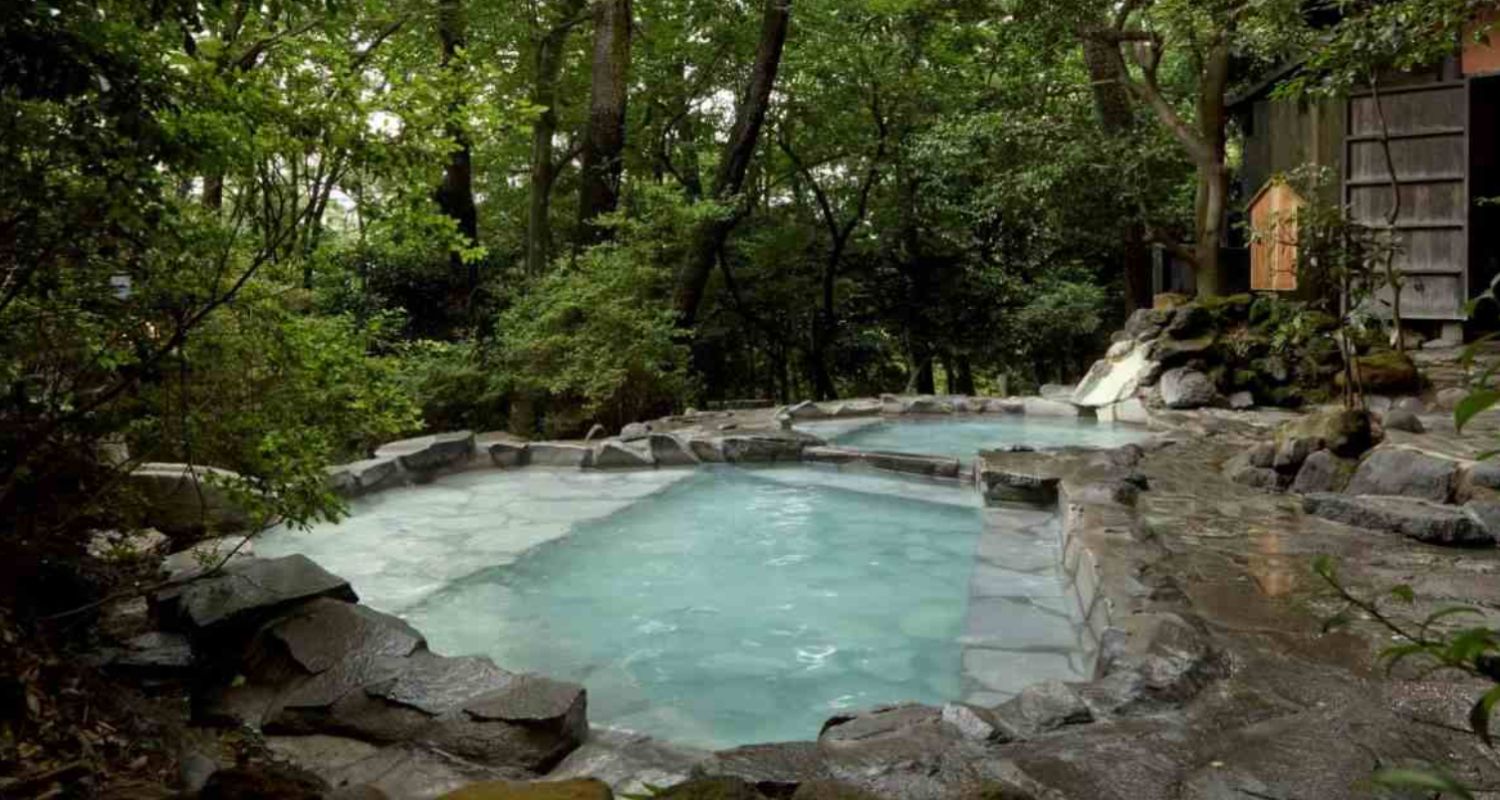
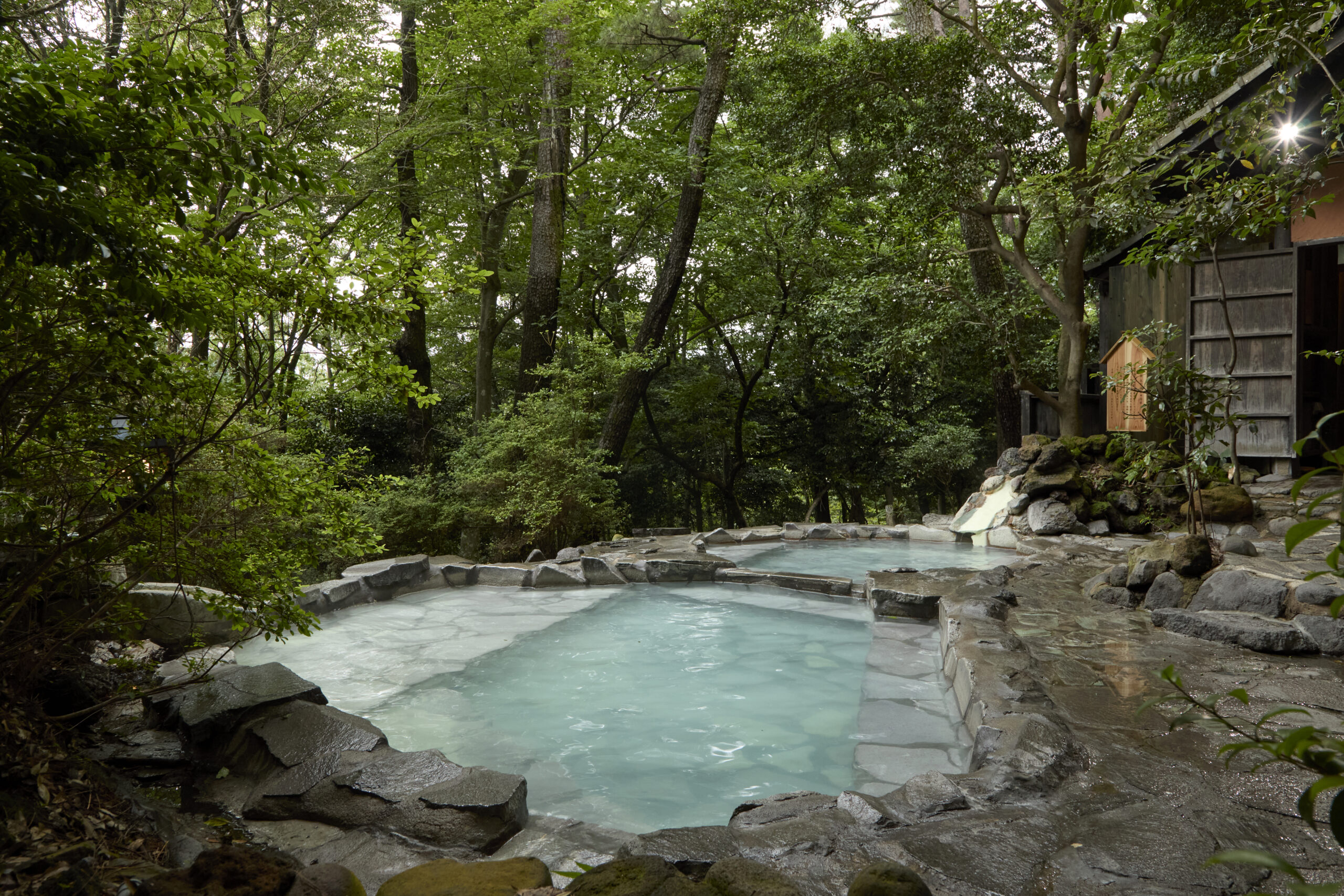
Kagoshima Prefecture is a hot spring prefecture. With the second-highest number of hot spring sources and the second-highest number of hot spring sources with a temperature of 42 degrees Celsius or higher in the country, and the third-highest total amount of hot spring water, it is no exaggeration to say that it is one of the leading hot spring areas in Japan. (Announced in 2023 by the Japan Hot Spring Association) One example of its abundance is that most public bathhouses in Kagoshima City use natural hot spring water. Most public bathhouses use hot spring water! Such an enviable thing is commonplace in Kagoshima, the hot spring prefecture. Abundant hot springs. It is truly Kagoshima's proud "treasure chest of the south."
Not only within the city, but also throughout the prefecture, there are many hot spring resorts and inns, each with its own unique style that attracts many hot spring enthusiasts. From among these inns, we will introduce "Wasure no Sato Gajōen" in Myōken Onsen, "Ryōkojin Sansō" in Kirishima Onsen, and "Ibusuki Hakusuikan" and "Ibusuki Shūsuien" in Ibusuki Onsen. Surrounded by lush forests, "Wasure no Sato Gajōen" and "Ryōkojin Sansō" can be described as "mountain hot springs," while "Ibusuki Hakusuikan" and "Ibusuki Shūsuien," overlooking Kinkō Bay, can be described as "sea hot springs."
- ・ Myoken Onsen "Wasure no Sato Gajyoen": A pristine Japanese mountain village landscape that feels like stepping back in time.
- ・ Kirishima Onsen "Ryokojin Sanso": Three open-air baths surrounded by primeval forest known as a power spot.
- ・ Ibusuki Onsen "Ibusuki Hakusuikan" is more like a "hot spring resort hotel" than a traditional inn, offering a sense of openness and freedom.
- ・ Ibusuki Onsen "Ibusuki Shusui-en": A hot spring inn where you are greeted by a Japanese house reminiscent of sukiya architecture.
Myoken Onsen "Wasure no Sato Gajyoen": A pristine Japanese mountain village landscape that feels like a time slip.
Let's start with "mountain hot springs." It's less than a 30-minute drive from Kagoshima Airport. Along the Amori River, which originates from Mount Kunimi and flows into Kinko Bay, there are several old hot spring resorts.
One such place is Myoken Onsen. About ten hot spring inns line the clear stream. In this hot spring town that retains the atmosphere of a rustic therapeutic hot spring resort, there is one inn that stands out and attracts attention not only from Japan but from all over the world. That is Wasure no Sato Gajyoen.
Leaving the national highway, we drove a short distance down a slope that led towards the Tenkawa River.
At first, you might be surprised and wonder, "Where's the inn?" That's because you can't really see anything resembling an inn building from the parking lot surrounded by trees. As you are guided up the stone steps by a staff member...
The eaves of thatched roofs come into view, and at the end of the narrow, lushly overgrown alley, only thatched roofs remain. It's a scene that evokes a sense of nostalgia, yet it's a quintessential image of a mountain village, a sight that has almost disappeared from Japan today. It gives you the feeling of having traveled back in time decades, or even more than a century.
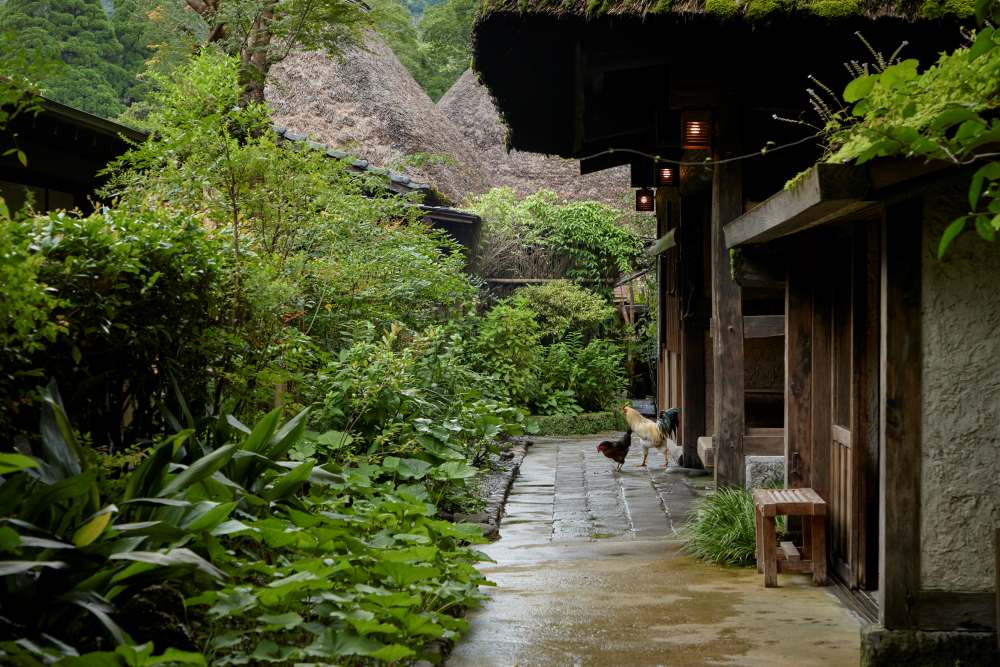
The view that appears after climbing the stone steps: a thatched roof visible beyond the trees. Sometimes, free-roaming chickens even greet you.
A pioneer in Japan, being the first to incorporate private open-air baths into guest rooms.
"Wasure no Sato Gajōen" was founded in 1970. At a time when large hot spring inns catering to group tourists were the norm, the owner, Takeo Tajima, decided to start as a small hot spring inn with only six rooms, based on his convictions. Eventually, he purchased an old farmhouse and relocated it to the inn's grounds.
Gathered around a traditional Japanese hearth, meals centered on home-grown chicken and vegetables. This style, which offered a taste of simple, old-fashioned Japan—something no other inn was doing at the time—became popular among travelers.
Next, in 53, Mr. Tajima introduced private open-air baths in the guest rooms. While private open-air baths are commonplace today, at the time they were the only ones of their kind in Japan. "Wasure no Sato Gajōen" can truly be called a pioneer, having created one of the forms of high-end hot spring inns in Japan that has now become the standard.
There are a total of eight guest rooms. Three of them are rooms with open-air baths, which are the symbol of the inn. In addition, five rooms have been converted from rooms with private open-air baths into "bath living rooms" by adding roofs and walls to the space that was previously used for the private open-air baths, allowing guests to enjoy the hot springs in any weather as if they were relaxing in a living room. Wasure no Sato Gajyoen was known as a pioneer of guest rooms with open-air baths, but the renovations were undertaken with the aim of creating an even more comfortable and unique hot spring inn.
The Japanese-style suite "Sora" offers a sense of liberation as if becoming one with the forest, and features a semi-open-air indoor bath and an open-air bath on the veranda.
The Japanese-style suite "Sora" boasts a spacious 27-tatami mat area. It's incredibly large. With floor-to-ceiling glass windows on two sides facing the river, the sense of openness is extraordinary. You feel as if you're becoming one with the forest while you're there.
This "sky" features two baths: a semi-open-air indoor bath and an open-air bath located on the veranda. As you soak in the water, surrounded by lush trees and the gentle murmur of the stream, you can feel your body slowly unwinding.
The hot springs at "Wasure no Sato Gajōen" are 100% pure, free-flowing natural spring water. Two springs on the property are blended, and in the summer, groundwater is added to maintain the appropriate temperature for each season, supplying the hot spring water to each room.
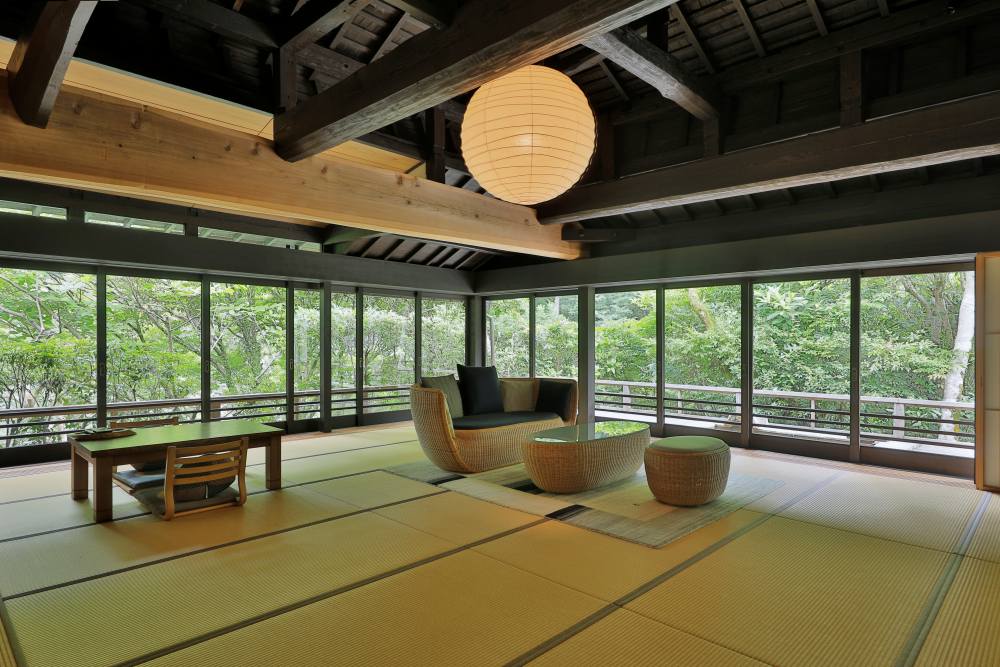
By renovating two guest rooms and combining them into one, a vast 27-tatami mat space was created. The Tenkōgawa River flows just below the window.
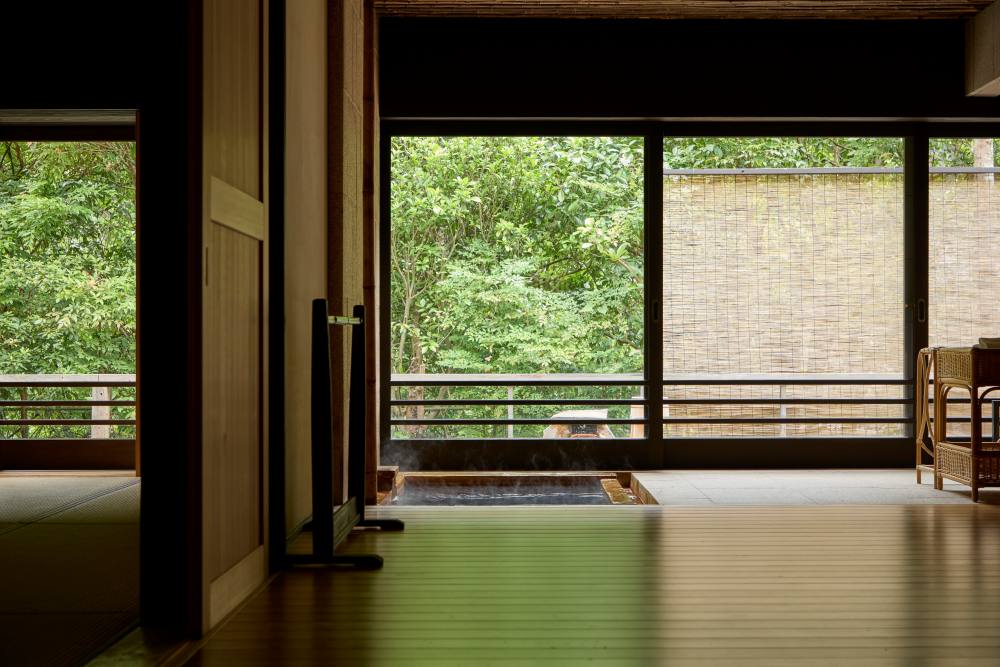
A semi-open-air indoor bath is located, separated from the tatami room by a wall. There is also an open-air bath on the veranda. With both an open-air and a semi-open-air indoor bath, it's fun to choose between the two baths depending on the weather and time of day.
Embrace the earth and be enveloped in the blessings of nature in two rustic, private baths.
It's not just the baths in the guest rooms that are wonderful. In the two private baths located along the Tenkawa River, you can enjoy 100% free-flowing hot spring water from the source of Myoken Onsen, a hot spring resort that has long been famous for its therapeutic properties.
One of the inn's symbols is the bath named "Takeruyu." This "Takeruyu" bathtub, made from a massive 20-ton rock, is an impressive creation that Mr. Tajima and the stonemasons spent six months carving out from a single rock.
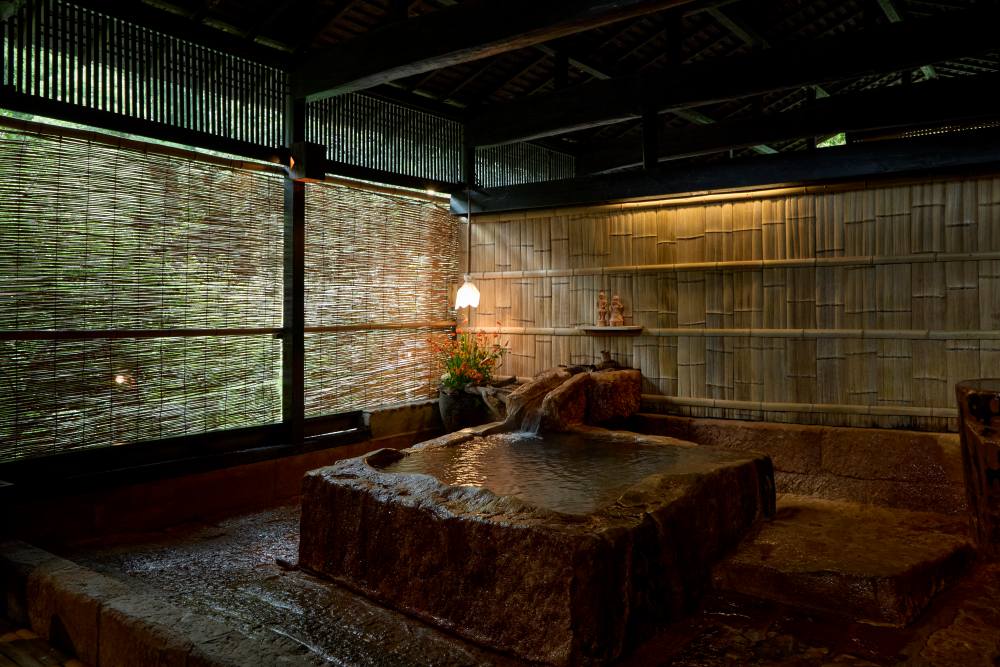
"Tateyu" has two bathhouses, both featuring bathtubs carved out of rock that exude an overwhelming presence. The photo shows the bathhouse used as the women's bath when visitors come for a day trip.
Further inside, the "Ramune Bath" lives up to its name, with bubbles rising from the bottom. This is because the hot spring water used in this bath contains a particularly high amount of carbon dioxide.
The endless stream of bubbles rising one after another evokes the breath of the earth, making you truly appreciate that the spring water at "Wasure no Sato Gajyoen" is a bicarbonate spring. Furthermore, the sodium bicarbonate dissolved in the water leaves your skin smooth after bathing, making it truly a "beauty spring."
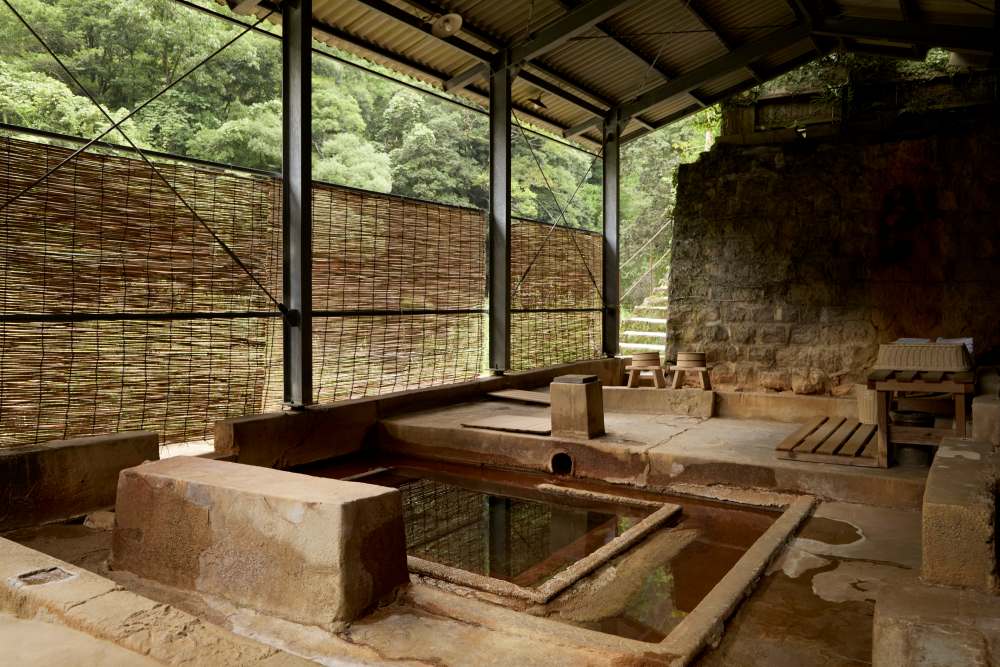
"Ramune no Yu" features two baths: one with only slightly lukewarm, naturally flowing bicarbonate spring water, and another where the spring water is blended with another high-temperature spring water to achieve a comfortable temperature of nearly 40 degrees Celsius.
While the baths in the guest rooms have a rather modern feel, "Tateyu" and "Ramune-yu" are full of rustic charm, giving you a sense of experiencing the ancient Earth and being healed by the blessings of nature. During the day (12:00 to 15:00), they are used for day-trip bathing, but at other times they are private baths reserved exclusively for overnight guests.
Seasonal Satsuma regional cuisine, mainly using self-sufficient ingredients.
This inn's culinary philosophy, which it has upheld since its founding, is to serve Satsuma regional cuisine using self-sufficient ingredients, primarily vegetables grown in its own garden and chickens sourced from trusted partner farms.
Dinner was served in the "Icho Room" dining area. The menu began with a sashimi platter and a seasonal vegetable assortment. Particularly noteworthy was the chicken sashimi made with Kirishima chicken. Because the chicken was so fresh, it was possible to serve it as sashimi, and the various parts of the chicken, including the thigh, tenderloin, and breast, released a rich flavor that spread throughout the mouth with every bite.
The incredibly fresh vegetables are, of course, organically grown. The savory flavor of the vegetables is further enhanced when served with a meat miso made from slowly sautéed ground Satsuma pork. The dishes skillfully utilize ingredients unique to Kagoshima, such as satsuma-age (fried fish cake), natural sweetfish caught in the Tenkawa River during the summer, and Satsuma Black Beef. You'll truly experience how delicious and comforting natural ingredients can be.
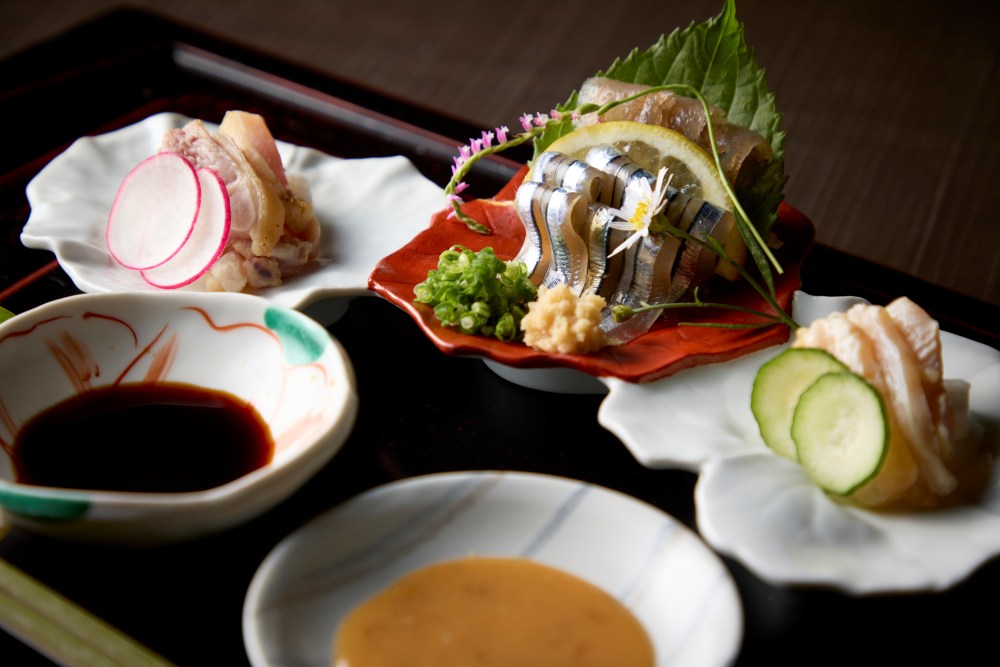
Enjoy our carefully prepared chicken sashimi and kibinago, a symbol of Kagoshima's seafood. Savor it with either vinegared miso or soy sauce, whichever you prefer.
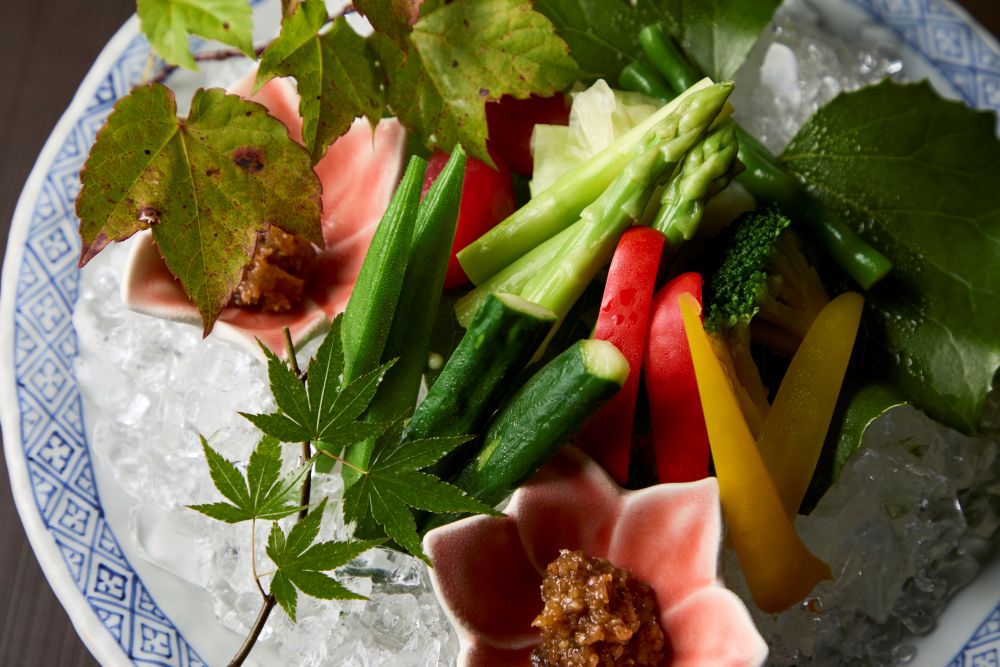
Freshly picked vegetables from our own farm are served with pork and miso. You'll be surprised at how rich and flavorful the vegetables themselves can be.

This local chicken hot pot features a broth made by simmering chicken bones for about three hours, to which bone-in chicken pieces, meatballs, and "dago," a specialty of Satsuma made from sweet potato starch, are added. It's sure to warm you up.
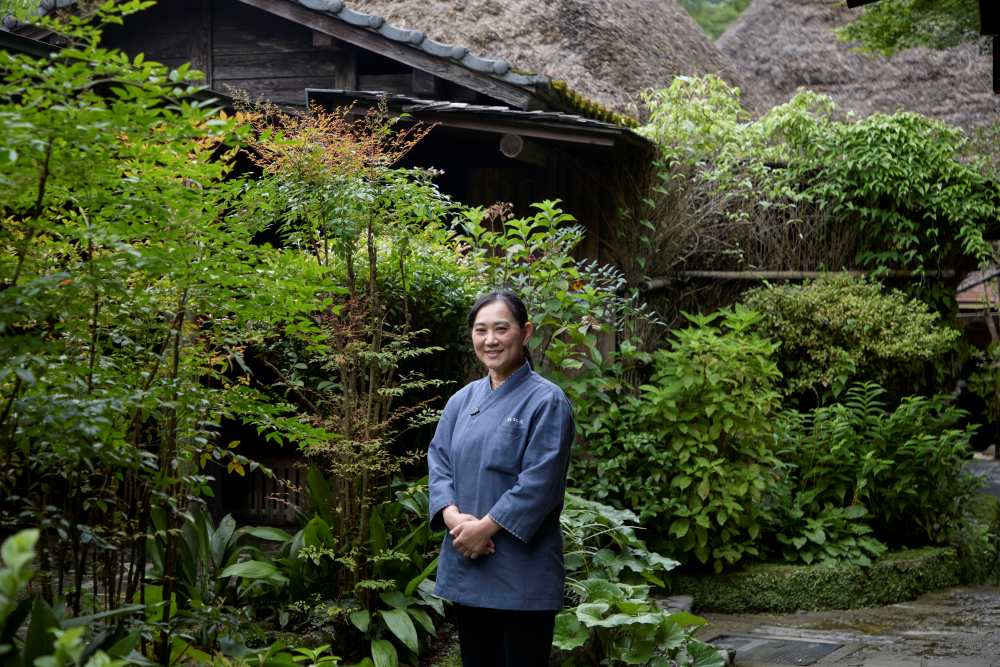
The young proprietress, Emiko Yamazaki, is Mr. Tajima's second daughter. She runs the inn together with her husband, Junichi Yamazaki, who is the head chef.
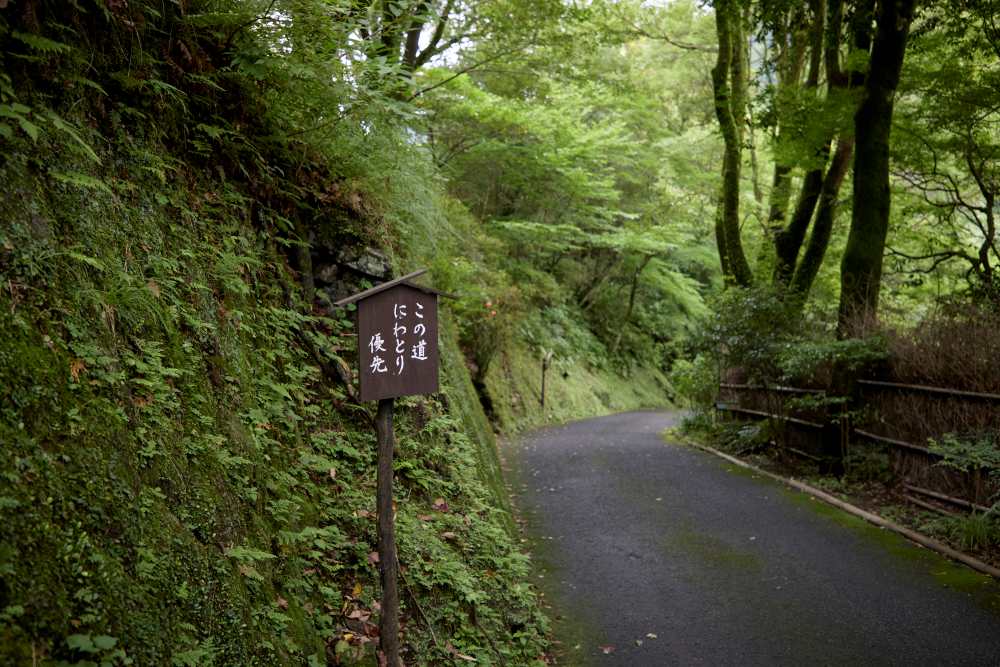
"Chickens have priority on this road."
It's not ostentatious at all. Weeds even grow on the thatched roof. But the warm thoughtfulness extends to every corner, and when you feel the gentle atmosphere flowing through the alley, you're struck by its simplicity and want to return again and again. That's "Wasure no Sato Gajōen."
On the road leading down from the national highway to the inn, there is a sign that reads, "Chickens have priority on this road." This phrase symbolizes the gentle and peaceful atmosphere that permeates the inn, soothing both mind and body.
Myoken Onsenkyo, Makizono-cho, Kirishima City, Kagoshima Prefecture
0995-77-2114
Kirishima Onsen "Ryokojin Sanso": Three open-air baths surrounded by primeval forest known as a power spot.
Located on a hill approximately 700 meters above sea level, Ryokojin Sanso offers guests the magnificent view of Sakurajima floating in Kinko Bay from every room on clear days. The inn is surrounded by approximately 50,000 tsubo (about 165,000 square meters) of primeval forest, and in addition to the large public bath located inside the building, it boasts three open-air baths nestled within the forest.
The primeval forest known as "Tatsuishi no Mori" (Dragon Stone Forest) is also known as one of Kirishima's most powerful spiritual spots. While primarily composed of Japanese red pines, the forest, which is also home to naturally growing sawtooth oaks, beeches, mountain cherry trees, and maple trees, is not overly dense due to the abundance of broad-leaved trees. Rather, the view is not significantly obstructed, and the forest is brimming with vitality.
The three open-air baths nestled within this primeval forest are known for offering the double benefits of hot springs and forest bathing, attracting many repeat visitors, including hot spring enthusiasts.
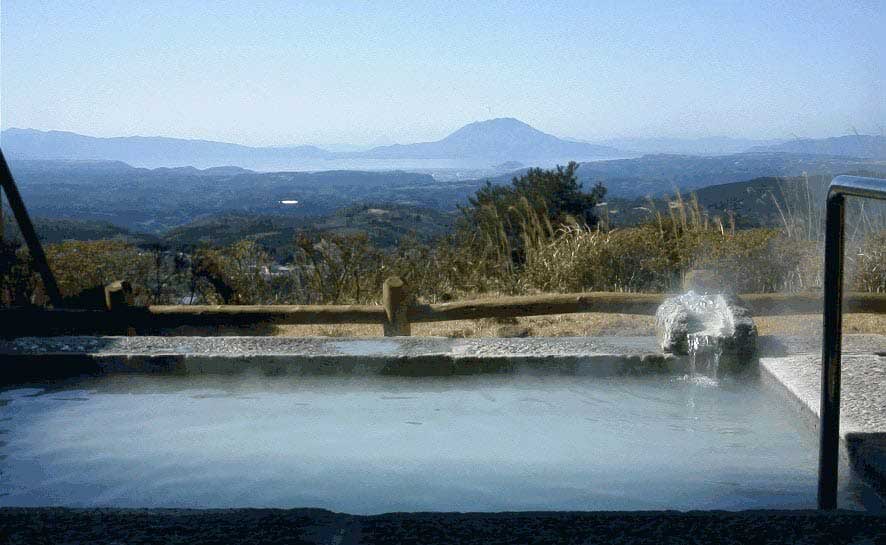
"Kinko no Yu" is an open-air bath attached to the large public bath located inside the hotel. On clear days, you can enjoy bathing while gazing at Sakurajima floating in Kinko Bay. © Ryokojin Sanso
An open-air bath, enveloped in natural aromas.
All three open-air baths are available for private use. Guests can reserve one of the three open-air baths or the semi-open-air bath "Shika no Yu" located inside the hotel, specifying their desired time when making their reservation, and can use it for 45 minutes free of charge.
After receiving the key at the front desk, it's time to head to the open-air bath. We're going to "Akamatsu no Yu," said to be the most popular bath. It's less than a 3-minute walk from the inn. We walk along a private path built into the primeval forest. Our whole bodies are enveloped in a natural aroma, a blend of the scent of damp earth and moss and the refreshing fragrance of the trees.
When the wind blows, you can hear the rustling of leaves in the forest, like a whisper. We arrived at Akamatsu no Yu hot spring. Although we had only walked for a short time, I could already feel my body being healed.
A simple hut nestled in the forest serves as the changing room. This is "Akamatsu no Yu" (Red Pine Hot Spring). From the two baths, you can see the seemingly endless "Ryuseki no Mori" (Dragon Stone Forest). Because the spring water is a simple sulfur spring, white mineral deposits adhere to the bottom and edges of the baths.
The water is a pale cobalt blue, and while the water itself feels smooth, there's a faint smell of sulfur. As you sink into the bath, your line of sight lowers, making the trees seem even closer. Just as the term "forest bathing" suggests, you feel as if you're literally "bathing" in the forest.
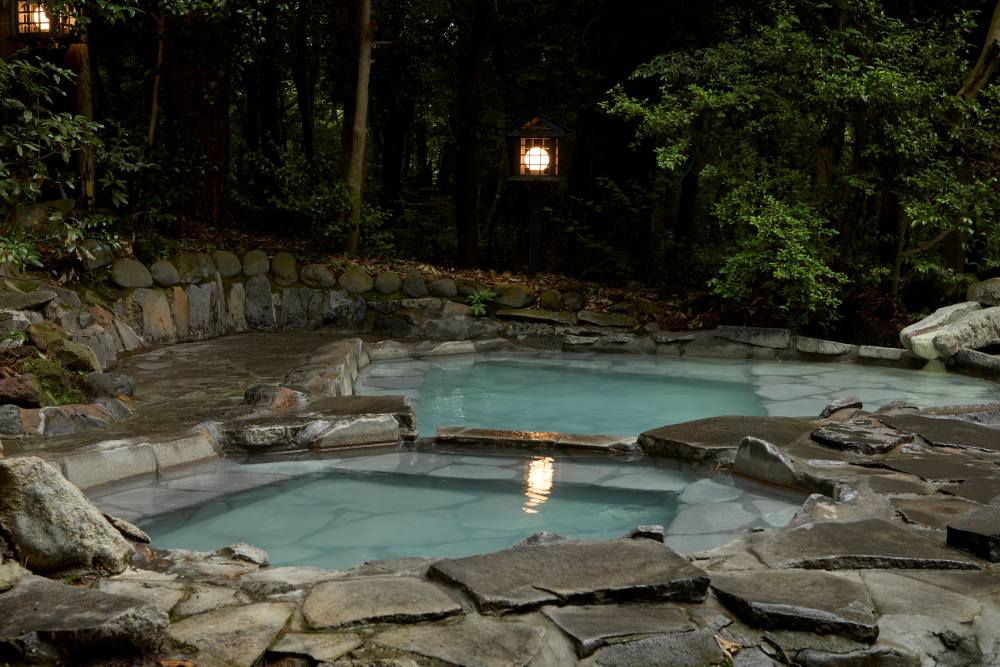
"Akamatsu no Yu" has two bathtubs and is a little larger than the other two open-air baths, so it can accommodate around 8 people.
The reason why "Akamatsu no Yu" is so popular is that it has two baths, allowing a fairly large number of people to enjoy it at once, and above all, because deer that inhabit the primeval forest sometimes make an appearance. The times when you are most likely to encounter deer are early morning or from evening until sunset. The deer are not afraid of people and sometimes come very close to the baths.
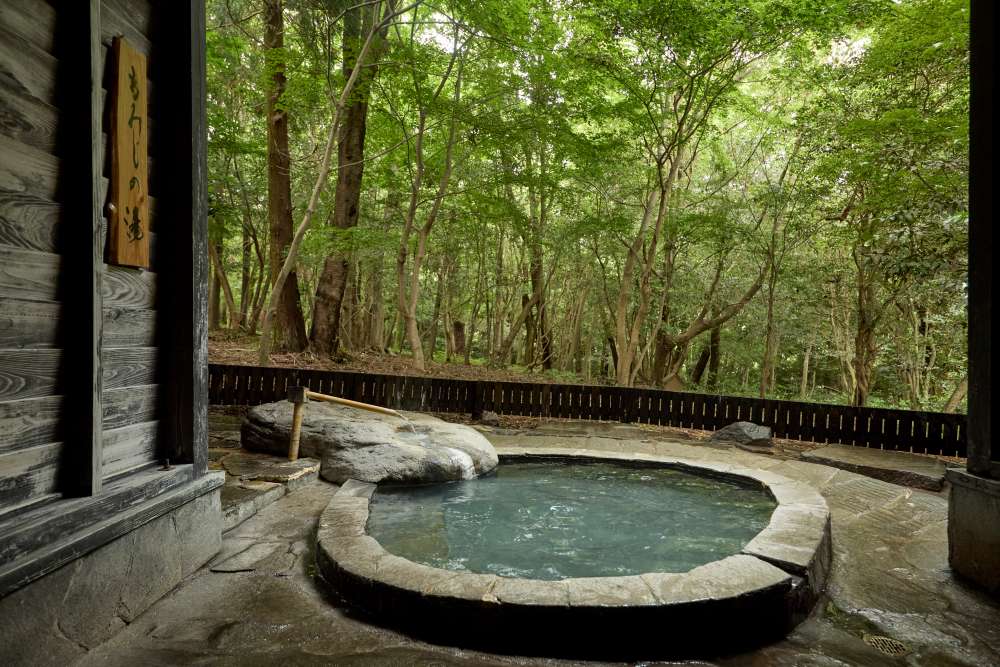
"Momiji no Yu" (Maple Leaf Hot Spring). As the name suggests, the surrounding area is covered in autumn leaves. In autumn, it is dyed a magnificent crimson.
While both "Momiji no Yu" and "Hinoki no Yu" are surrounded by forest, each offers a different atmosphere and view. For a two-day, one-night trip, it's recommended to visit at different times to experience the open-air baths with their distinct atmospheres.
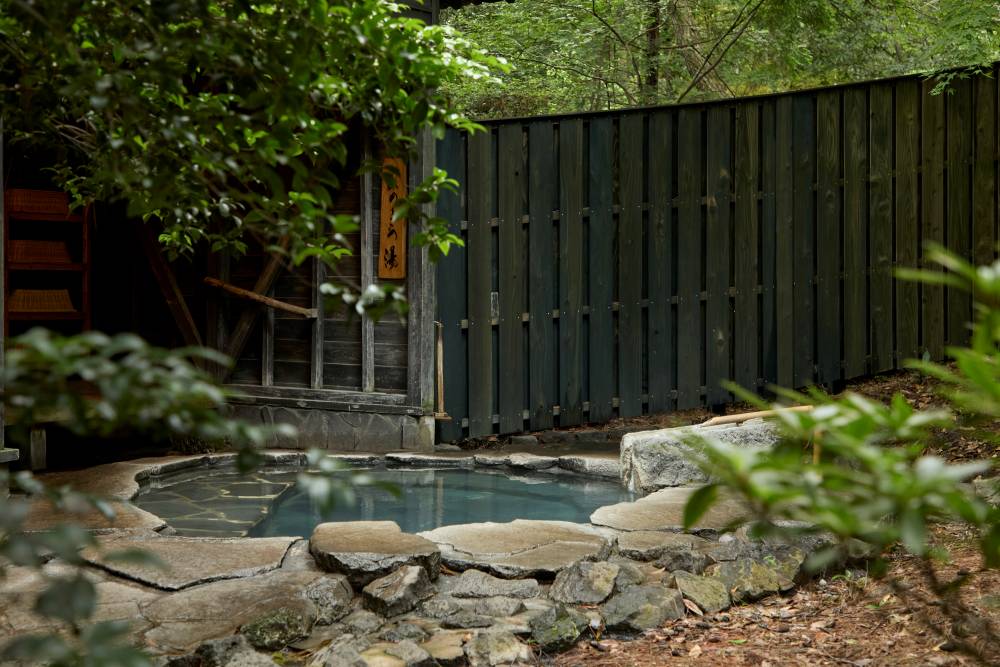
"Hinoki no Yu" (Hinoki Hot Spring). Amenities are provided in the shower area of each open-air bath.
The unique name of the inn originates from a travel magazine that was immensely popular at the time.
"Ryokojin Sanso" (Traveler's Mountain Lodge). This unique name, along with the three open-air baths nestled in the forest, speaks to another distinctive feature of this inn. The inn's predecessor was a hot spring inn founded in 1917 in the nearby Maruo Onsen, which moved to its current location in 1968 and was renamed "Kirishima Prince Hotel." Eventually, in 1997, it changed its name again to "Ryokojin Sanso."
"Ryokojin" is actually the name of a travel magazine. It was run by Jinichi Kuramae, a member of the inn's family, and at one time was even called the "backpacker's bible," but unfortunately it ceased publication. Despite ceasing publication, this name, which was loved by many travelers, was passed down to the present day through a name change in 9.
Surrounded by a vast collection of books numbering in the tens of thousands
Upon entering the "Traveler's Lodge" and proceeding to the back of the lobby, one is struck by the sheer number of books lining the library space and gallery. There are tens of thousands of them.
The library boasts an astonishing scale, far exceeding that of a typical hotel's book corner. It's practically a library, featuring ethnological books from around the world, including Asia, Africa, and Central and South America, as well as travelogues of various genres, and even donated novels and comics.
Furthermore, the collection includes complete works of literary figures who visited the inn during its time as Maruo Onsen, showcasing not only a large number of books but also remarkable quality. The availability of back issues of "Ryokojin" (Traveler), which are now difficult to obtain, is a delight for anyone who once traveled the world with a backpack. Guests are free to browse these books.
Additionally, folk art from Asia and Africa is displayed in a corner of the lobby.
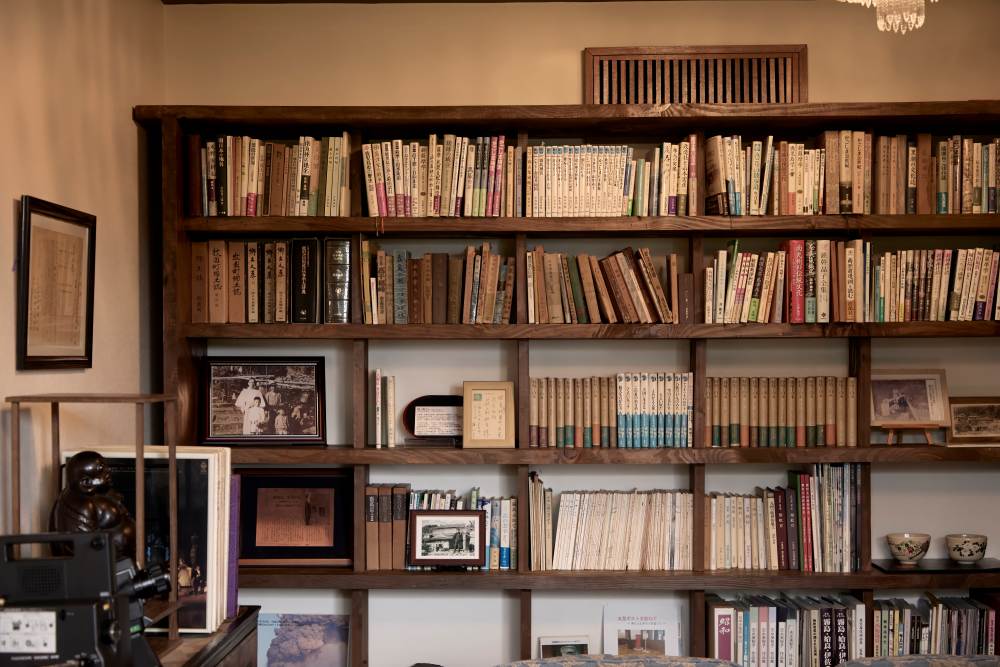
The collection of tens of thousands of books spans a wide range of genres, including novels, travelogues, academic books on folklore, and comics.
A heartfelt dinner served at a restaurant with a spectacular view of Sakurajima.
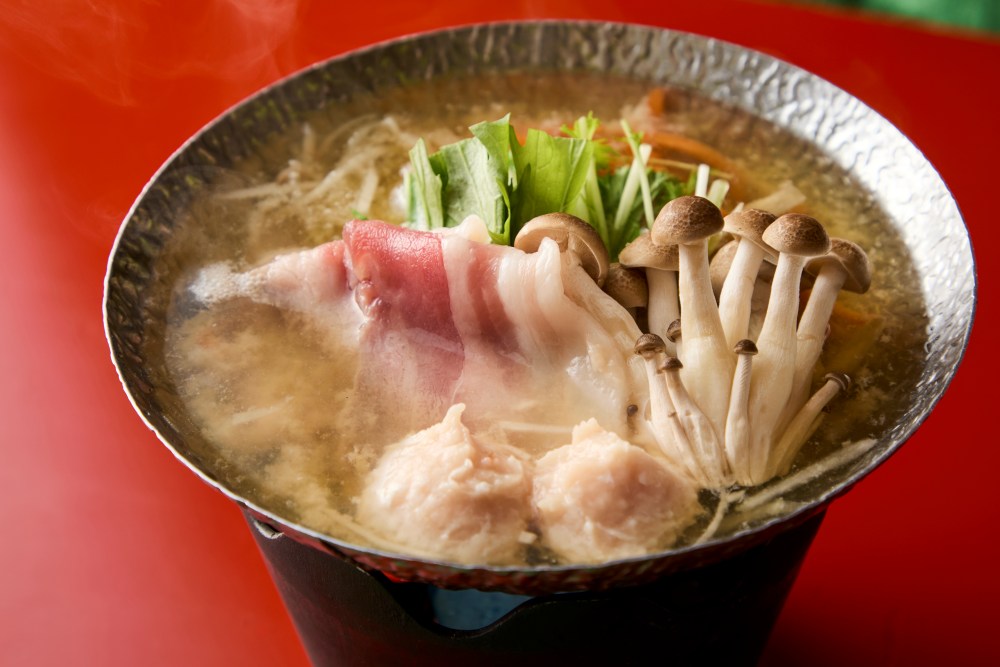
The main dining experience is a Japanese kaiseki meal served in a panoramic restaurant with a view of Sakurajima volcano, and there are three different course options. Each dish, served at just the right moment, is a carefully prepared meal using plenty of local Kagoshima specialties.
In particular, the "Osumi Nabe," included in the "Hanabusa Gozen" set meal, is popular. It features meatballs made from Satsuma red chicken and Kagoshima black pork, served with locally grown vegetables and simmered in white miso. The rich and profound flavor, a result of the chicken and pork's individual flavors combined with the white miso, is an exquisite dish that is hard to find elsewhere.
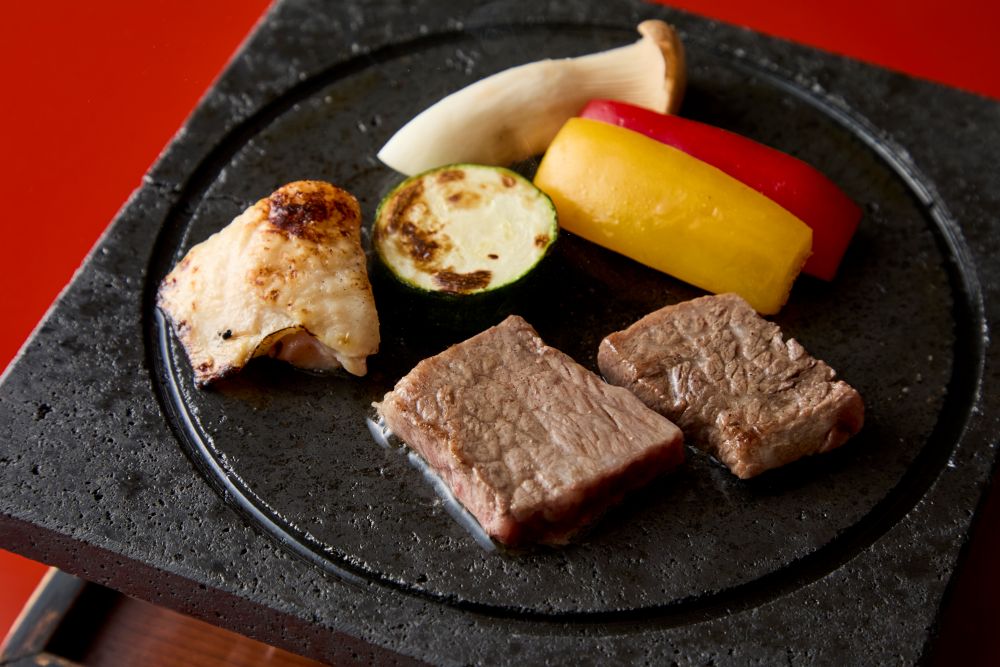
Another popular menu item is the "Sakurajima Lava Plate Grilled Kagoshima Wagyu Beef Loin," which can be ordered separately and grilled by the guests themselves on a special plate made from Sakurajima lava. When heated, the lava plate emits far-infrared rays, resulting in tenderly cooked meat. In addition, because the lava plate has countless air bubbles, excess fat released from the meat is absorbed, resulting in a light and refreshing finish.
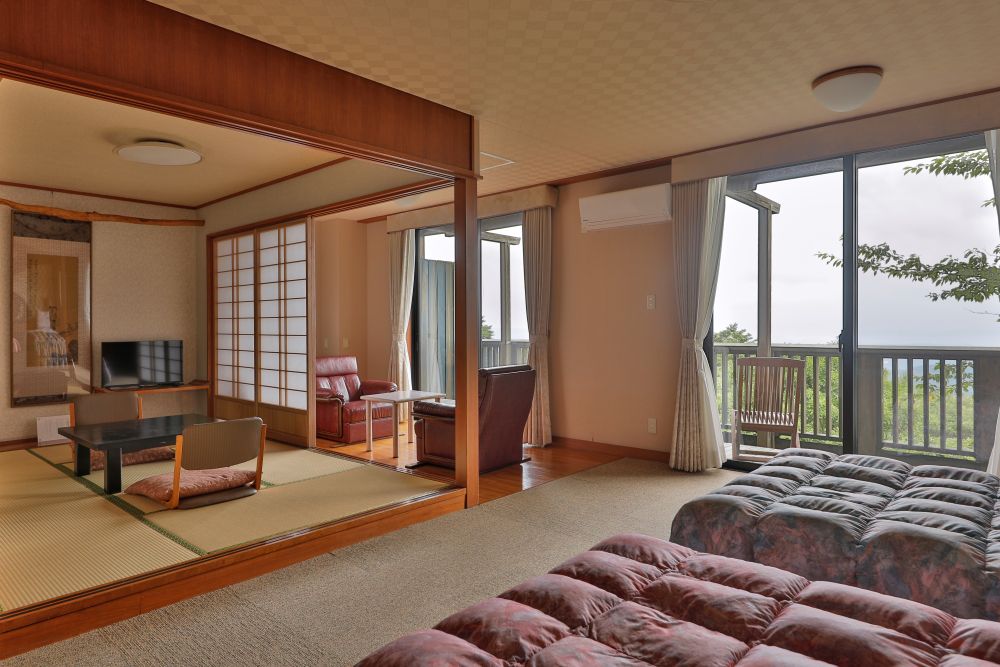
Every room offers a magnificent view of Kinko Bay and Sakurajima volcano. There are also rooms with open-air baths on the second floor.
A nostalgic yet somewhat exotic inn, imbued with a cultural atmosphere.
The entire interior of "Ryokojin Sanso" retains the classic charm of the good old Showa era. This charm, along with the vast collection of books and the displayed ethnic artifacts, harmonize to create a nostalgic yet somewhat exotic atmosphere.
And above all, it exudes a strong sense of culture, evoking the very essence of the word "culture." Lobby concerts are also held on the grand piano placed in the lobby.
Literary giants and poets once cherished the refined, literary atmosphere of these inns, and visited them repeatedly. This unique ambiance of the inns has been faithfully preserved even after many years.
In the library area, an elderly woman, who seemed to have just returned from the open-air bath, was relaxing comfortably with a photo book of foreign countries in her hand, her mind and body completely relaxed.
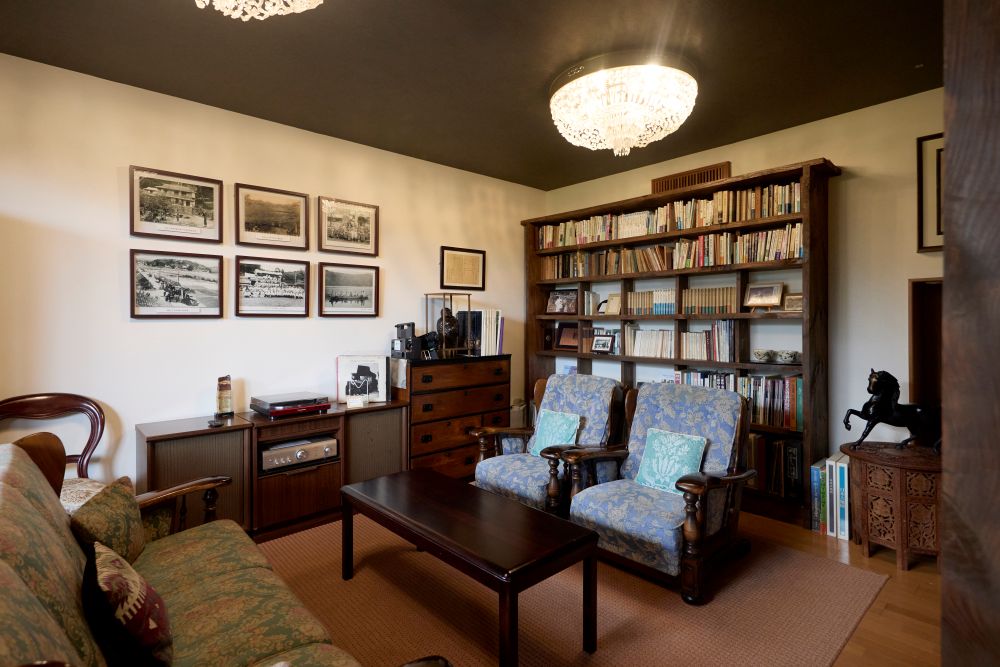
A study corner with a classic atmosphere, complete with a record player and vintage cameras. A place where you'd want to settle down and stay forever.
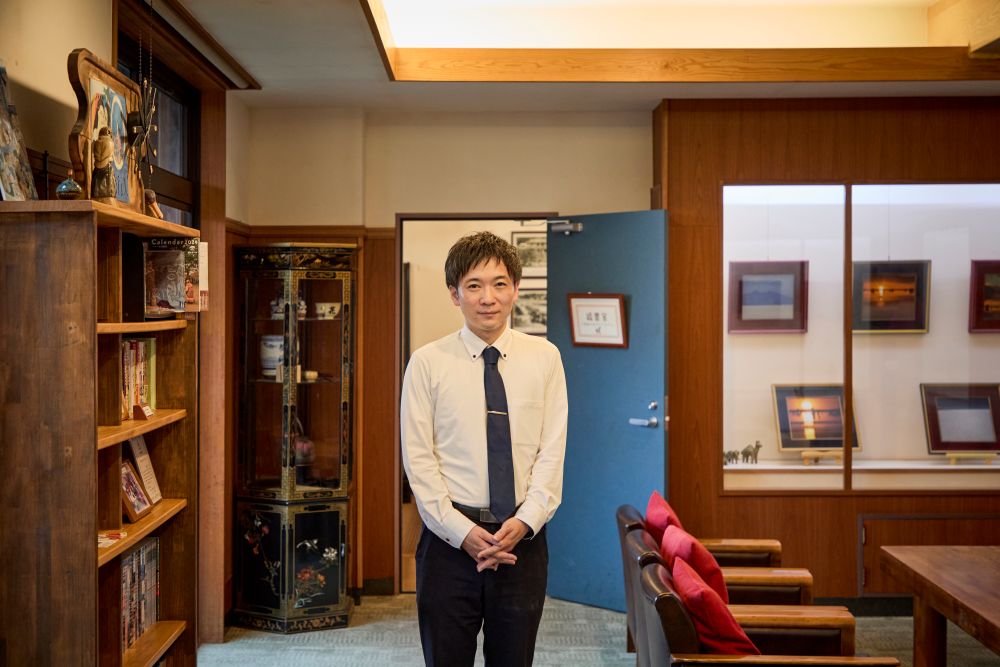
Hironori Kuramae, the representative director, is the nephew of Jinichi Kuramae, who founded the travel magazine "Ryokojin." His honeymoon was a three-month overseas tour. The Kuramae family's love of travel is still alive and well.
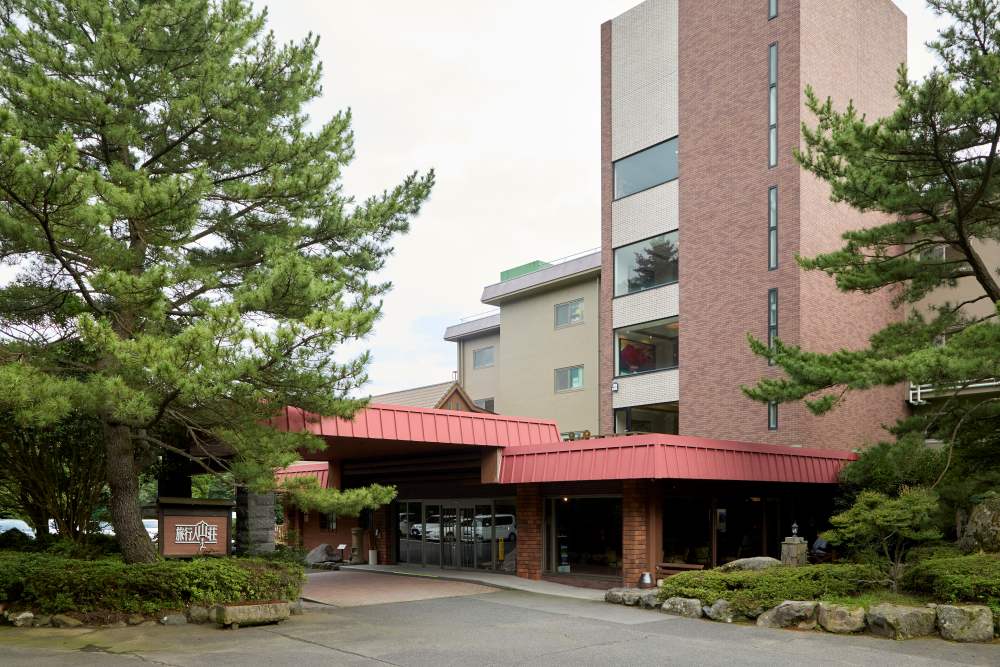
3865 Takachiho, Makizono-cho, Kirishima City, Kagoshima Prefecture
0995-78-2831
Ibusuki Hakusuikan, a hot spring inn in Ibusuki Onsen, offers a sense of openness that makes it more fitting to call it a "hot spring resort hotel" than a typical hot spring inn.
Located at the southern tip of the Satsuma Peninsula, Ibusuki is one of Kagoshima Prefecture's leading hot spring resorts. It is particularly well-known nationwide for its "sand bath" hot springs, where guests lie down covered in sand from the neck down to reap the benefits of the hot springs. Among the many hot spring inns in Ibusuki, "Ibusuki Hakusuikan" boasts exceptional scale and prestige.
Founded in Kagoshima City in 1947, "Ibusuki Hakusuikan" relocated to Ibusuki in 1960. With a vast 50,000-tsubo (approximately 165,000 square meters) site facing Kinko Bay and four guest room buildings, it is more appropriately called a "hot spring resort hotel" than a simple hot spring inn.
The spacious lobby exudes a sense of openness, and beyond the meticulously maintained pine trees of the garden, Kinko Bay, bathed in the southern sun, shimmers with a brilliant blue light. It is truly a view worthy of being called a "hot spring by the sea."
A large, open space with a high ceiling. It's like the "Genroku Bath," a large public bath at a hot spring theme park.
Making full use of the vast grounds, this large public bath at Ibusuki Hakusuikan is named "Genroku-buro" (Genroku Bath).
Named after the Genroku era of the Edo period, when public bath culture spread among the common people, this space, encompassing both men's and women's baths, covers approximately 1000 tsubo (about 3,300 square meters). As its name suggests, the bathhouse, with its Edo-period aesthetics incorporated throughout, has the feel of a hot spring theme park.
After leaving the changing room on the second floor, the building has an open atrium, so you cross a bridge overlooking the bathhouse, descend the stairs, and head towards the bath, creating a highly dramatic effect. The first floor is divided into various sections, including the "Ukiyo Bath," the "Barrel Bath," and the "Edo Pomegranate Bath" (sauna), each offering a different atmosphere.
The hot spring water is, of course, 100% natural spring water flowing abundantly from a source on the premises, with no added water. The water quality is sodium chloride spring water. In particular, it is characterized by containing five times the standard amount of "metasilicic acid," which is said to have skin-beautifying effects.
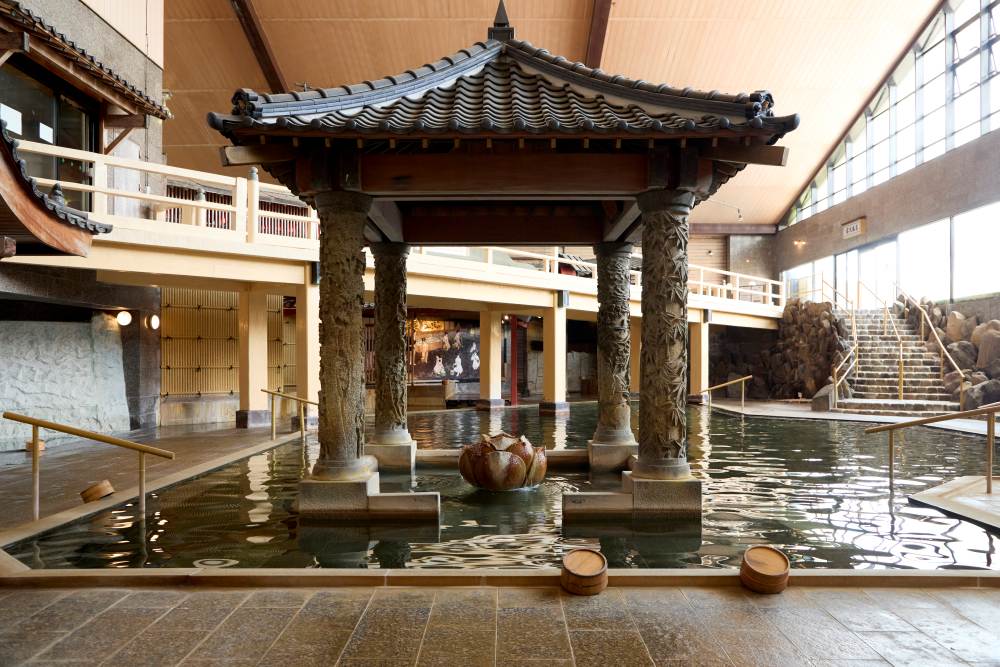
From the changing room on the second floor, you cross a bridge overlooking the bathhouse to reach the bathtub. The vast space is like a theme park.
From the "Genroku Bath," we went straight to the all-weather "Sand Bath."
High-temperature hot springs flow underground along the coast of Ibusuki, and these springs heat the steam in the ground, warming the sand near the surface to approximately 50 degrees Celsius. Covering your entire body from the neck down with this sand is what makes up a sand bath.
While there are several facilities in Ibusuki where you can experience sand baths, Ibusuki Hakusuikan boasts its own unique sand bath facility located within the hotel. Unlike typical sand baths, which are often set up in the open air along the coast and therefore subject to weather conditions, Ibusuki Hakusuikan's sand bath is indoors, allowing you to enjoy it regardless of the weather. Moreover, it is directly connected to the Genroku Bath, so you can soak in the hot springs again after your sand bath.
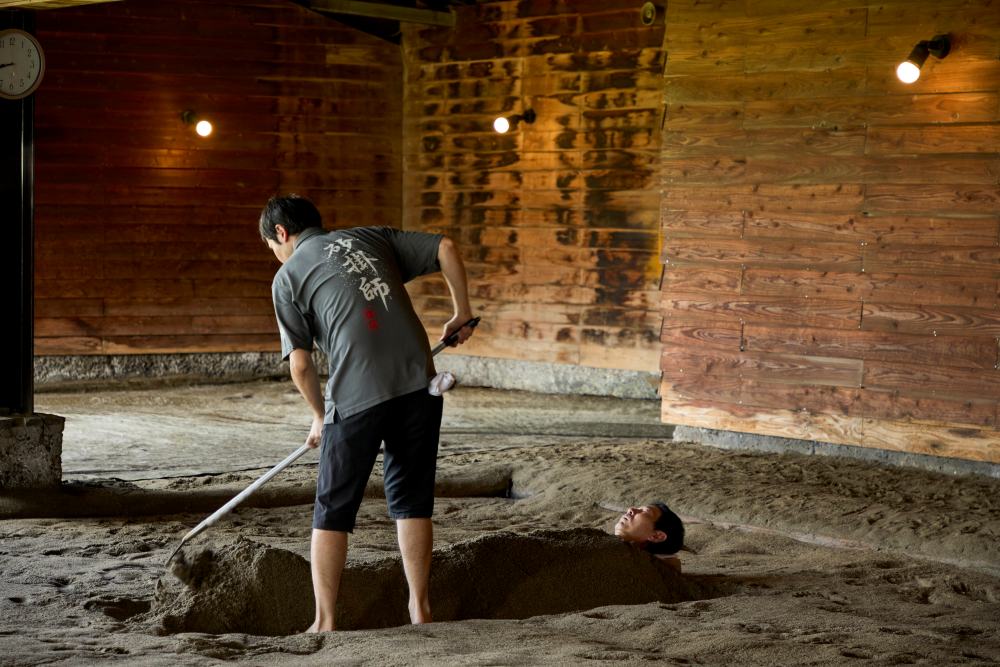
The "sand-throwing master" skillfully covers the body with sand. The amount of sand covering the body is about 15 to 20 kilograms.
Blood oxygen levels increase, and the rate of waste product elimination rises by 3 to 4 times. Medical data illustrates the effects of "sand baths."
I put on a special yukata and lay down on the sand. My back was already warm.
Staff members, known as "sand throwers," skillfully sprinkle sand on you. Gradually, the weight of the sand presses down on your entire body. According to the sand throwers, the total weight of the sand, depending on the person's build, is about 15 to 20 kilograms. At first, it felt strange, but once the sand covered your entire body, you feel a pleasant sensation of being moderately compressed, like receiving a full-body pressure massage.
And it's hot. Sweat immediately starts pouring out. I feel like my blood circulation is increasing. As the sand-covering expert sprinkles sand on me, he tells me, "There's medical data showing that this increases the amount of oxygen in your blood and increases the rate of waste elimination by 3 to 4 times compared to taking a regular hot spring bath." I find that to be convincing.
The time spent steaming in the sand is about 10 to 15 minutes. When I get up and brush off the sand, I feel somehow lighter. "They say even feudal lords used to do this on the beach," I'm told as I head back to the Genroku bath. Immersing myself in the Edo period atmosphere, I felt a little like a feudal lord.
Italian food at the "Satsuma Tradition Museum," which is modeled after the Byodo-in Phoenix Hall in Uji.
While dinner at Ibusuki Hakusuikan is typically a Japanese kaiseki meal served in the hotel's dining area, guests can enjoy authentic Italian cuisine in a course meal at Fenice, a restaurant that opened inside the Satsuma Tradition Museum, which was established in 20.
The location of "Fenice," housed in the "Satsuma Tradition Museum," is immediately striking: a building modeled after the Byodo-in Phoenix Hall in Uji, Kyoto, surrounded by a water garden. Upon entering the restaurant, the same water garden unfolds before you through the glass windows.
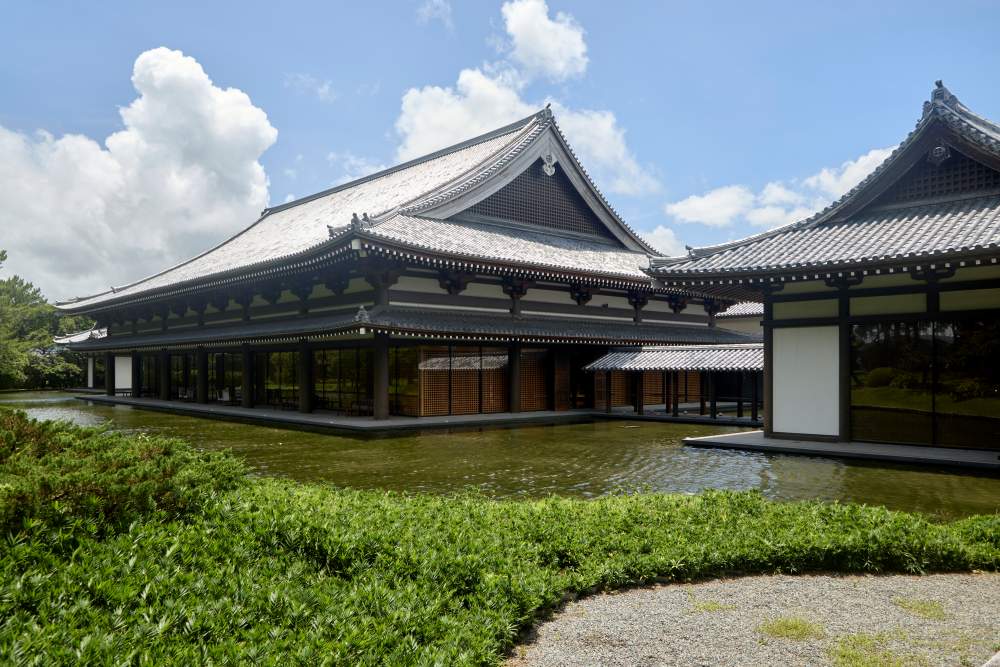
The "Satsuma Tradition Museum" is modeled after the Byodo-in Phoenix Hall in Uji, Kyoto. The art museum and the Italian restaurant "Fenice" are located inside this building.
The course menu, which makes full use of ingredients from Kagoshima, is essentially "Satsuma Italian."
One day's menu began with appetizers such as Satsuma young chicken with black truffle flavor, slow-roasted Kagoshima beef, and Takaji (a type of sea snail caught at the southern tip of the Satsuma Peninsula) sautéed in Burgundy butter, and continued with dishes like sea bream cutlets using herbs from the "Kaimon Mountain Foot Fragrance Garden," a nationally renowned herb garden—a true parade of Kagoshima ingredients.
Italian cuisine values the natural flavors of the ingredients themselves. Kagoshima, with its abundance of seafood and mountain produce, and its reputation as a leading producer of domestic herbs, is the perfect place to create "Satsuma Italian" cuisine.
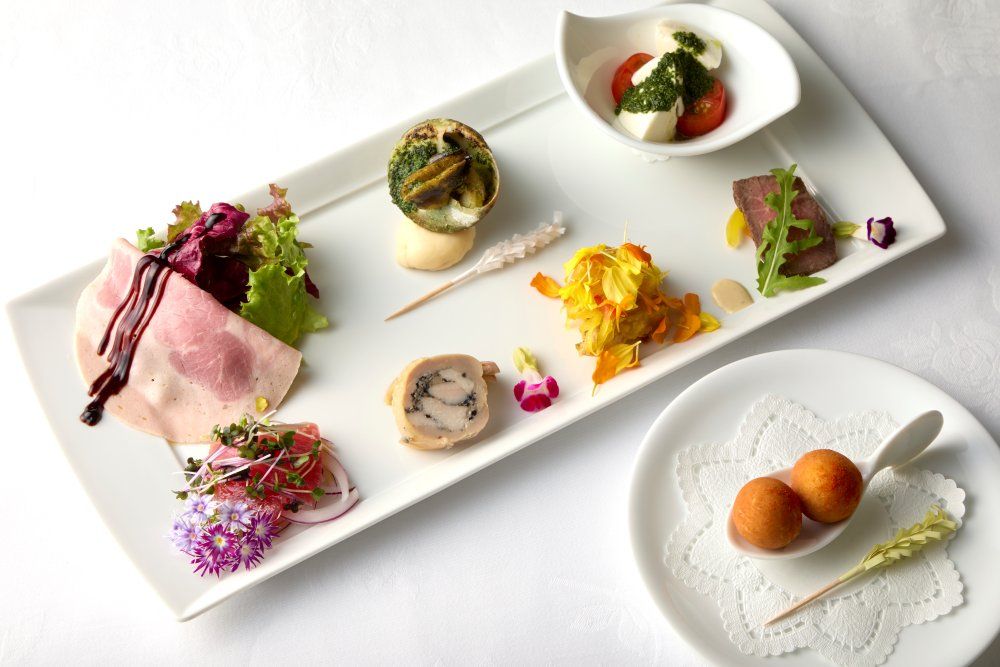
The appetizer platter is packed with Kagoshima ingredients, including Satsuma young chicken with black truffle flavor, slow-roasted Kagoshima beef, and bologna ham from Fukudome Komaki Farm. Cheese fritters are in the front right.
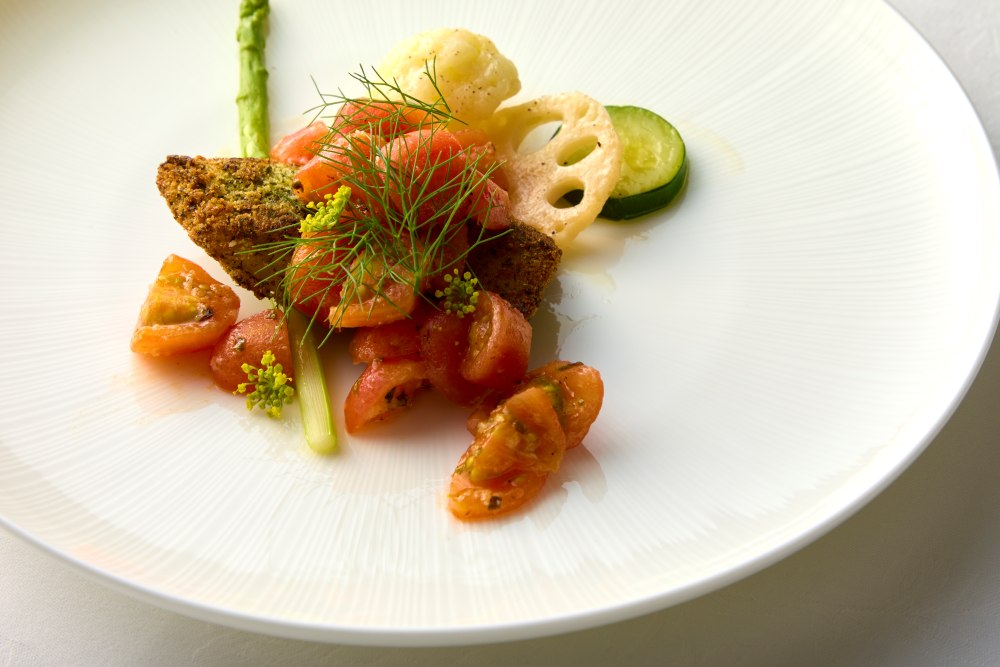
Sea bream herb cutlet from the Herb Garden. The "Herb Garden" refers to the "Kaimon Mountain Foot Herb Garden," the first herb garden in Japan, located at the foot of Mt. Kaimon.
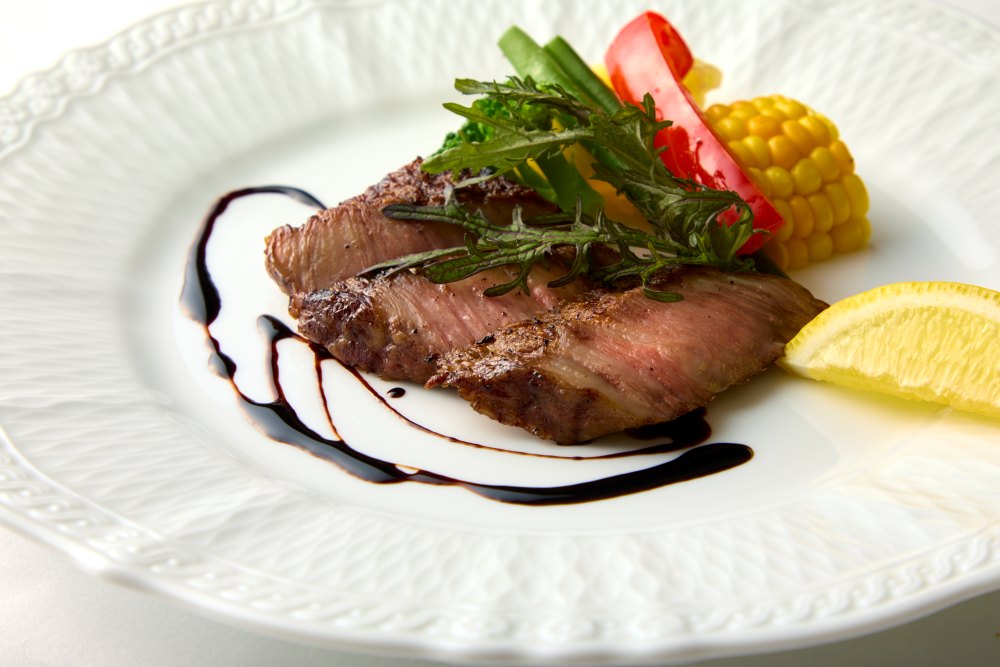
Grilled Kuroge Wagyu beef chuck roll. Chuck roll is another name for the shoulder loin, which comes from the neck to the back of the cow. It is characterized by its easy marbling and the coexistence of fine texture and the savory flavor of lean meat.
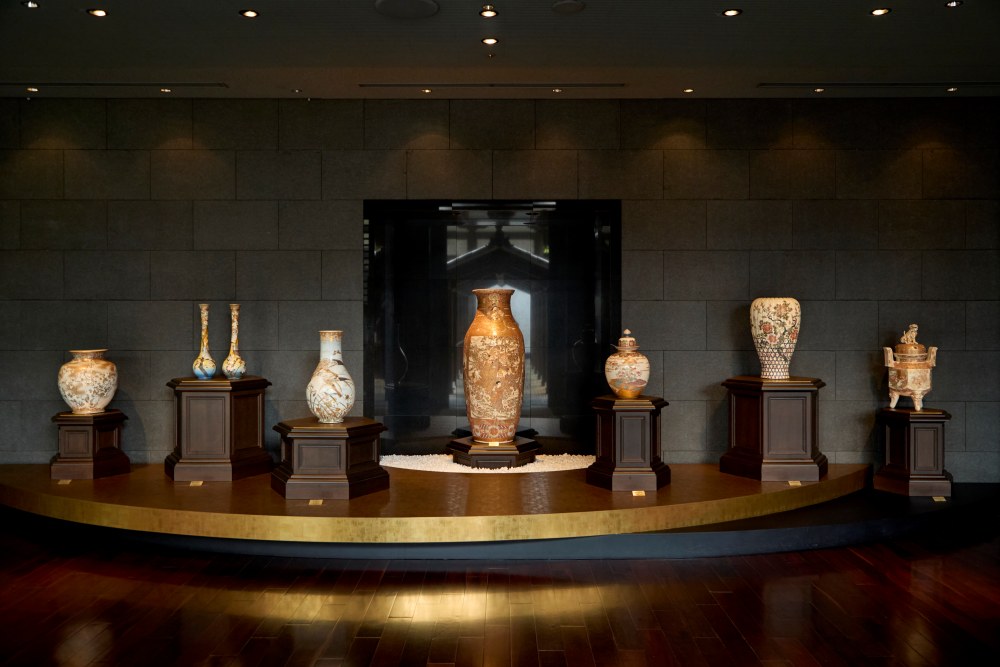
The Satsuma Tradition Museum displays a collection of approximately 3,000 Satsuma ware pieces amassed by Hiroshi Shimotakehara, the founder of Ibusuki Hakusuikan, and his successor, Kazuhisa. The sheer magnificence of the collection is breathtaking. The inn's official website also offers accommodation plans that include free admission to the museum as a perk.
A concept room called "The White Sand Room," inspired by "sand baths."
In April 2024, the "Shirasuna no Ma" (White Sand Room) was created as a concept room in the "Hana no Tou" (Flower Building), one of the accommodation buildings of "Ibusuki Hakusuikan".
The plaster-finished floors, walls, and ceilings evoke the texture and color of sand. This truly embodies the image of the "sand bath" hot springs, a symbol of Ibusuki. The room, unified in a calming beige, is simple in design with no unnecessary decorations, and a bed placed in the center. Having been created by combining two rooms, the spacious room offers a magnificent and refreshing view of Kinko Bay.
The house also features a raised tatami area and a separate earthen floor area one step lower, and the attention to detail is evident in the fact that the earthen floor of the separate earthen floor area was actually made by mixing sand from Ibusuki.
While cherishing local culture, Ibusuki Hakusuikan is exploring the future of hot spring inns. The "Shirasuna no Ma" room symbolizes the future vision of Ibusuki Hakusuikan.
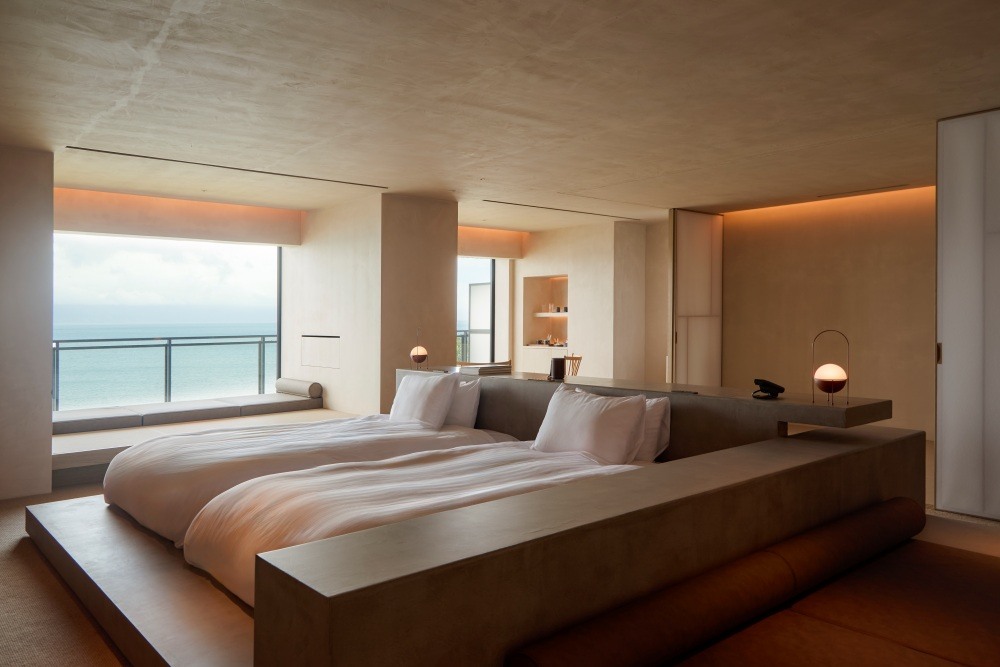
The newly created "White Sand Room," formed by combining two rooms, is a spacious 90 square meters. Guests can enjoy the luxury of gazing at the sea while lying in bed.
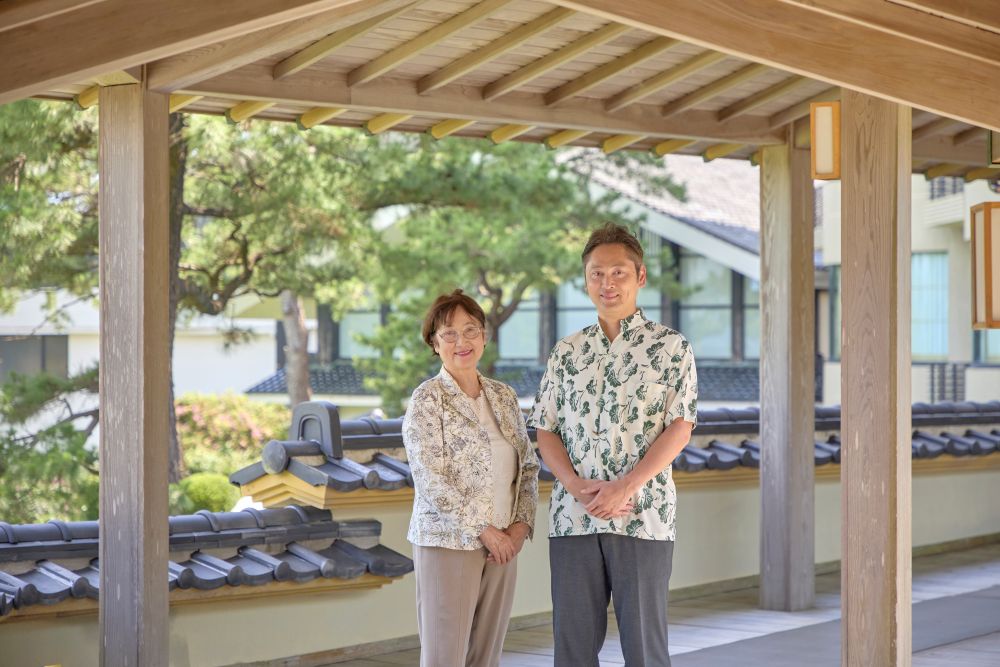
The proprietress, Narumi Shimotakehara, and her son, Toshihiko Shimotakehara, who is the representative director and president. "Creating the 'White Sand Room' was quite a gamble, but thankfully it has been well received. We plan to gradually increase the number of these concept rooms in the future," says Toshihiko.
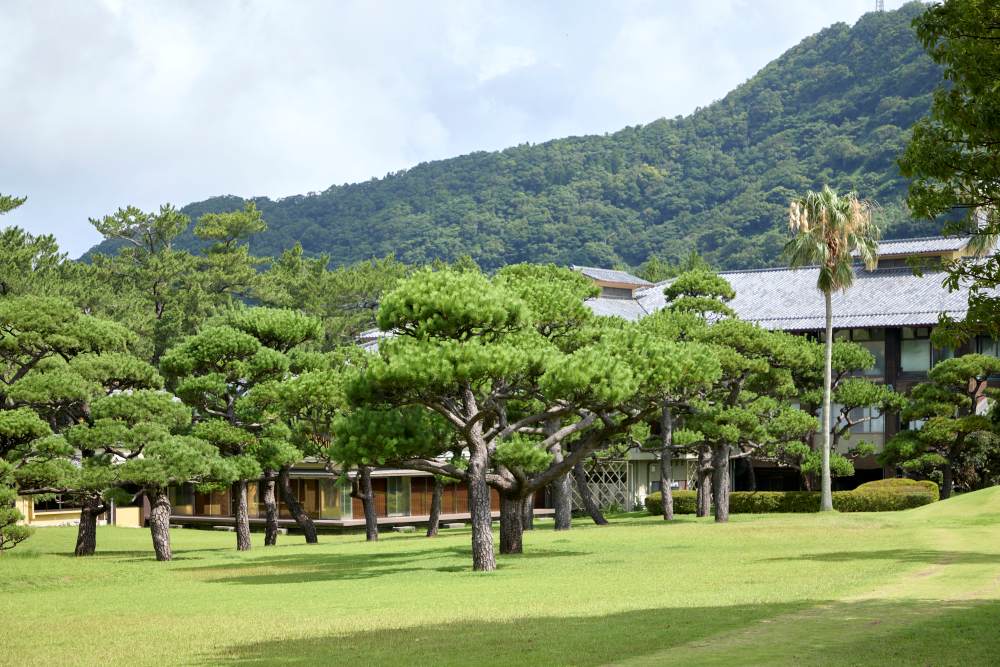
Ibusuki Onsen "Ibusuki Shusui-en" is a hot spring inn where you are greeted by a Japanese house reminiscent of sukiya architecture.
This hot spring inn welcomes guests with a beautiful tiled roof and a Japanese-style building reminiscent of sukiya architecture. The inn's origins trace back to 38, when Yasushi Yutsudo, who ran a shochu brewery, renovated his brewery owner's villa and opened "Kiraku," a purely Japanese-style inn with eight rooms.
Since then, the small inn has undergone repeated renovations and expansions, and in 27 it was renamed "Ibusuki Shusui-en," developing into one of the most prestigious hot spring inns in Ibusuki Onsen, boasting 46 guest rooms.
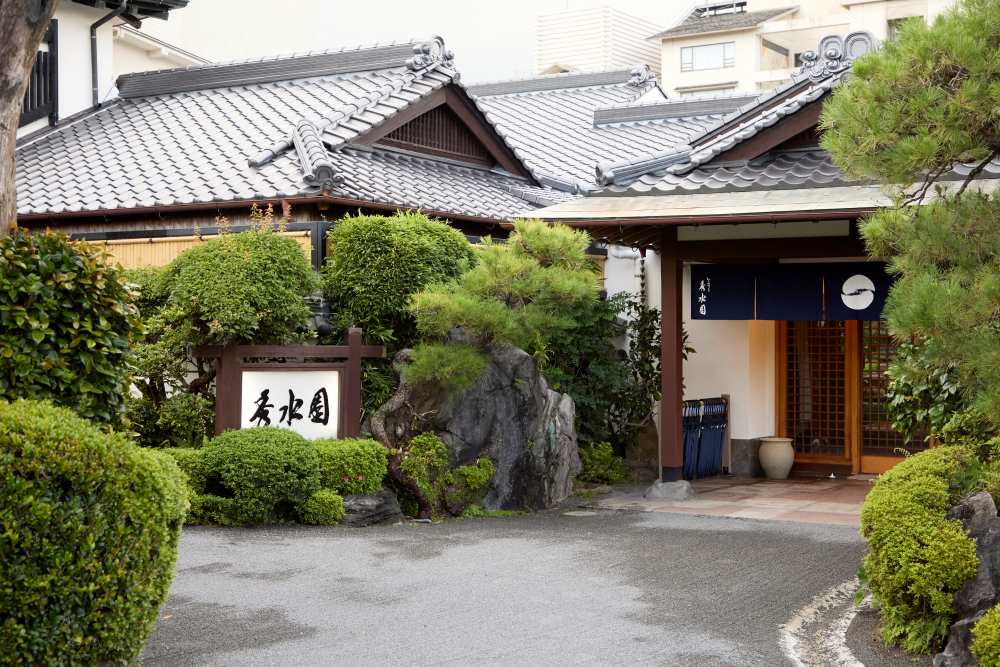
The entrance area is a single-story building in the sukiya style. The contrast between the tiled roof and the greenery is beautiful.
The traces of its origins as a purely Japanese-style inn can still be seen in the elegant dry landscape Japanese garden that spreads out beyond the lobby.
The garden, with its skillfully arranged lanterns, pebbles, and vibrant greenery, presents a deeply atmospheric setting reminiscent of an ancient temple steeped in history. It's the kind of place you'd want to sink into on a sofa and gaze at forever.
The lobby is lined with works of art collected by Mr. Tamotsu Yuto. Many of the hanging scrolls are the work of figures associated with the history of Kagoshima, such as Takamori Saigo and Toshimichi Okubo. Standing before these unique calligraphic works, one can reflect on the role that the Satsuma Domain played in Japanese history.

A dry landscape garden unfolds at the back of the lobby. The balance of trees, lanterns, and pebbles is exquisite, creating a beautiful world.
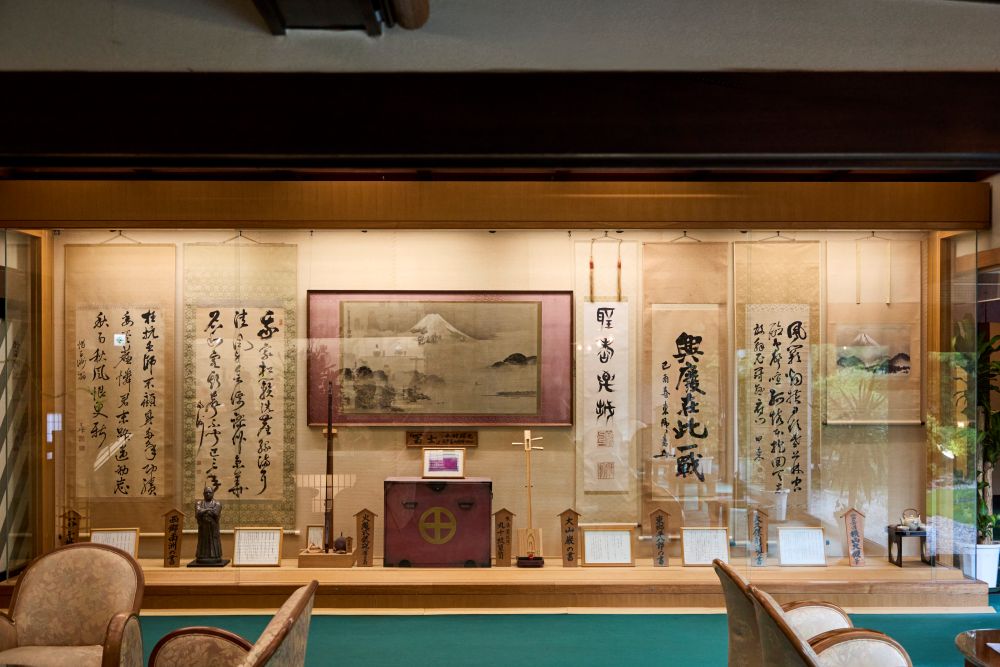
In the center is a chest of drawers bearing the Shimazu family crest, surrounded by calligraphic works by figures such as Saigo Takamori, Oyama Iwao, and Togo Heihachiro.
A simple "sand foot bath" where you bury only your ankles and feet in the sand.
Stepping out of the small, tea-room-style tatami room next to the lobby, you'll find a "sand foot bath." It's essentially a compact sand bath, where only your ankles and feet are bathed in sand.
The principle is the same as a regular sand bath: you bury your feet in sand heated by a hot spring source. The gentle warmth is soothing, like wearing socks with electric heaters. What's best of all is that you don't need to change clothes, and you can enjoy it while gazing at the beautiful Japanese garden spread out before you.
If you're looking for an authentic sand bath experience, head to "Sunamushi Kaikan Sunaraku," a day-use sand bath facility located right in front of the inn. "Ibusuki Shusui-en" rooms are equipped with a sand bath set, which you can use as is. After enjoying the sand bath, strolling along the coast in your yukata (Japanese robe) is another unique pleasure of staying in a hot spring resort.
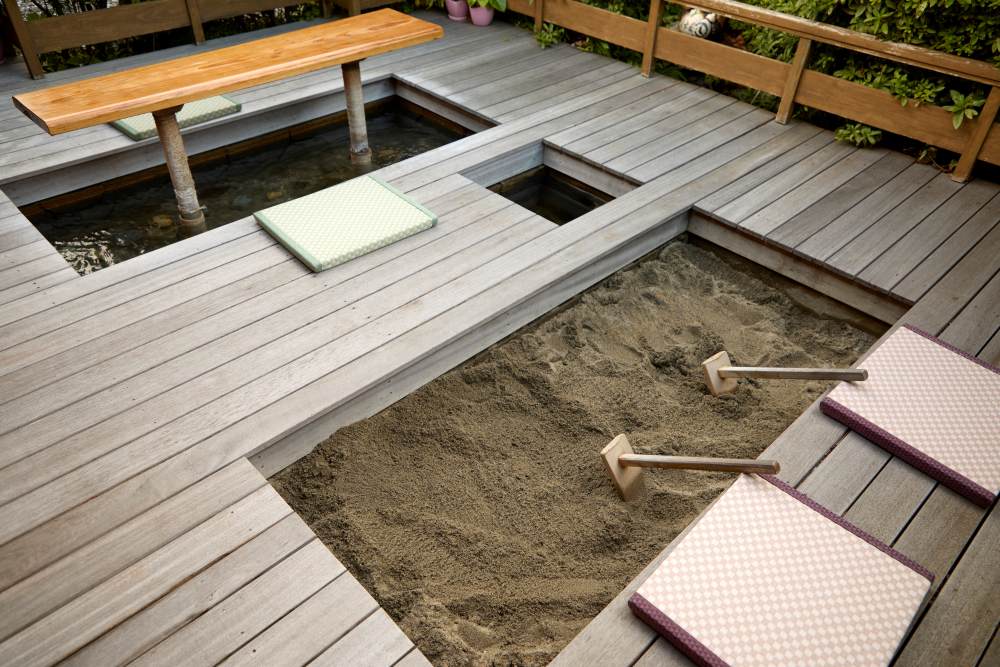
Guests can enjoy the "sand footbath" at any time. Further inside, there is also a so-called "footbath" using water drawn from the hot spring source.
Relax to your heart's content in the private bathing area, which is integrated with the living room.
The hot springs at "Ibusuki Shusui-en," which boasts an abundant supply of hot spring water, are free-flowing sodium chloride springs. They are said to have the effect of regulating melanin, which protects the skin from ultraviolet rays.
While the large public bath with an open-air bath is certainly impressive, we recommend the "private bathing area" with its own living room. The rooms come in two styles: a Japanese-style room with a semi-open-air bath made entirely of cypress wood, and a Western-style room with a stone bathtub inspired by the blue waters of Kinko Bay.2There are two types of rooms, both offering a completely private space where you can relax after your bath. It's best to inform them of your desired usage time as early as possible when checking in.
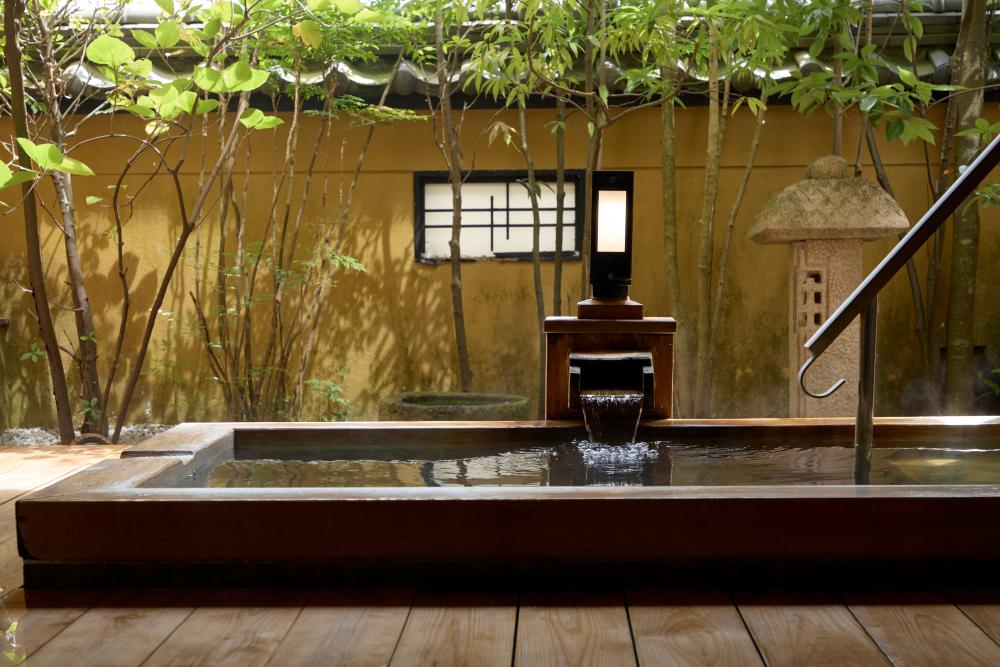
The private bathing area, a Japanese-style room equipped with a bathtub made entirely of cypress wood, is literally named "Hinoki" (cypress). Private use is available in units of 60 minutes.
"An inn with delicious food will succeed." They continue to adhere to the advice given to them at the time of founding.
"Ibusuki Shusui-en" has long been highly regarded as an inn where guests can enjoy superb cuisine, upholding the principle that its founder, Yasushi Yutodo, received advice that "running a ryokan (traditional Japanese inn) is tough, but an inn with delicious food might be successful."
That philosophy is still upheld today. From autumn to early winter, the "Akizuki Kaiseki" and "Mifuyu Kaiseki" take center stage. These kaiseki meals, which incorporate autumn delicacies such as matsutake mushrooms, saury, and the last of the season's conger eel, have fans who come back every year just to enjoy them.
"Ibusuki Shusui-en's" signature dish, "Abalone grilled with plain miso."
Another dish that is said to be a signature dish of "Ibusuki Shusui-en" is "Abalone grilled with plain miso."
This dish, made with abalone in its shell, combined with plain miso paste and other ingredients such as abalone and mushrooms, and then baked in the oven, is essentially a Japanese-style abalone gratin.
Because the abalone is steamed slowly beforehand, it has a soft texture, yet retains its original rich flavor. When combined with the tastes of plain miso and mushrooms, it creates an unparalleled, rich flavor.
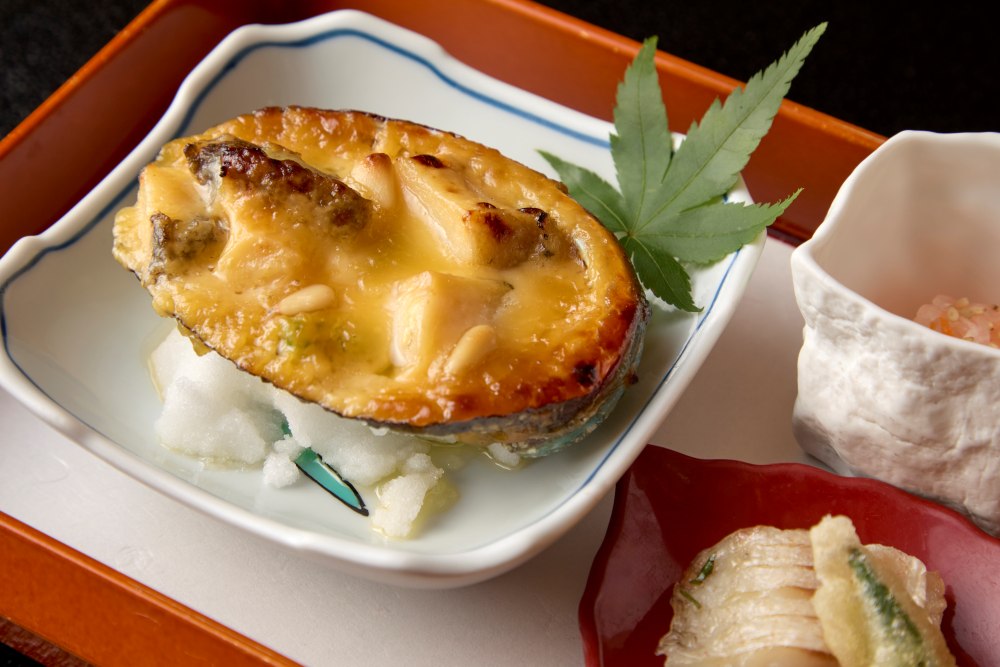
"Grilled abalone with plain miso." Plain miso is a type of "tamamiso" (a type of miso paste) unique to the inn, made by kneading white miso with dashi (broth) and egg yolk.
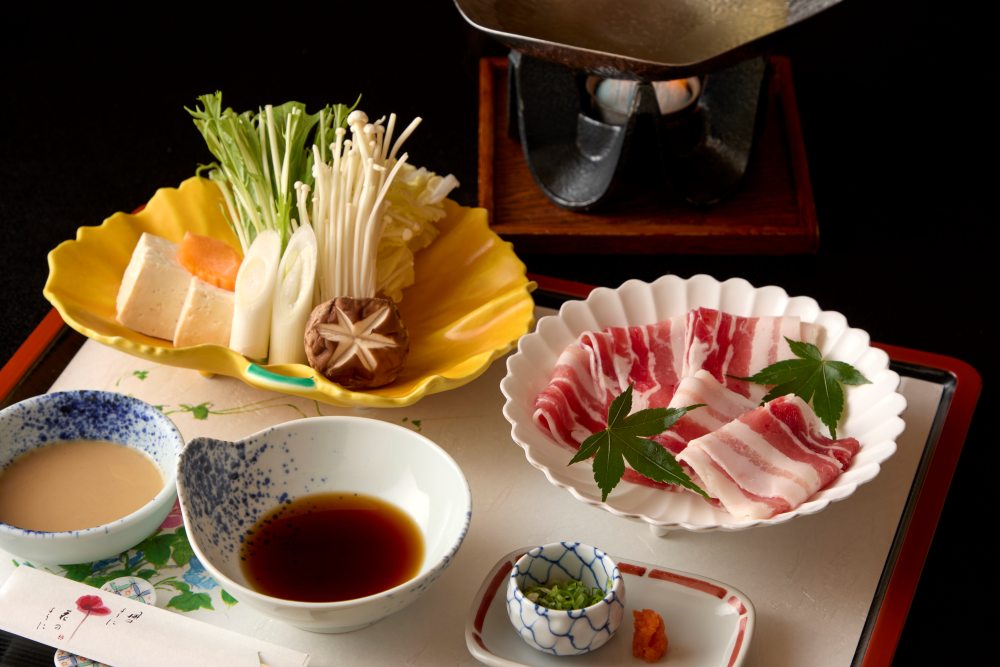
Furthermore, the Kurobuta pork served in the "Kurobuta Shabu-Shabu" is a special breed called "Rokuhaku-buta." Its name comes from the fact that only six parts of its body (four legs, nose, and tail) are white. The meat is rich in amino acids and has a deep umami flavor in its fat, yet it is not greasy and has a light texture, because it is raised primarily on sweet potatoes. At Ibusuki Shusui-en, the shabu-shabu is typically prepared by first dipping this "Rokuhaku-buta" in bonito broth, and then enjoying it with sesame sauce or homemade bitter orange ponzu sauce. The bonito flakes used to make the broth are, of course, from nearby Makurazaki. It is a dish that allows you to fully enjoy the ingredients of Satsuma.
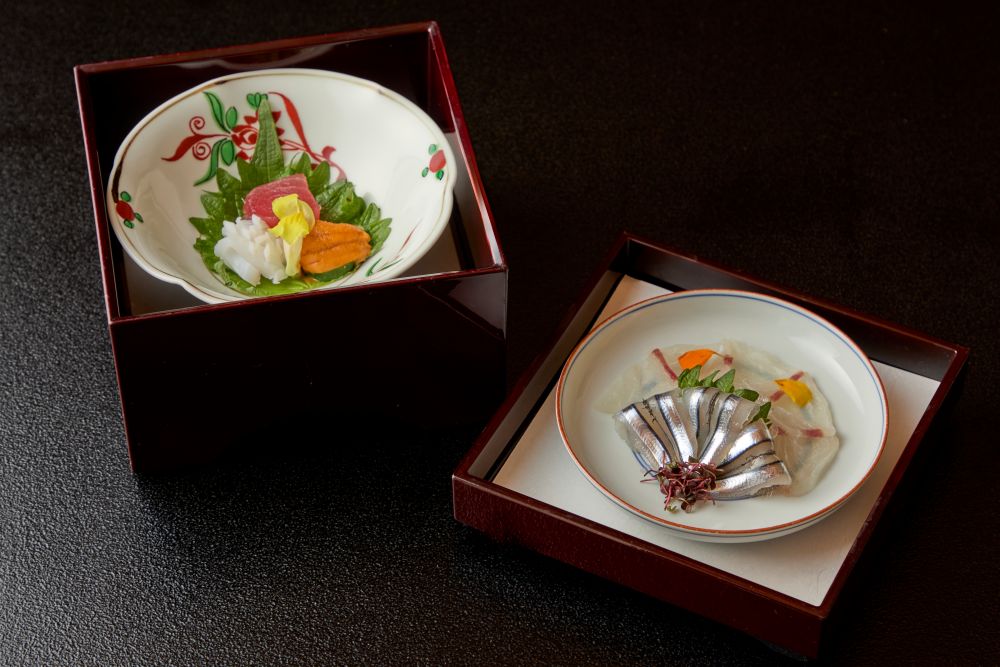
Small fish like sardines, sea bream, tuna, cuttlefish, and sea urchin... When you open the small bento box, a beautifully arranged sashimi platter appears, like opening a treasure chest. Sometimes, the head chef himself goes to the market to buy the seafood. In winter, yellowtail and filefish caught in Kinko Bay are added to the sashimi platter.
The carefully selected materials in this special room speak to the prestige of the inn.
The top floor features two "special rooms."
The spacious Japanese-Western style room, with its 15-tatami mat living room, 12.5-tatami mat Japanese-style room, 8-tatami mat bedroom with a semi-double bed, and a veranda of about 6 tatami mats, offers a magnificent view unique to the upper floors, overlooking not only Kinko Bay but also the Osumi Peninsula on a clear day.
The lavish use of carefully selected materials in areas such as the alcove and study also reflects the inn's prestigious status.
In addition to the "Special Room," there are various types of guest rooms to suit different group sizes and purposes, such as the Japanese-Western style "Tsurumaru Room" and the "Shusui Room" which faces the garden.
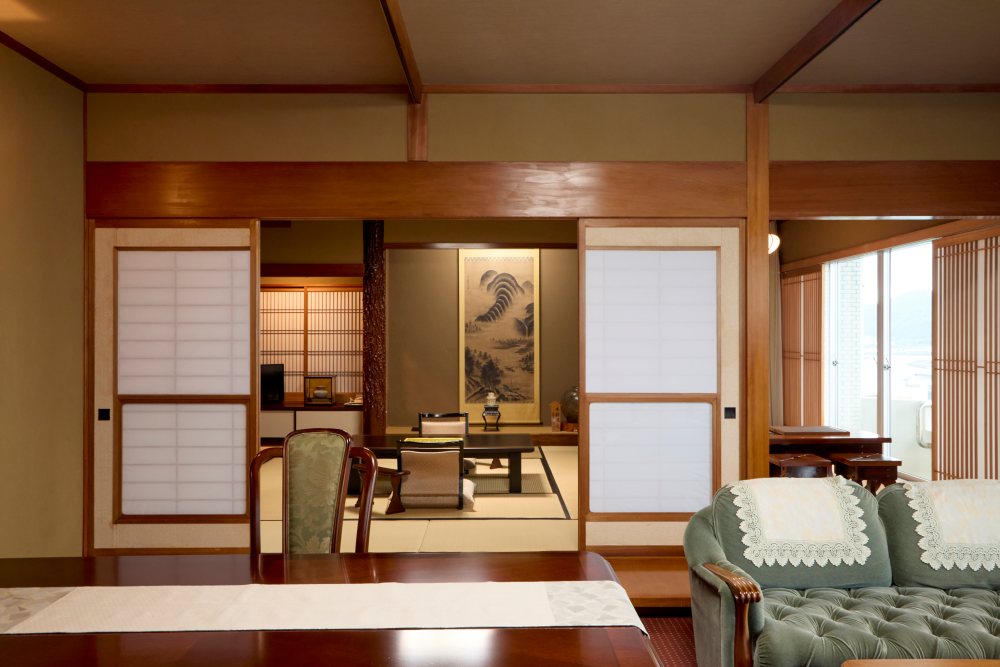
The "special room" features high-quality building materials throughout, such as floor pillars made from precious wood and thick beams made from single planks.
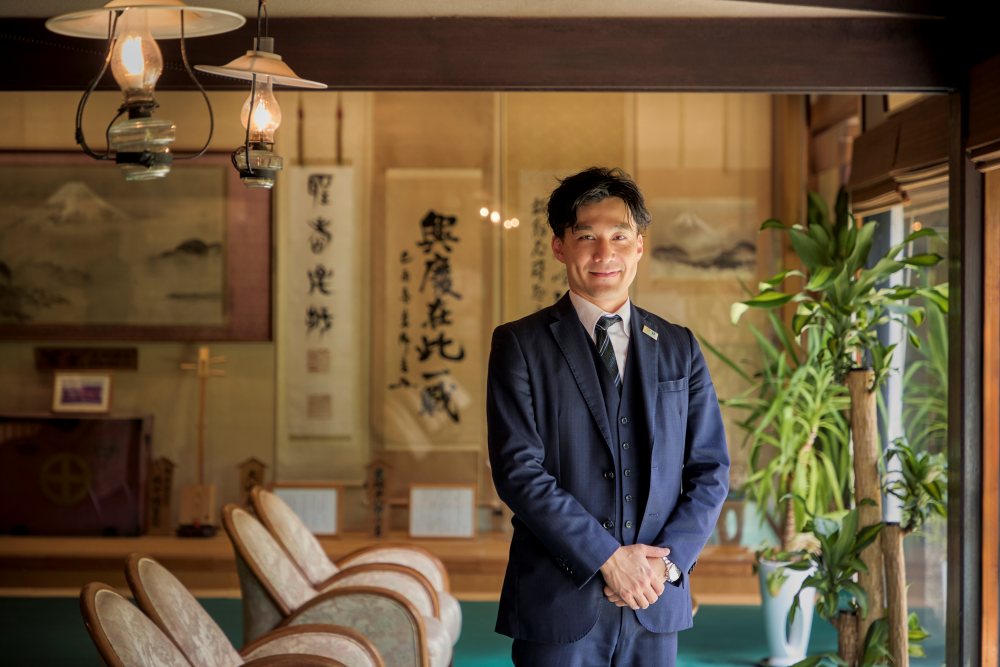
Hiroshi Yutodo, the deputy general manager, is the grandson of the founder, Mr. Tamotsu. "While preserving the traditions of Japanese inns, I intend to actively change what needs to be changed to suit the times."
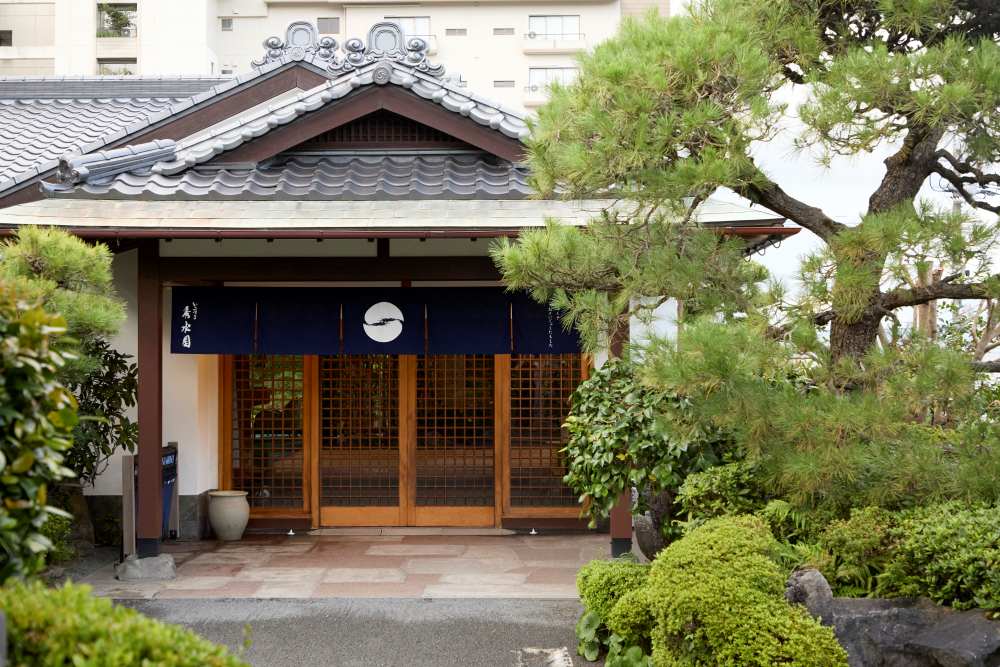
Ibusuki Shusui-en
5-27-27 Yunohama, Ibusuki City, Kagoshima Prefecture
0993-23-4141
The journey to discover the treasures of Kagoshima continues. You can find previous installments of "Southern Treasure Chest: A Journey Through Kagoshima" below.
Click here for the first Kagoshima Tea Journey
Click here for the second Kagoshima Whisky Journey
Photography by Makoto Ito
Stories
Premium X
A trip around Kagoshima's "treasures"


Premium X